
Student Support
Thesis writing and academic support
I write bachelor's, master's and postgraduate diploma theses, individual chapters, presentations and coursework materials. I also help plan research, analyse real research findings, carry out statistical analysis and refine an existing text. Choose a complete project or support at a specific stage – we will agree on the scope, deadline and price before starting.
Do you have a topic, a draft, or feedback from your supervisor? Let's start with what you have.
- clear services and a defined scope of support,
- help with editing, formatting, and text structure,
- support with research methodology and research results.
Who is this site for?
For students who are just starting their thesis, have data to analyse or are revising an existing text. You don't need to know which service to choose. Tell me where you are stuck, and I will help define the support you need.
How do we work?
Send the topic, materials, and required deadline. I will check what needs to be done and discuss the scope, price, and feasibility with you. Before starting, we will agree on what you will receive and when.
What makes Student Support different?
I have personally run Student Support since 2018. You discuss your topic, agree on the scope of support and go through feedback directly with me. I take care of the content, clarity, presentation and compliance with your university’s requirements.
Search the site
Search for a service, guide or subject area
Try a phrase such as thesis, master’s thesis, research methodology, survey, references, JSA, research chapter or your subject area. The search suggests relevant content and links directly to the right page.
Services
What do you need help with?
A bachelor’s or master’s thesis, a class presentation, an essay or a coursework project. Choose a complete project, help with a chapter, research analysis or revisions to existing material.
- Bachelor’s and master’s thesis writingTheses, chapters and revisions following supervisor feedback.
- Bachelor’s and master’s thesis proofreading and editingImprovements to the language, style and coherence of your text. Clear sentences and logical links between paragraphs.
- Bachelor’s and master’s thesis formattingA thesis layout aligned with the requirements.
- Help with the theoretical chapter of your thesisKey concepts, comparison of perspectives and a coherent argument based on actual publications.
- Help with your thesis methodology chapterA coherent research plan, questionnaire or interview.
- Questionnaire design for your thesisQuestions and response options aligned with your research aim and plan.
- Analysis and presentation of research results for your thesisFrom survey responses and other research data to analysis and conclusions.
- Statistical analysis for bachelor’s and master’s thesesChoice of statistical tests, calculations and a clear explanation of results.
- Thesis research section: methodology, results and discussionMethodology, research tools, actual results and discussion within one agreed scope.
- Choosing a bachelor’s or master’s thesis topicTopic proposals with an explanation of scope, sources and feasibility.
- Help with your thesis outline and structureA logical outline and connected chapters.
- Literature search and selection for your thesisSources selected for your whole thesis or one chapter, with a bibliography.
- Thesis reviewAssessment of thesis structure, content coherence, sources and formal aspects. Specific comments on the document and a prioritised list of revisions.
- Thesis revisions following supervisor feedbackAgreed changes to your text based on your supervisor’s comments.
- Reference list and citation corrections for your thesisConsistent reference lists, footnotes and in-text citations.
- Thesis revisions after a JSA similarity reportReview of the JSA report and editing of flagged passages: paraphrasing, citations, references and textual consistency.
- Bachelor’s and master’s thesis consultationsDiscuss a specific thesis issue, the relevant materials and your next steps.
- Verification and editing of AI-assisted textSource and claim verification, editing and coherent argumentation for AI-assisted text.
- Presentations for classes and thesis defencesContent and slide design for your thesis defence or classes. Speaker notes as agreed.
- Coursework and essaysEssays, seminar papers, semester projects and reports aligned with the lecturer’s brief.
- Research projectsA standalone project for a class or seminar: a research proposal or a report based on actual data.
Subject areas
What are you studying?
Explore support tailored to your topic, type of research and thesis requirements.
Working together
How does it work, step by step?
Studies, work, and daily duties do not always leave time for everything. Write to me about what is holding you back. I will help identify which tasks you can delegate. You can handle everything online.
- STEP 01
Describe what you need
Provide the topic, stage of work, and deadline. Attach the current file and supervisor or university guidelines if you have them. You can submit the whole thesis or just one issue.
You don't need to know which service to choose. I will help define the support you need.
- STEP 02
Learn about the scope, price, and deadline
I will review your materials and provide a quote. Before starting, we will agree on what I will prepare, when you will receive it and the payment arrangements.
You know exactly what you are paying for and what you will receive before making a decision.
- STEP 03
Receive the prepared material
Once the terms and arrangements are confirmed, I will carry out the agreed tasks. I will check the completed work and send it in the agreed format by the agreed deadline.
While I work on your material, you have time for your other responsibilities.
Reviews
Reviews from our clients
These messages are genuine recommendations from clients after using our services. The reviews are translated from Polish; you can view the original messages in the preview.
Statistical analysis - a client’s review
Thanks for the help and continued support
Thesis approved and prompt communication
Bachelor’s thesis defended and a return for pedagogy support
Gratitude for help and commitment
Trust and a wish to continue working together on a master’s thesis
A grade of 5 for the thesis and defence - thanks for working together
First of all, I want to thank you so much for “everything” ☺️
Now I can officially share the good news - both my thesis and defence received 5.0 🥳🥳🥳 The reviewer and chair themselves said yesterday that it was one of the better theses they had come across 🤩
I can recommend you wholeheartedly, and this certainly isn’t the end of our work together ☺️
Thank you once again 🙏🤗”
Master’s thesis support - fast, reliable and professional
The help I received with writing my master’s thesis was invaluable. The collaboration was reliable, efficient and - which mattered enormously to me - EXTREMELY QUICK! 🙂 Communication was excellent, with full commitment, diligence and professionalism from start to finish. I’m so grateful to have found someone so competent and kind.
🫶”
Stress-free support with an administration thesis
I was given her contact details through a recommendation, and I confidently recommend her to others 😊”
Student Support review - similarity level of 5%
A thesis meeting the requirements - no revisions and a low plagiarism-check result
Professional thesis formatting and work completed as agreed
Student Support review - on-time help with a thesis on an agreed topic
„I recommend Ms Wiola Boćkowska 🙂 The thesis on the given topic was written without any problems and completed on time, with consistent, efficient communication throughout. I recommend her to anyone who is undecided!”Testimonial following completion of our work together
Student Support review - reliability, punctuality and prompt contact
Recommendation - professional support and a satisfied client!
Urgent thesis help - quick revisions and contact
Last-minute thesis help - effective support before submission
Honest, practical thesis help - a low similarity level
Rapid thesis delivery and a successful plagiarism check
Student Support recommendation - professional support, step by step
Thesis writing support - punctuality, reliability and good communication
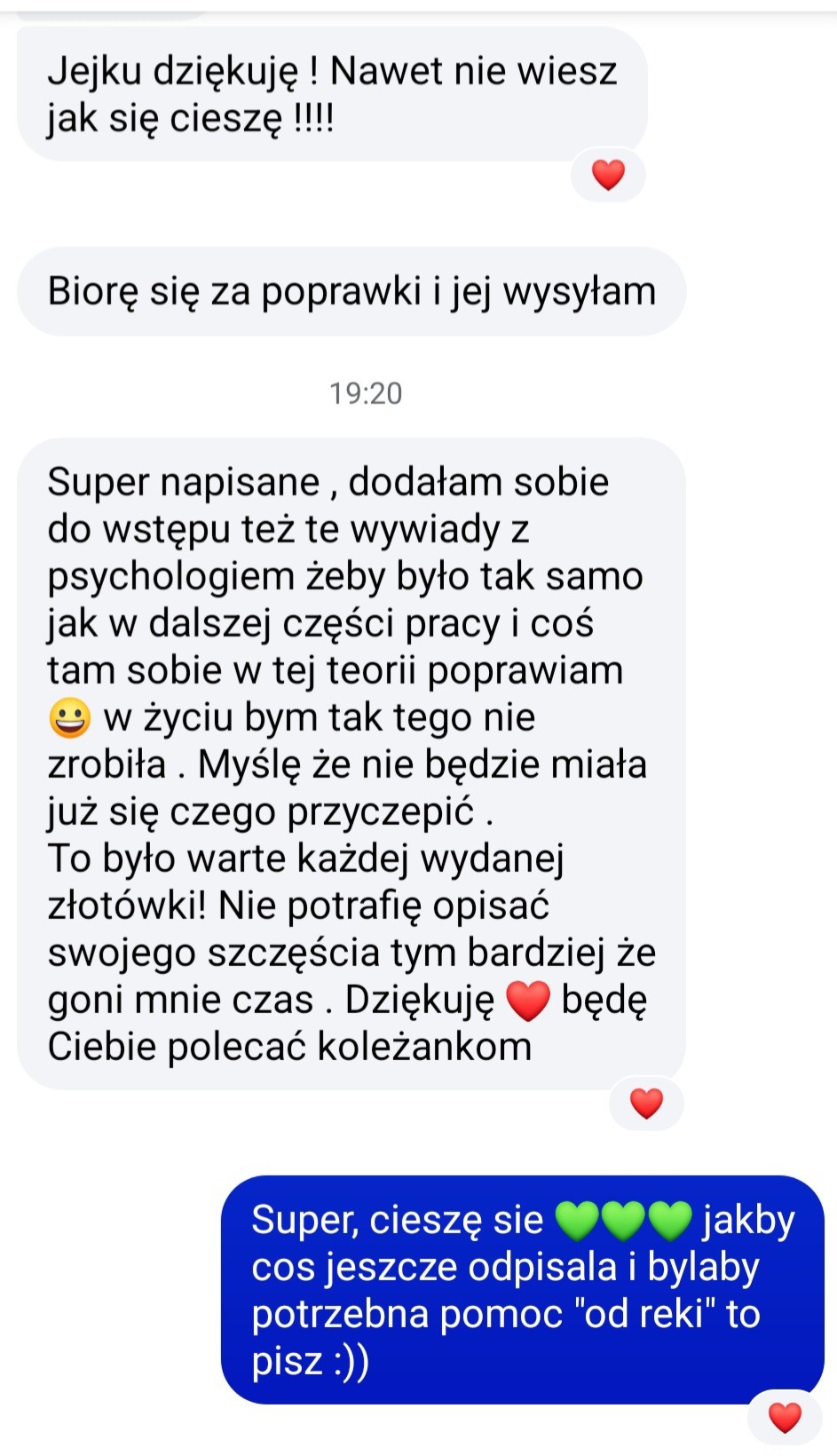 01
Statistical analysis - a client’s review
A client’s message following completion of statistical analysis.
 02
Thanks for the help and continued support
The client thanks us for the help and kindness. She emphasises how important continued support with her work is to her.
 03
Thesis approved and prompt communication
The client reports that the thesis was approved and passed the plagiarism check. He appreciates the commitment, prompt contact and quality of the collaboration.
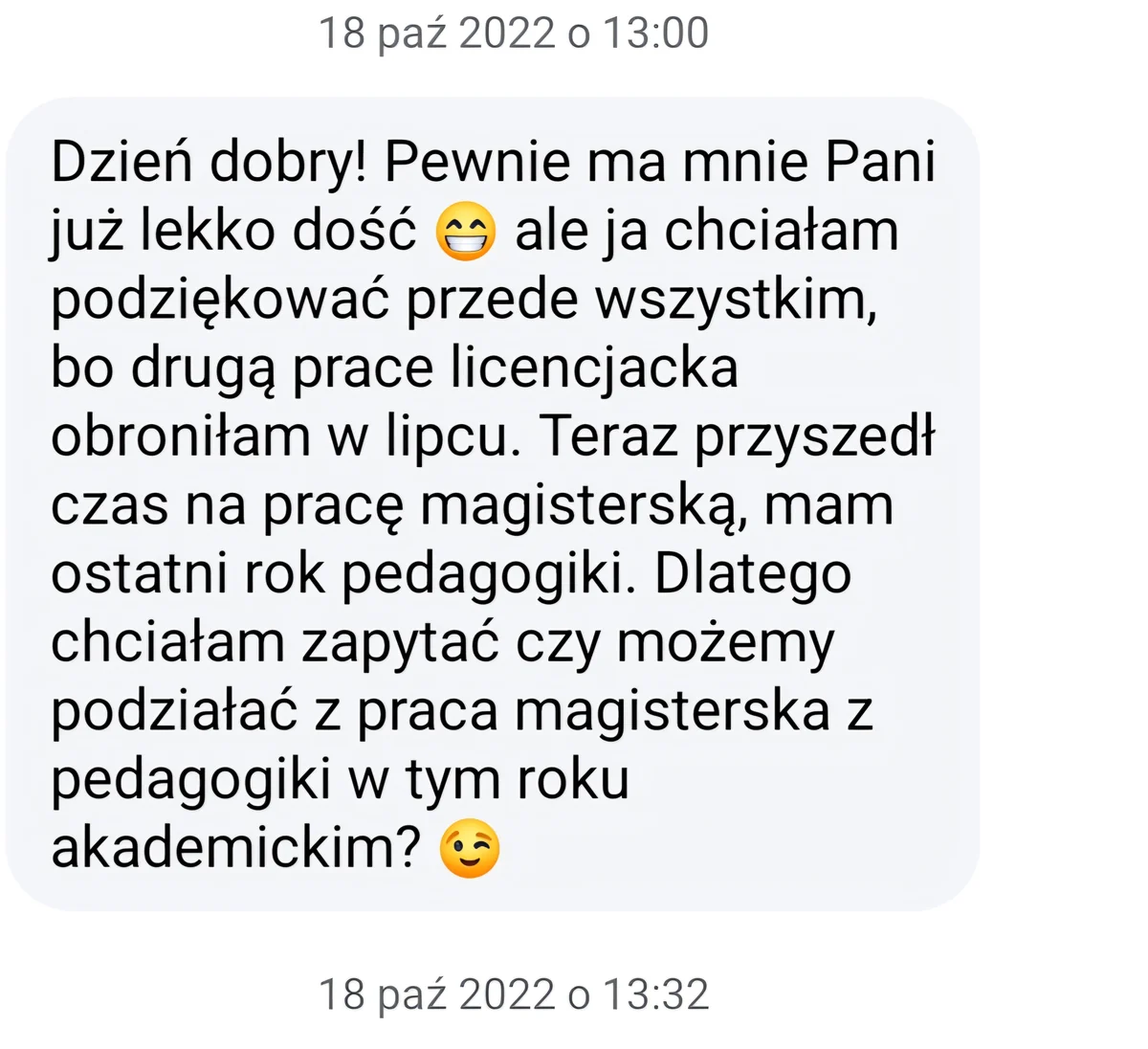 04
Bachelor’s thesis defended and a return for pedagogy support
The client reports defending her second bachelor’s thesis and asks about continuing to work together on a master’s thesis in pedagogy.
 05
Gratitude for help and commitment
The client thanks us for the help, expresses gratitude and says she will get in touch again after receiving her supervisor’s comments.
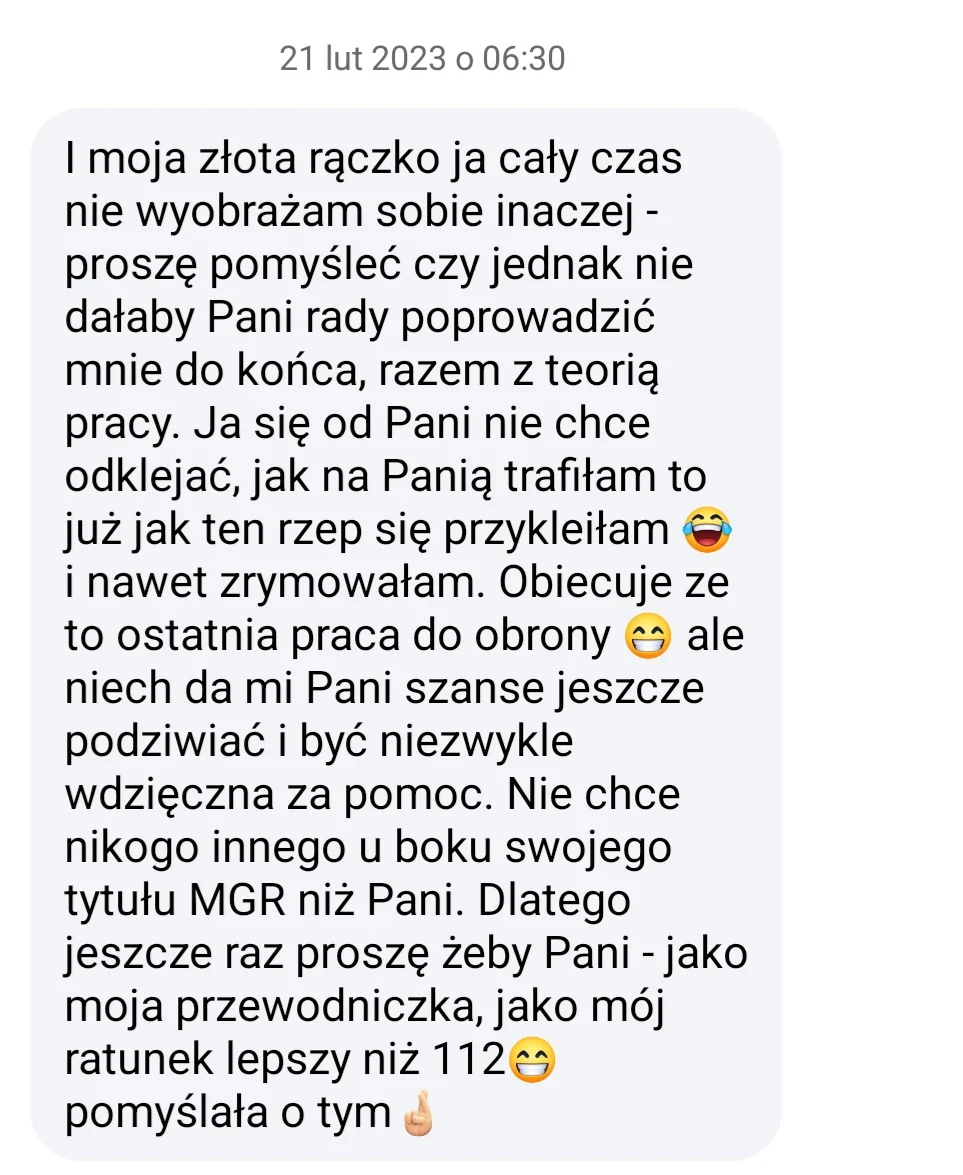 06
Trust and a wish to continue working together on a master’s thesis
The client expresses gratitude for the help and asks for further support with her master’s thesis, including the theoretical section.
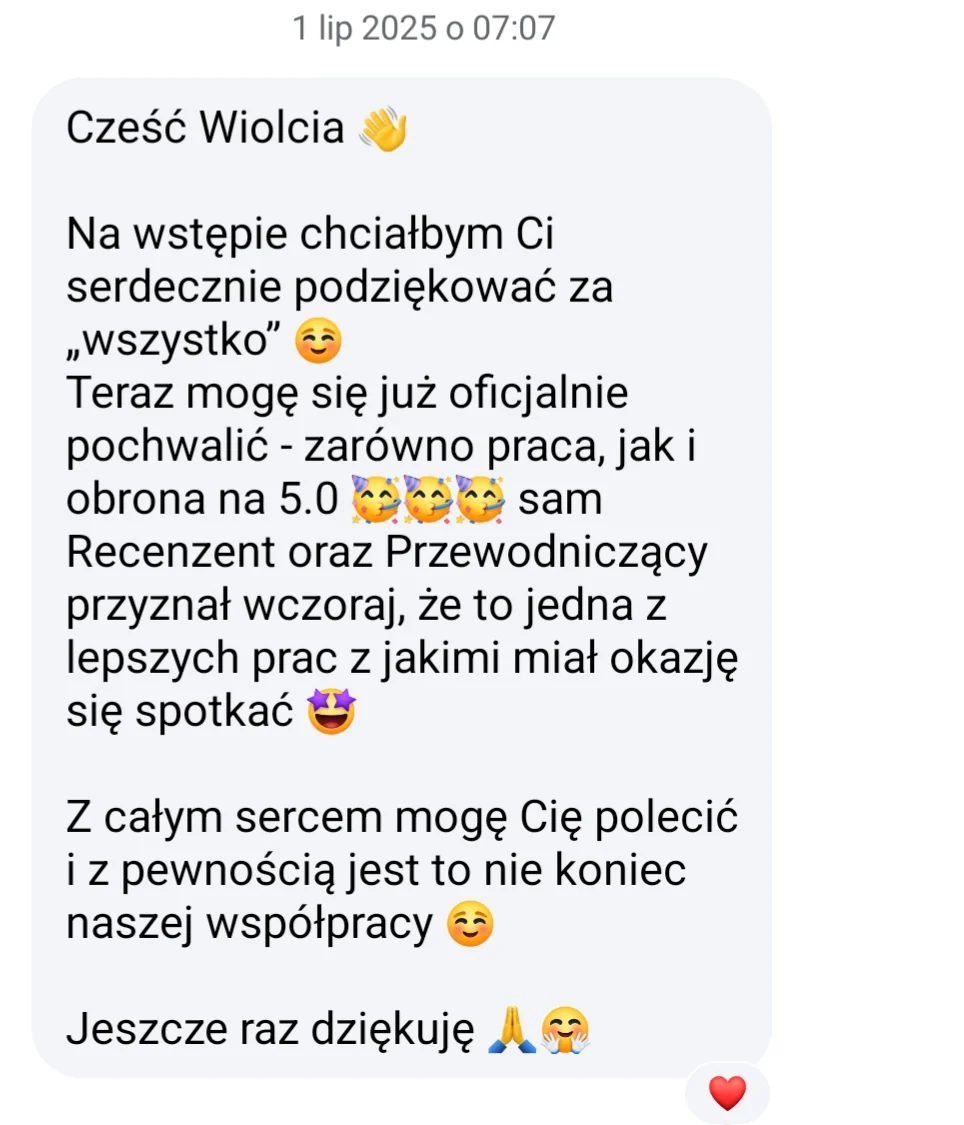 07
A grade of 5 for the thesis and defence - thanks for working together
The client shares her grade of 5.0 for the thesis and defence and praise from the reviewer. She thanks us for working together and expresses a wish to continue.
First of all, I want to thank you so much for “everything” ☺️
Now I can officially share the good news - both my thesis and defence received 5.0 🥳🥳🥳 The reviewer and chair themselves said yesterday that it was one of the better theses they had come across 🤩
I can recommend you wholeheartedly, and this certainly isn’t the end of our work together ☺️
Thank you once again 🙏🤗”
 08
Master’s thesis support - fast, reliable and professional
The client valued help with her master’s thesis, efficient delivery, full commitment and excellent communication.
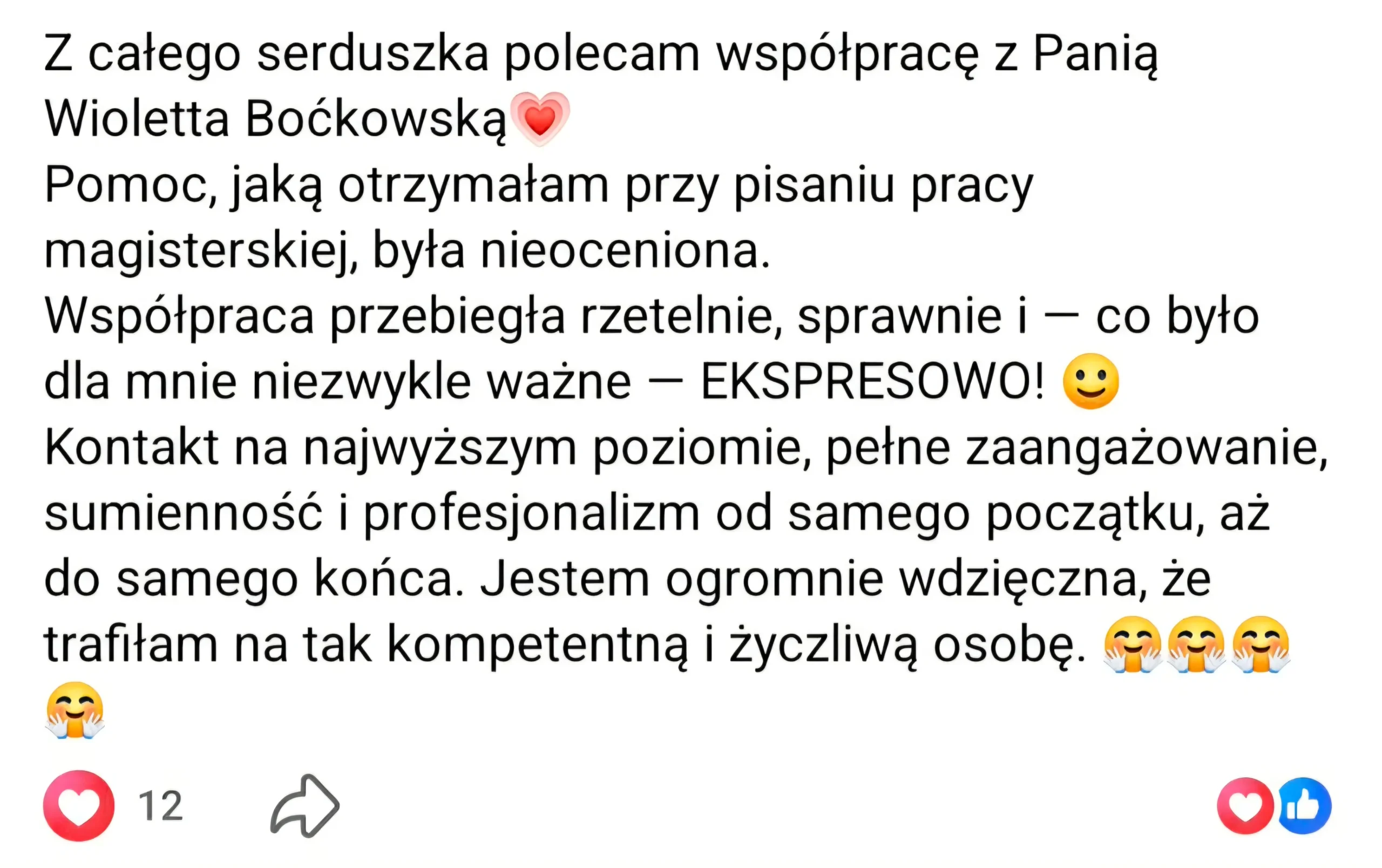
The help I received with writing my master’s thesis was invaluable. The collaboration was reliable, efficient and - which mattered enormously to me - EXTREMELY QUICK! 🙂 Communication was excellent, with full commitment, diligence and professionalism from start to finish. I’m so grateful to have found someone so competent and kind.
🫶”
 09
Stress-free support with an administration thesis
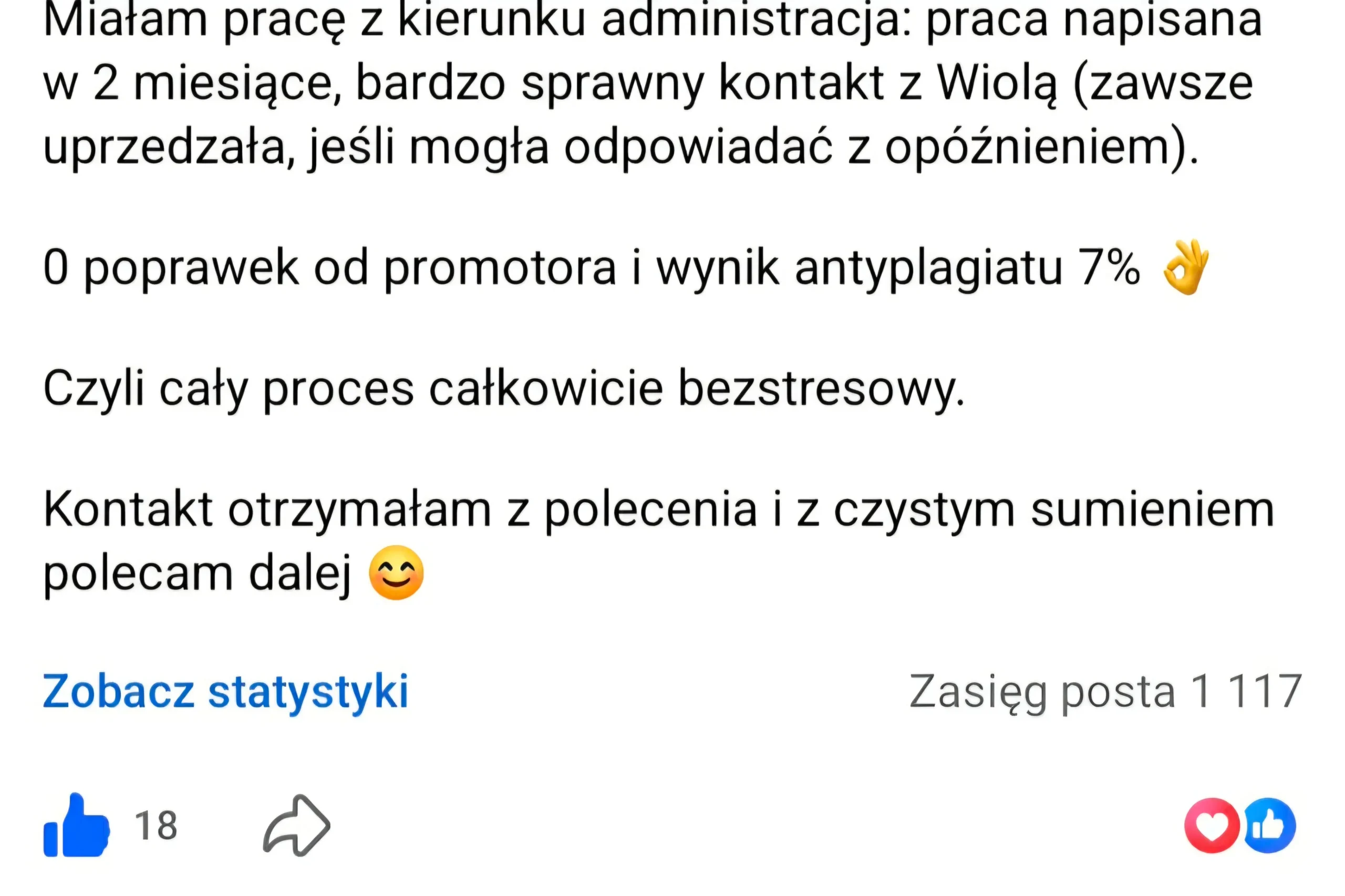
The client describes an efficient process of preparing an administration thesis, good communication, no revisions and a favourable plagiarism-check result.
I was given her contact details through a recommendation, and I confidently recommend her to others 😊”
Show more reviewsShow fewer reviews
 10
Student Support review - similarity level of 5%
The client highlights a low plagiarism level, the quality of the thesis’s content and support that helped her approach the defence with peace of mind.
 11
A thesis meeting the requirements - no revisions and a low plagiarism-check result
The client reports timely delivery, work meeting the requirements, no revisions and a very low plagiarism-check result.
 12
Professional thesis formatting and work completed as agreed
A recommendation praising reliable collaboration, careful thesis formatting and preparation of the material in line with the prior arrangements.
 13
Student Support review - on-time help with a thesis on an agreed topic
The client highlights timely delivery, regular contact and efficient support with preparing academic work on an agreed topic.
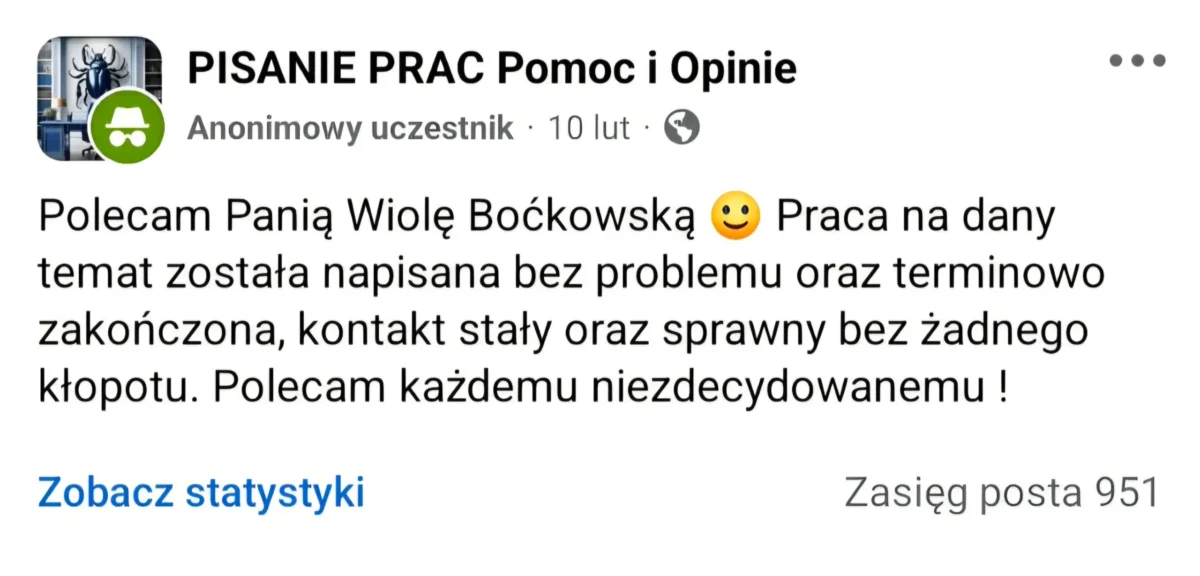
„I recommend Ms Wiola Boćkowska 🙂 The thesis on the given topic was written without any problems and completed on time, with consistent, efficient communication throughout. I recommend her to anyone who is undecided!”
 14
Student Support review - reliability, punctuality and prompt contact
The client notes reliable collaboration, timely delivery and prompt replies to messages and questions.
 15
Recommendation - professional support and a satisfied client!
The client review confirms professional support, efficient communication and a positive experience of working together!
 16
Urgent thesis help - quick revisions and contact
A review from a client who needed quick help with revisions and received efficient support even in an urgent situation.
 17
Last-minute thesis help - effective support before submission
We go to great lengths! Even urgent work can be organised, refined and prepared for submission in a short time.
 18
Honest, practical thesis help - a low similarity level
The client review highlights timely delivery, practical support and a low similarity level in the plagiarism report.
 19
Rapid thesis delivery and a successful plagiarism check
The client highlights fast work, regular contact and the thesis passing the plagiarism-checking system without problems.
 20
Student Support recommendation - professional support, step by step
A client recommendation praising ongoing support, good communication and substantive help at every stage of the work.
 21
Thesis writing support - punctuality, reliability and good communication
A short client review highlighting professionalism, punctuality, reliability and efficient communication throughout the work.
Read the testimonial in English
English translation of the selected testimonial from Polish. The original screenshot is shown above.
Knowledge base
Practical guidance for each stage of your thesis
Find clear guidance on formal requirements, research methodology, references, footnotes, surveys and organising your material. Use it to bring your work into order and avoid common mistakes.

2026-09-01
Bachelor's and master's thesis plan - how to prepare for a meeting with your supervisor?
Not sure what to say to your supervisor at the first seminar? Find out how to choose a topic, define the aim and prepare a bachelor's or master's thesis plan. You will find an example chapter structure, a fill-in synopsis template, questions for your supervisor and a seven-day preparation plan. Example of a decision: two variants, different access to material If you cannot collect opinions, document analysis is not a substitute measurement of those opinions. It is a different concept: it requires agreeing on the topic, objective, and method of analysis. Bring both variants to the meeting, along with information about what material is actually available. You do not have a topic yet, and comparing several ideas still does not give you a direction? Check - proposals can be based on your interests, available sources, and realistic possibilities for collecting material. Would you like to discuss specific doubts and prepare for the meeting first, instead of commissioning a ready-made outline? Check and indicate the questions and materials needed to analyse them. I am studying: … My thesis is a bachelor’s / master’s / engineering thesis. I plan an empirical / literature-based / project-based / other study: … Proposed title: … Key concepts that I must define: … I want to focus on this issue because: … Its significance for my field of study or professional practice is: … The objective of the thesis is: … After its completion, I want to be able to answer the question: … The thesis concerns: … The analysed group or material: … Location and period: … I leave out of scope: … Main question: … Specific questions: … Data or sources needed for the answer: … Predicted relationship or answer: ... Justification in the literature: ... Method of verification: ... If you lack the basis for a hypothesis, note this issue for consultation. I intend to use: ... I will obtain access to the material through: ... Planned method of analysis: ... Limitations or necessary agreements: ... First chapter: ... Its purpose: ... Second chapter: ... Its purpose: ... Subsequent parts: ... Subchapters: ......

2026-05-07
Thesis research methodology - how to formulate the aim, research questions and hypotheses?
Writing the methodology for your research can be difficult because each element must follow from the previous one. Learn how to organise the aim, research questions, hypotheses, variables, indicators, method, technique and research instrument in a bachelor's or master's thesis. Have you already collected responses? See step-by-step survey result analysis, including how to calculate percentages and a sample description. It is worth preparing the analysis plan in advance so that each research question has its place in the write-up. If your quantitative study will compare groups or test associations, also plan how you will assess the hypotheses. As part of test selection and statistical analysis I will help link the research questions to the variable types and calculations needed. Qualitative research or a theoretical thesis will require a different approach to analysis. When investigating associations, specify which characteristic you want to explain and which one you will examine alongside it. The dependent variable is the characteristic whose variation you are analysing. The independent variable is the characteristic assumed as the explanatory factor or the basis for comparison (Apanowicz, 2005). For example, when studying the relationship between social media use and peer relationships, you might treat time spent using social media as the independent variable and the reported frequency of meetings with peers as the dependent variable. Specify how you will measure both. An association in questionnaire data alone does not show that one characteristic causes a change in the other. Once the research design is established and you need only the instrument itself, see . Questionnaire items and response options should follow from the research questions and analysis plan, rather than take the place of developing them. Example of linking a research question, questionnaire item and analysis This illustrates one link between the question and the planned analysis, not a validated scale of peer relationships. Before collecting data, check that the item is understandable and fits the aim. After collecting responses, describe the instrument actually used; do not rewrite the description as though a revised version had been used in the study. The same considerations are needed for an independent...

2026-04-24
How to analyse survey results for a thesis: Excel and examples
Do you have survey or interview results and do not know how to prepare the research chapter? Find out how to organise the data, calculate percentages, choose charts and write comments on the results. See concrete examples, principles for analysing open-ended responses and a checklist before sending the thesis to your supervisor. The workbook contains 30 fictional responses: 18 'Yes', 7 'No' and 5 'Hard to say'. Change the responses in the Data tab, then check the recalculated counts, percentages and chart in the Results tab. Missing data are shown separately. Percentages refer to valid responses to this question. After changing the data, adjust the comment on the results as well. You can find a sample description below. The following steps use the same fictitious frequencies as the previous example: 18 “yes” responses, 7 “no”, and 5 “hard to say”. Perform your own calculations on a copy of the data. The cell layout is an example to be reproduced independently, not a description of all form exports. Place data for one person in one row and the answer to one question in one column. Assume that responses to the question about difficulties with the bibliography are in cells B2:B31. Standardise the notation of the same answer, e.g. remove unnecessary spaces, while preserving the original export. Add a separate note about changes and the meaning of codes. A category number, e.g. 1 for “yes”, is a label, not a measure of the difficulty level. In C2, C3 and C4, enter the Polish example categories in order: tak (yes), nie (no), trudno powiedzieć (hard to say). In D2, enter =LICZ.JEŻELI($B$2:$B$31;C2) and copy the formula to D4. You will get 18, 7, and 5. This is the syntax for the Polish version of Excel; in the English version, the function is called COUNTIF, and the argument separator depends on settings. Check that every non-empty response belongs to one of these categories. Unknown entries must be explained rather than omitted without comment. For this question, the number of valid responses is the sum of the counts in three mutually exclusive categories. In D5, enter...

2026-04-02
How to design a research questionnaire without confusion or random questions
A research questionnaire should not be a collection of random questions. A good research instrument must follow from the thesis aim, research questions, hypotheses and variables. Learn how to prepare a questionnaire step by step so that it is easier to report the results in your research chapter later. For each question, note provisionally how you will present the answers. For single-choice questions, this may be the number of people and the percentage; for multiple-choice questions, the number of selections for each option; and for open questions, thematic categories along with a description of how they were created. Practise this on a small set of fictitious answers, clearly marked as a test. If a question about difficulties allows selecting several options, the sum of percentages of people may exceed 100%. If a question applies only to participants of consultations, percentages must be calculated for that group, not for everyone who fills in the questionnaire. Also record how missing data will be handled. No answer to the question “How many times did you use consultations?” does not mean zero consultations. Meanwhile, “I do not remember” is a provided answer with a different meaning than an empty field. If you plan to compare groups, ensure that you have a variable allowing you to identify them. If you want to calculate a composite score from several items, establish the justification for such a combination and the scoring rules in advance. Do not sum random questions just because each has answers marked with numbers from 1 to 5. We described the next stage in the guide on processing research results, percentages and comments on the questionnaire. It is worth looking at it before the study to check whether the designed questions will provide the data needed in the empirical chapter. Are you planning group comparisons or tests of associations and unsure what data you will need? Before distributing the questionnaire, you can discuss with me selecting statistical analyses for research questions. I will help determine whether the answers will allow the planned calculations to be performed, before you collect material that cannot be used...

2026-03-12
Bibliography and footnotes - common formal errors that weaken a thesis
Bibliography and footnotes often seem like a purely technical addition to a thesis. In practice, they can strongly affect how the text is assessed, because they show whether sources were used carefully, consistently and in line with university requirements. If the text lacks source material, first return to searching for and evaluating literature for the thesis. Add references based on publications you have read, rather than matching random titles to existing statements. If the problem is a lack of sources for an argument, rather than the formatting of known publications, check . This scope covers preparing all necessary literature and bibliography for agreed topics before references are created in the finished text. If you are correcting citations after an anti-plagiarism check, also see how to interpret a JSA report and distinguish similarity from AI indicators. This will help you determine what the note refers to before you start changing the text. Work on one clearly labelled version. Attach current guidelines and supervisor comments. If you use a bibliography manager, keep the document with active citation fields. Review references in chapters, table captions, appendices, and footnotes. Collect missing files or addresses. Pay special attention to working notes such as “add source,” “page?,” and “author to check.” Compare quotes with the original. For paraphrases, check whether the author's conclusion has been extended beyond what follows from the publication. For example, describing the results of one group of respondents does not automatically justify a claim about all students. Correct authors, dates, titles, and publishing data. Apply the appropriate scheme for each type of source. Do not fill in gaps based on assumptions. If information cannot be determined, return to the rules for handling missing data in the chosen style. Sources of methods and tools should correspond to what is described in the research chapter. In case of doubt, return to the guide on research methodology. The bibliography will not fix discrepancies between the tool actually applied and the tool named in the text. If the problems also concern the order of chapters, use the guide on thesis structure. Make changes to the text...
2026-02-14
How can you organise a thesis without losing the logic of your argument?
Example topic: use of consultations by students preparing their thesis. Example topic: ways of organising thesis consultations presented in the literature. Example topic: design of a thesis consultation booking system. If the layout is established but there is no text explaining concepts and comparing authors' positions, check . The scope of writing is then agreed on the basis of the aim, outline and available publications. Example of a working transition from the conceptual part to the methodology: The framework presented distinguished the availability of consultations from their perceived usefulness. These were treated as two separate areas in the study. The next section explains how participants and questions for describing these areas were selected. Send a plan or a written fragment. I will help determine what to move, combine, or supplement so that the parts of the thesis follow logically from one another and address its objective. Pomoc w przygotowaniu planu pracy licencjackiej i magisterskiej concerns the arrangement of chapters, gaps, and repetitions. If the order is already set but paragraphs are hard to read, usługa „Korekta i redakcja pracy licencjackiej i magisterskiej” will help refine the language and transitions between ideas.
Page 4 of 5