
Student Support
Thesis writing and academic support
I write bachelor's, master's and postgraduate diploma theses, individual chapters, presentations and coursework materials. I also help plan research, analyse real research findings, carry out statistical analysis and refine an existing text. Choose a complete project or support at a specific stage – we will agree on the scope, deadline and price before starting.
Do you have a topic, a draft, or feedback from your supervisor? Let's start with what you have.
- clear services and a defined scope of support,
- help with editing, formatting, and text structure,
- support with research methodology and research results.
Who is this site for?
For students who are just starting their thesis, have data to analyse or are revising an existing text. You don't need to know which service to choose. Tell me where you are stuck, and I will help define the support you need.
How do we work?
Send the topic, materials, and required deadline. I will check what needs to be done and discuss the scope, price, and feasibility with you. Before starting, we will agree on what you will receive and when.
What makes Student Support different?
I have personally run Student Support since 2018. You discuss your topic, agree on the scope of support and go through feedback directly with me. I take care of the content, clarity, presentation and compliance with your university’s requirements.
Search the site
Search for a service, guide or subject area
Try a phrase such as thesis, master’s thesis, research methodology, survey, references, JSA, research chapter or your subject area. The search suggests relevant content and links directly to the right page.
Services
What do you need help with?
A bachelor’s or master’s thesis, a class presentation, an essay or a coursework project. Choose a complete project, help with a chapter, research analysis or revisions to existing material.
- Bachelor’s and master’s thesis writingTheses, chapters and revisions following supervisor feedback.
- Bachelor’s and master’s thesis proofreading and editingImprovements to the language, style and coherence of your text. Clear sentences and logical links between paragraphs.
- Bachelor’s and master’s thesis formattingA thesis layout aligned with the requirements.
- Help with the theoretical chapter of your thesisKey concepts, comparison of perspectives and a coherent argument based on actual publications.
- Help with your thesis methodology chapterA coherent research plan, questionnaire or interview.
- Questionnaire design for your thesisQuestions and response options aligned with your research aim and plan.
- Analysis and presentation of research results for your thesisFrom survey responses and other research data to analysis and conclusions.
- Statistical analysis for bachelor’s and master’s thesesChoice of statistical tests, calculations and a clear explanation of results.
- Thesis research section: methodology, results and discussionMethodology, research tools, actual results and discussion within one agreed scope.
- Choosing a bachelor’s or master’s thesis topicTopic proposals with an explanation of scope, sources and feasibility.
- Help with your thesis outline and structureA logical outline and connected chapters.
- Literature search and selection for your thesisSources selected for your whole thesis or one chapter, with a bibliography.
- Thesis reviewAssessment of thesis structure, content coherence, sources and formal aspects. Specific comments on the document and a prioritised list of revisions.
- Thesis revisions following supervisor feedbackAgreed changes to your text based on your supervisor’s comments.
- Reference list and citation corrections for your thesisConsistent reference lists, footnotes and in-text citations.
- Thesis revisions after a JSA similarity reportReview of the JSA report and editing of flagged passages: paraphrasing, citations, references and textual consistency.
- Bachelor’s and master’s thesis consultationsDiscuss a specific thesis issue, the relevant materials and your next steps.
- Verification and editing of AI-assisted textSource and claim verification, editing and coherent argumentation for AI-assisted text.
- Presentations for classes and thesis defencesContent and slide design for your thesis defence or classes. Speaker notes as agreed.
- Coursework and essaysEssays, seminar papers, semester projects and reports aligned with the lecturer’s brief.
- Research projectsA standalone project for a class or seminar: a research proposal or a report based on actual data.
Subject areas
What are you studying?
Explore support tailored to your topic, type of research and thesis requirements.
Working together
How does it work, step by step?
Studies, work, and daily duties do not always leave time for everything. Write to me about what is holding you back. I will help identify which tasks you can delegate. You can handle everything online.
- STEP 01
Describe what you need
Provide the topic, stage of work, and deadline. Attach the current file and supervisor or university guidelines if you have them. You can submit the whole thesis or just one issue.
You don't need to know which service to choose. I will help define the support you need.
- STEP 02
Learn about the scope, price, and deadline
I will review your materials and provide a quote. Before starting, we will agree on what I will prepare, when you will receive it and the payment arrangements.
You know exactly what you are paying for and what you will receive before making a decision.
- STEP 03
Receive the prepared material
Once the terms and arrangements are confirmed, I will carry out the agreed tasks. I will check the completed work and send it in the agreed format by the agreed deadline.
While I work on your material, you have time for your other responsibilities.
Reviews
Reviews from our clients
These messages are genuine recommendations from clients after using our services. The reviews are translated from Polish; you can view the original messages in the preview.
Statistical analysis - a client’s review
Thanks for the help and continued support
Thesis approved and prompt communication
Bachelor’s thesis defended and a return for pedagogy support
Gratitude for help and commitment
Trust and a wish to continue working together on a master’s thesis
A grade of 5 for the thesis and defence - thanks for working together
First of all, I want to thank you so much for “everything” ☺️
Now I can officially share the good news - both my thesis and defence received 5.0 🥳🥳🥳 The reviewer and chair themselves said yesterday that it was one of the better theses they had come across 🤩
I can recommend you wholeheartedly, and this certainly isn’t the end of our work together ☺️
Thank you once again 🙏🤗”
Master’s thesis support - fast, reliable and professional
The help I received with writing my master’s thesis was invaluable. The collaboration was reliable, efficient and - which mattered enormously to me - EXTREMELY QUICK! 🙂 Communication was excellent, with full commitment, diligence and professionalism from start to finish. I’m so grateful to have found someone so competent and kind.
🫶”
Stress-free support with an administration thesis
I was given her contact details through a recommendation, and I confidently recommend her to others 😊”
Student Support review - similarity level of 5%
A thesis meeting the requirements - no revisions and a low plagiarism-check result
Professional thesis formatting and work completed as agreed
Student Support review - on-time help with a thesis on an agreed topic
„I recommend Ms Wiola Boćkowska 🙂 The thesis on the given topic was written without any problems and completed on time, with consistent, efficient communication throughout. I recommend her to anyone who is undecided!”Testimonial following completion of our work together
Student Support review - reliability, punctuality and prompt contact
Recommendation - professional support and a satisfied client!
Urgent thesis help - quick revisions and contact
Last-minute thesis help - effective support before submission
Honest, practical thesis help - a low similarity level
Rapid thesis delivery and a successful plagiarism check
Student Support recommendation - professional support, step by step
Thesis writing support - punctuality, reliability and good communication
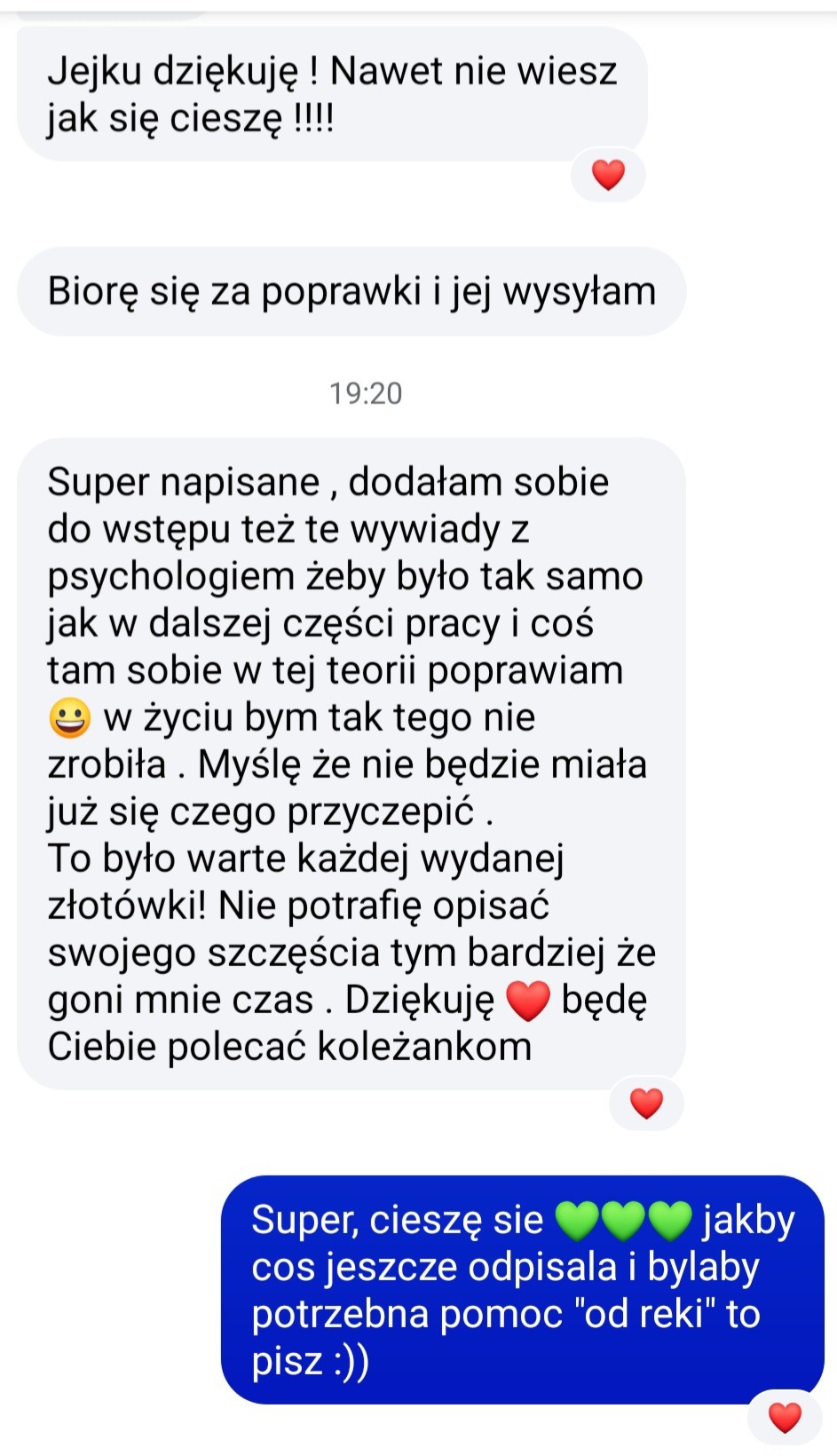 01
Statistical analysis - a client’s review
A client’s message following completion of statistical analysis.
 02
Thanks for the help and continued support
The client thanks us for the help and kindness. She emphasises how important continued support with her work is to her.
 03
Thesis approved and prompt communication
The client reports that the thesis was approved and passed the plagiarism check. He appreciates the commitment, prompt contact and quality of the collaboration.
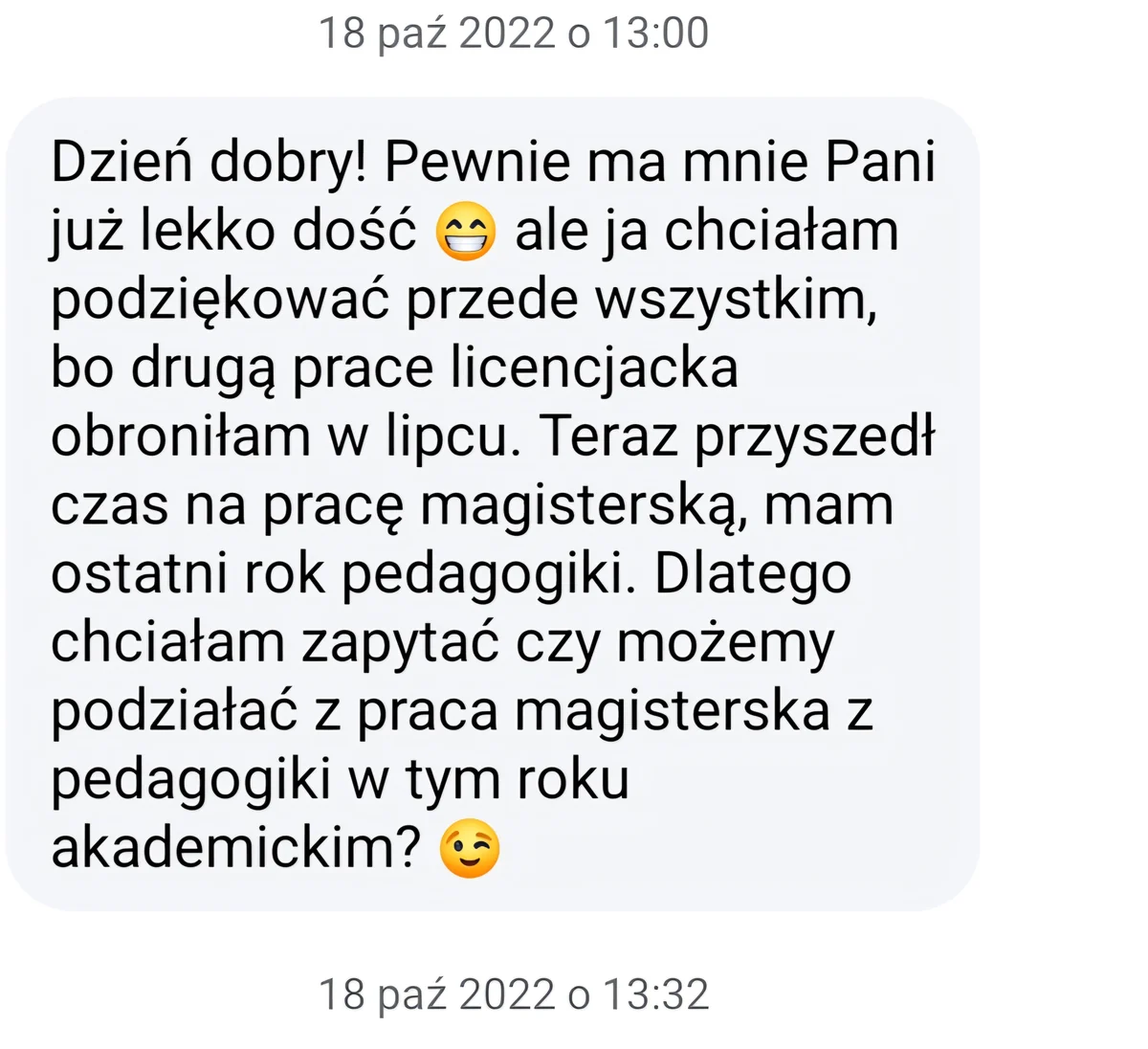 04
Bachelor’s thesis defended and a return for pedagogy support
The client reports defending her second bachelor’s thesis and asks about continuing to work together on a master’s thesis in pedagogy.
 05
Gratitude for help and commitment
The client thanks us for the help, expresses gratitude and says she will get in touch again after receiving her supervisor’s comments.
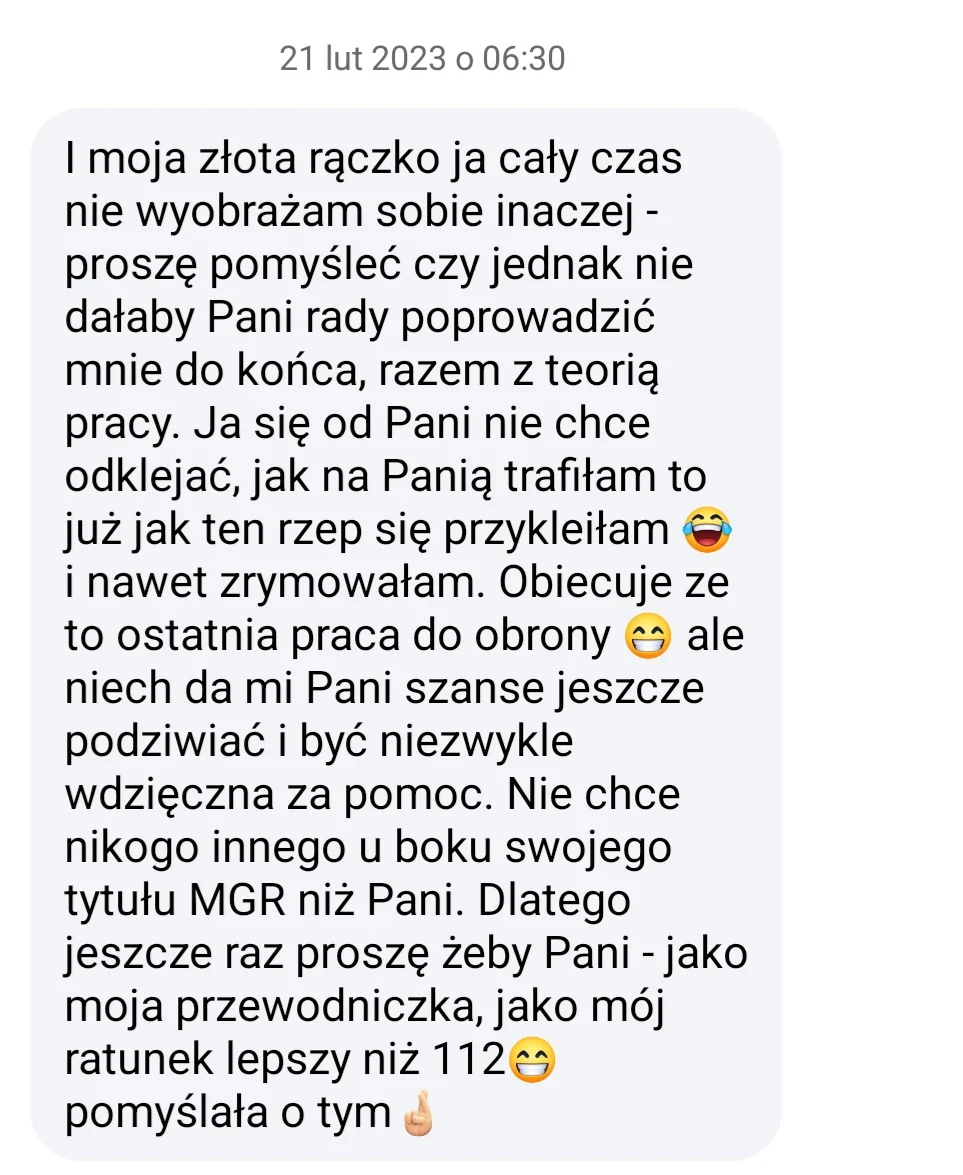 06
Trust and a wish to continue working together on a master’s thesis
The client expresses gratitude for the help and asks for further support with her master’s thesis, including the theoretical section.
 07
A grade of 5 for the thesis and defence - thanks for working together
The client shares her grade of 5.0 for the thesis and defence and praise from the reviewer. She thanks us for working together and expresses a wish to continue.
First of all, I want to thank you so much for “everything” ☺️
Now I can officially share the good news - both my thesis and defence received 5.0 🥳🥳🥳 The reviewer and chair themselves said yesterday that it was one of the better theses they had come across 🤩
I can recommend you wholeheartedly, and this certainly isn’t the end of our work together ☺️
Thank you once again 🙏🤗”
 08
Master’s thesis support - fast, reliable and professional
The client valued help with her master’s thesis, efficient delivery, full commitment and excellent communication.
The help I received with writing my master’s thesis was invaluable. The collaboration was reliable, efficient and - which mattered enormously to me - EXTREMELY QUICK! 🙂 Communication was excellent, with full commitment, diligence and professionalism from start to finish. I’m so grateful to have found someone so competent and kind.
🫶”
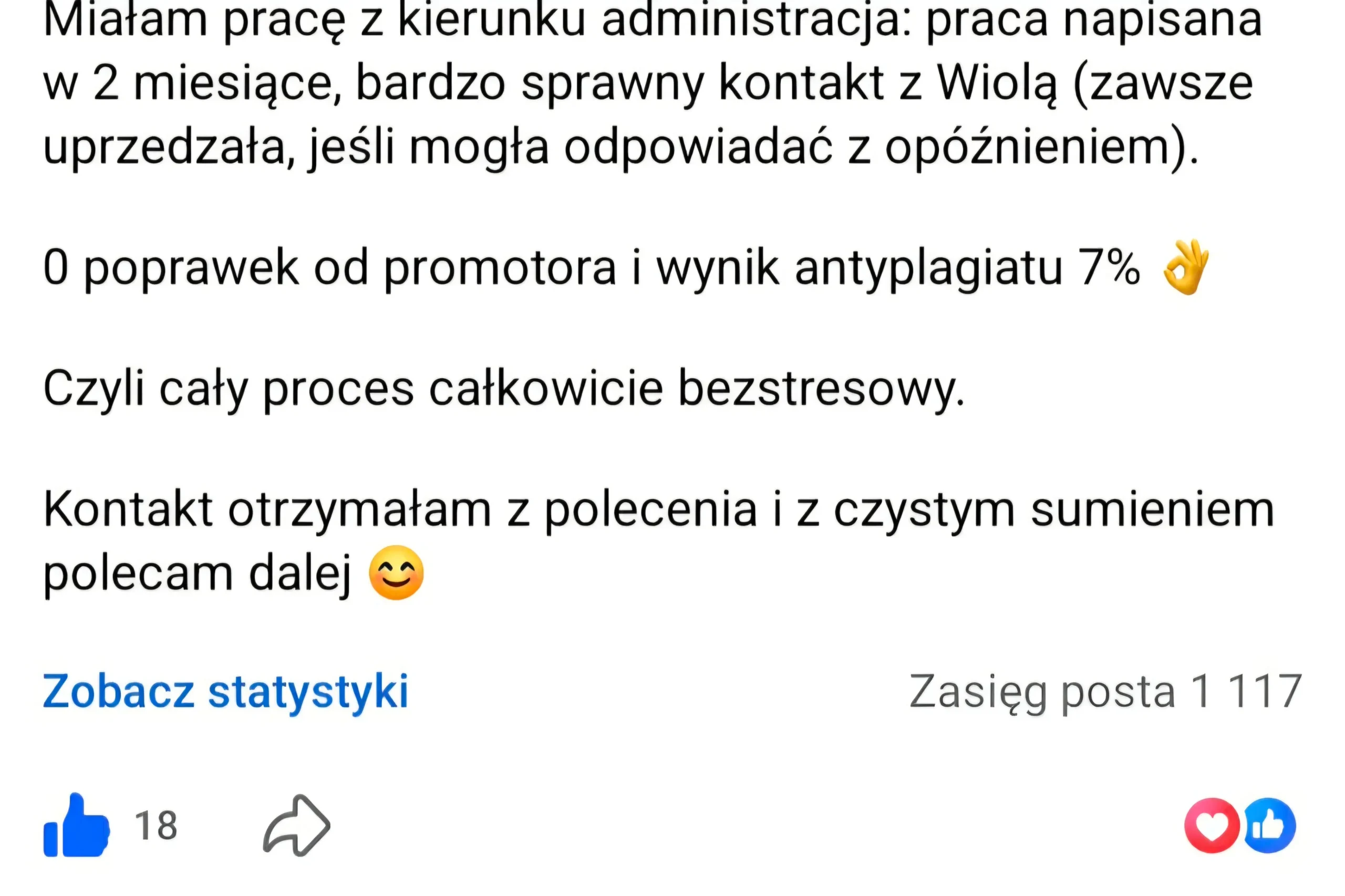 09
Stress-free support with an administration thesis
The client describes an efficient process of preparing an administration thesis, good communication, no revisions and a favourable plagiarism-check result.
I was given her contact details through a recommendation, and I confidently recommend her to others 😊”
Show more reviewsShow fewer reviews
 10
Student Support review - similarity level of 5%
The client highlights a low plagiarism level, the quality of the thesis’s content and support that helped her approach the defence with peace of mind.
 11
A thesis meeting the requirements - no revisions and a low plagiarism-check result
The client reports timely delivery, work meeting the requirements, no revisions and a very low plagiarism-check result.
 12
Professional thesis formatting and work completed as agreed
A recommendation praising reliable collaboration, careful thesis formatting and preparation of the material in line with the prior arrangements.
 13
Student Support review - on-time help with a thesis on an agreed topic
The client highlights timely delivery, regular contact and efficient support with preparing academic work on an agreed topic.
„I recommend Ms Wiola Boćkowska 🙂 The thesis on the given topic was written without any problems and completed on time, with consistent, efficient communication throughout. I recommend her to anyone who is undecided!”
 14
Student Support review - reliability, punctuality and prompt contact
The client notes reliable collaboration, timely delivery and prompt replies to messages and questions.
 15
Recommendation - professional support and a satisfied client!
The client review confirms professional support, efficient communication and a positive experience of working together!
 16
Urgent thesis help - quick revisions and contact
A review from a client who needed quick help with revisions and received efficient support even in an urgent situation.
 17
Last-minute thesis help - effective support before submission
We go to great lengths! Even urgent work can be organised, refined and prepared for submission in a short time.
 18
Honest, practical thesis help - a low similarity level
The client review highlights timely delivery, practical support and a low similarity level in the plagiarism report.
 19
Rapid thesis delivery and a successful plagiarism check
The client highlights fast work, regular contact and the thesis passing the plagiarism-checking system without problems.
 20
Student Support recommendation - professional support, step by step
A client recommendation praising ongoing support, good communication and substantive help at every stage of the work.
 21
Thesis writing support - punctuality, reliability and good communication
A short client review highlighting professionalism, punctuality, reliability and efficient communication throughout the work.
Read the testimonial in English
English translation of the selected testimonial from Polish. The original screenshot is shown above.
Knowledge base
Practical guidance for each stage of your thesis
Find clear guidance on formal requirements, research methodology, references, footnotes, surveys and organising your material. Use it to bring your work into order and avoid common mistakes.

2026-10-08
How to choose a supervisor for your bachelor’s or master’s thesis?
Choosing a supervisor often takes only a few minutes, but the student feels the consequences for months to come. The supervisor helps define the topic, assesses successive chapters, and requests corrections in line with the degree regulations adopted by the university. Therefore, when registering for the seminar, it is not worth relying solely on the opinion that "writing a thesis under this supervisor is easy" or "this supervisor has few requirements." It is far more important to match the supervisor to the thesis topic, the student's working style, and the type of planned research. How to choose a supervisor? Check three things: alignment of research interests with the topic, communication style, and the organisation of collaboration. Popularity and academic title may be additional information, but they do not replace these criteria. If the thesis topic is already roughly known, choosing a supervisor becomes easier. Among the people available on your course, look for someone who knows the area of your work. Example topic: occupational stress of Prison Service officers. In such a situation, it is good to look for a person whose interests include, for example, security, social rehabilitation, work psychology, the functioning of services, or occupational stress. This does not mean that the supervisor must have previously published an article specifically about Prison Service officers. However, they should know the area in which the student will be working. Collaboration with a supervisor whose academic work concerns a completely different field can be much more difficult. Therefore, a good supervisor for one thesis is not necessarily a good supervisor for every thesis. This is a normal situation. At the beginning of the seminar, many people have only general interests. Instead of looking for a ready-made title, you can start with an idea: This is already enough to check which of the available supervisors works in a similar area. A good choice may be a person who helps students narrow down the topic. Some supervisors propose research areas, while others expect an original idea. It is best to clarify this before registering. Before choosing a supervisor, it is worth having at...

2026-10-07
How to write the discussion in a bachelor’s or master’s thesis
The discussion in a bachelor’s or master’s thesis is the section where you explain your own research findings and relate them to existing knowledge. It is not enough to repeat how many people chose a particular answer or reproduce conclusions from tables. You need to show what the findings mean, how they compare with other authors’ research and what might explain the similarities or differences observed. This is why students often find the discussion more challenging than describing the results themselves. The results show what you found. The discussion explains what it means. This guide takes you from a single finding to a complete paragraph, comparison with the literature and cautious conclusions. Dean R. Hess (2023, pp. 1771-1774) identifies explaining the meaning of the findings to the reader as the discussion’s central task. Rather than presenting the results again, it should answer the question: what follows from them? Similarly, Thomas M. Annesley (2010, pp. 1671-1674) emphasises that the discussion should explain the meaning of the findings and show how the study contributes to understanding the issue. It should also relate the results to previous research and consider possible explanations and the study’s limitations. An example makes the distinction easiest to understand. The three versions below concern the same fictional finding. They illustrate the difference between description and interpretation. Among the teachers surveyed, 62% identified an excessive workload as one source of occupational stress. This describes a result. It reports what the study found. 62% of teachers identified an excessive workload as a source of stress. This means that most teachers identified an excessive workload. The finding indicates that an excessive workload is a frequently reported problem among the teachers studied. Its interpretation should take account of the nature of their work, which involves preparing documentation, communicating with parents and additional organisational duties alongside teaching. The finding should then be compared with previous research on sources of occupational stress among teachers. Writing guidance for scientific texts emphasises this principle: the discussion should interpret results rather than duplicate the results chapter. If you first need to organise your data, read the step-by-step...

2026-10-06
The first chapter of a bachelor's or master's thesis - how to write the theoretical part?
You have a topic, a thesis plan, and a few publications, but you do not know how to start the first chapter of your bachelor's or master's thesis? Check what the theoretical part should contain, how to outline subsections, and how to assign sources to them. See how to compare authors' findings, build paragraphs, and connect theory with further analysis. In this guide, you will find a sample chapter plan, cards for organising literature, a text editing exercise, and a checklist before sending the thesis to the supervisor. Prepare the first fragment step by step and avoid unnecessary repetitions. To write the first chapter of a bachelor's or master's thesis, define what it needs to explain and the scope it should cover. Break it down into subchapters and assign verified sources to each. Then work on one issue at a time: explain the concepts, compare the findings of different authors, and show how they will be used in your thesis. You do not need to begin with a perfect opening sentence. It is easier to write the chapter introduction once you know what the chapter will actually contain. You open the document, type 'Chapter 1' and stop in front of a blank page. The folder contains books, articles and notes, but they do not yet form a text. In this situation, dividing the work into stages helps: first, you decide what you want to explain, then you select the material, and only then do you build the sentences. The following guide mainly concerns theses where the theoretical part prepares for further analysis or research. If you are still choosing a topic, start with the thesis plan and preparation for the meeting with your supervisor. Here, we move from an approved direction of work to the first draft of the chapter. The first chapter of a bachelor's thesis, if it serves as the theoretical part, explains the meaning in which you use concepts, which approaches help understand the problem, and what follows from previous studies. Its scope should correspond to the aim of the thesis. The reader should receive the foundations...
2026-10-05
Can plagiarism checkers detect AI? JSA and similarity reports
The JSA report raises doubts, and your supervisor expects revisions? Check whether anti-plagiarism software detects ChatGPT, what the similarity percentage means, and why the result alone does not determine the grade of your thesis. Learn how to review highlighted fragments, improve citations, and distinguish notes about sources from AI indicators. This guide provides a step-by-step action plan, an example of report interpretation, and a template message for your supervisor. Identify what requires correction before you start rewriting the entire chapter. This does not establish authorship with certainty. AI analysis and the percentage of similarity to sources answer different questions. Neither result replaces the supervisor’s assessment of the thesis. Text watermarks are a separate way of investigating where a text came from. Check what an AI watermark in ChatGPT and Claude means for a thesis and why you should use your own arguments and verified sources. You have a report, see highlighted fragments, and do not know whether you need to correct a few footnotes or the entire chapter? Start by determining what the note refers to. Working on incorrect citation is different from working on a too-close paraphrase, and explaining doubts regarding AI use is yet another matter. Below you will find a way to organise this situation: what to check in the report, what materials to prepare, and what to ask the supervisor. This guide primarily concerns the Unified Anti-Plagiarism System used in Polish universities. Yes, JSA provides an analysis that may indicate AI use. The Ministry of Science announced the introduction of this feature in February 2024. Therefore, the general answer that JSA does not detect AI is outdated. At the same time, detection does not provide one hundred percent certainty. The Ministry's announcement about the AI analysis feature in JSA clearly points to the need for the supervisor's assessment. The system's indication does not by itself explain how the entire document was created. It should also not be equated with proof of using a specific tool, such as ChatGPT. The most important factors are the rules in force at your university, the actual way of working on...

2026-09-26
How to write the aim of a bachelor's or master's thesis: examples
The aim of a master's or bachelor's thesis states what you intend to establish, explain, compare or develop. To write it, identify the intended outcome, the issue being studied and the limits of the analysis. Then check whether the literature and available data will allow you to achieve that aim. A useful opening is “The aim of this thesis is...”, but the quality depends on what follows. You have a topic, a few books and an idea for a survey. But your supervisor asks: “What exactly do you want to establish?” The answer “I want to describe this issue” turns out to be too broad. It is unclear what information you need, what to ask participants and what the conclusions should address. This guide takes you from a general idea to an aim that is justified and feasible. You will see a sentence template, a detailed example with specific objectives and six suggestions for different fields of study. At the end, you will find a worksheet to complete before your consultation. A practical test: after reading your aim, another person should be able to say what they will learn from the thesis. The topic title alone usually does not provide that answer. If you cannot define the aim because the topic itself covers several different problems, revisit its scope first. You can choose . This lets you compare narrower options before refining the aim and outline. The aim of this thesis is [type of result] concerning [the issue] in relation to [the group, material or case], within [the main limitation]. The aim can be achieved even when the findings do not support the hypothesis. If the association analysis was properly planned and conducted, not finding the expected relationship is a result to report. It is not a reason to change the data or hide the findings. Send your draft aim and explain which material or data you can access. I can help check whether the intended outcome is feasible and addresses the research questions. As part of usługi „Pomoc przy rozdziale metodologicznym pracy licencjackiej i magisterskiej” we can refine the aim,...

2026-09-14
How to find literature for a bachelor's or master's thesis
Have a thesis topic but no idea where to find suitable books and articles? Learn how to search Google Scholar and Polish databases, assess publications and assign them to chapters. The guide includes a worked example using real sources and a note-taking template you can copy. For each source, note which concept it explains and which other author’s position you can compare it with. For the hybrid-work topic, keep the definition of the way work is organised separate from the definition of satisfaction. An article on productivity is not automatically a substitute for a source on employee satisfaction. Note what the publication justifies: the choice of method, the measurement approach, the selection of material or the data analysis. If you use an existing instrument, check its intended purpose, conditions of use and interpretation rules. A description of a similar study does not in itself entitle you to reuse its questionnaire however you choose. Alongside other authors’ findings, record the study group, measurement approach and study conditions. This helps you establish whether you can compare their result with your own. Keep publications with different findings too, if they address the same problem. Assigning sources in this way shows what is missing from each chapter. Preparing a set of literature can cover the whole thesis or one specified chapter: the necessary publications and materials, their organisation and a bibliography for the agreed scope. How full texts are supplied depends on lawful access and permission to share them. A reference that looks correct does not confirm that the source exists or contains the cited finding. Locate the publication and read the passage on which you want to base your argument. I discuss how AI detection works and how to interpret its results separately in the guide on whether plagiarism detection can identify AI and how to read a JSA report. If a generated source list has already been used in your paragraphs and you are unsure whether the claims match the sources, see . Checking an existing text requires more than finding a publication with a similar title. Request the preparation and supply...
Page 3 of 5