
Student Support
Thesis writing and academic support
I write bachelor's, master's and postgraduate diploma theses, individual chapters, presentations and coursework materials. I also help plan research, analyse real research findings, carry out statistical analysis and refine an existing text. Choose a complete project or support at a specific stage – we will agree on the scope, deadline and price before starting.
Do you have a topic, a draft, or feedback from your supervisor? Let's start with what you have.
- clear services and a defined scope of support,
- help with editing, formatting, and text structure,
- support with research methodology and research results.
Who is this site for?
For students who are just starting their thesis, have data to analyse or are revising an existing text. You don't need to know which service to choose. Tell me where you are stuck, and I will help define the support you need.
How do we work?
Send the topic, materials, and required deadline. I will check what needs to be done and discuss the scope, price, and feasibility with you. Before starting, we will agree on what you will receive and when.
What makes Student Support different?
I have personally run Student Support since 2018. You discuss your topic, agree on the scope of support and go through feedback directly with me. I take care of the content, clarity, presentation and compliance with your university’s requirements.
Search the site
Search for a service, guide or subject area
Try a phrase such as thesis, master’s thesis, research methodology, survey, references, JSA, research chapter or your subject area. The search suggests relevant content and links directly to the right page.
Services
What do you need help with?
A bachelor’s or master’s thesis, a class presentation, an essay or a coursework project. Choose a complete project, help with a chapter, research analysis or revisions to existing material.
- Bachelor’s and master’s thesis writingTheses, chapters and revisions following supervisor feedback.
- Bachelor’s and master’s thesis proofreading and editingImprovements to the language, style and coherence of your text. Clear sentences and logical links between paragraphs.
- Bachelor’s and master’s thesis formattingA thesis layout aligned with the requirements.
- Help with the theoretical chapter of your thesisKey concepts, comparison of perspectives and a coherent argument based on actual publications.
- Help with your thesis methodology chapterA coherent research plan, questionnaire or interview.
- Questionnaire design for your thesisQuestions and response options aligned with your research aim and plan.
- Analysis and presentation of research results for your thesisFrom survey responses and other research data to analysis and conclusions.
- Statistical analysis for bachelor’s and master’s thesesChoice of statistical tests, calculations and a clear explanation of results.
- Thesis research section: methodology, results and discussionMethodology, research tools, actual results and discussion within one agreed scope.
- Choosing a bachelor’s or master’s thesis topicTopic proposals with an explanation of scope, sources and feasibility.
- Help with your thesis outline and structureA logical outline and connected chapters.
- Literature search and selection for your thesisSources selected for your whole thesis or one chapter, with a bibliography.
- Thesis reviewAssessment of thesis structure, content coherence, sources and formal aspects. Specific comments on the document and a prioritised list of revisions.
- Thesis revisions following supervisor feedbackAgreed changes to your text based on your supervisor’s comments.
- Reference list and citation corrections for your thesisConsistent reference lists, footnotes and in-text citations.
- Thesis revisions after a JSA similarity reportReview of the JSA report and editing of flagged passages: paraphrasing, citations, references and textual consistency.
- Bachelor’s and master’s thesis consultationsDiscuss a specific thesis issue, the relevant materials and your next steps.
- Verification and editing of AI-assisted textSource and claim verification, editing and coherent argumentation for AI-assisted text.
- Presentations for classes and thesis defencesContent and slide design for your thesis defence or classes. Speaker notes as agreed.
- Coursework and essaysEssays, seminar papers, semester projects and reports aligned with the lecturer’s brief.
- Research projectsA standalone project for a class or seminar: a research proposal or a report based on actual data.
Subject areas
What are you studying?
Explore support tailored to your topic, type of research and thesis requirements.
Working together
How does it work, step by step?
Studies, work, and daily duties do not always leave time for everything. Write to me about what is holding you back. I will help identify which tasks you can delegate. You can handle everything online.
- STEP 01
Describe what you need
Provide the topic, stage of work, and deadline. Attach the current file and supervisor or university guidelines if you have them. You can submit the whole thesis or just one issue.
You don't need to know which service to choose. I will help define the support you need.
- STEP 02
Learn about the scope, price, and deadline
I will review your materials and provide a quote. Before starting, we will agree on what I will prepare, when you will receive it and the payment arrangements.
You know exactly what you are paying for and what you will receive before making a decision.
- STEP 03
Receive the prepared material
Once the terms and arrangements are confirmed, I will carry out the agreed tasks. I will check the completed work and send it in the agreed format by the agreed deadline.
While I work on your material, you have time for your other responsibilities.
Reviews
Reviews from our clients
These messages are genuine recommendations from clients after using our services. The reviews are translated from Polish; you can view the original messages in the preview.
Statistical analysis - a client’s review
Thanks for the help and continued support
Thesis approved and prompt communication
Bachelor’s thesis defended and a return for pedagogy support
Gratitude for help and commitment
Trust and a wish to continue working together on a master’s thesis
A grade of 5 for the thesis and defence - thanks for working together
First of all, I want to thank you so much for “everything” ☺️
Now I can officially share the good news - both my thesis and defence received 5.0 🥳🥳🥳 The reviewer and chair themselves said yesterday that it was one of the better theses they had come across 🤩
I can recommend you wholeheartedly, and this certainly isn’t the end of our work together ☺️
Thank you once again 🙏🤗”
Master’s thesis support - fast, reliable and professional
The help I received with writing my master’s thesis was invaluable. The collaboration was reliable, efficient and - which mattered enormously to me - EXTREMELY QUICK! 🙂 Communication was excellent, with full commitment, diligence and professionalism from start to finish. I’m so grateful to have found someone so competent and kind.
🫶”
Stress-free support with an administration thesis
I was given her contact details through a recommendation, and I confidently recommend her to others 😊”
Student Support review - similarity level of 5%
A thesis meeting the requirements - no revisions and a low plagiarism-check result
Professional thesis formatting and work completed as agreed
Student Support review - on-time help with a thesis on an agreed topic
„I recommend Ms Wiola Boćkowska 🙂 The thesis on the given topic was written without any problems and completed on time, with consistent, efficient communication throughout. I recommend her to anyone who is undecided!”Testimonial following completion of our work together
Student Support review - reliability, punctuality and prompt contact
Recommendation - professional support and a satisfied client!
Urgent thesis help - quick revisions and contact
Last-minute thesis help - effective support before submission
Honest, practical thesis help - a low similarity level
Rapid thesis delivery and a successful plagiarism check
Student Support recommendation - professional support, step by step
Thesis writing support - punctuality, reliability and good communication
 01
Statistical analysis - a client’s review
A client’s message following completion of statistical analysis.
 02
Thanks for the help and continued support
The client thanks us for the help and kindness. She emphasises how important continued support with her work is to her.
 03
Thesis approved and prompt communication
The client reports that the thesis was approved and passed the plagiarism check. He appreciates the commitment, prompt contact and quality of the collaboration.
 04
Bachelor’s thesis defended and a return for pedagogy support
The client reports defending her second bachelor’s thesis and asks about continuing to work together on a master’s thesis in pedagogy.
 05
Gratitude for help and commitment
The client thanks us for the help, expresses gratitude and says she will get in touch again after receiving her supervisor’s comments.
 06
Trust and a wish to continue working together on a master’s thesis
The client expresses gratitude for the help and asks for further support with her master’s thesis, including the theoretical section.
 07
A grade of 5 for the thesis and defence - thanks for working together
The client shares her grade of 5.0 for the thesis and defence and praise from the reviewer. She thanks us for working together and expresses a wish to continue.
First of all, I want to thank you so much for “everything” ☺️
Now I can officially share the good news - both my thesis and defence received 5.0 🥳🥳🥳 The reviewer and chair themselves said yesterday that it was one of the better theses they had come across 🤩
I can recommend you wholeheartedly, and this certainly isn’t the end of our work together ☺️
Thank you once again 🙏🤗”
 08
Master’s thesis support - fast, reliable and professional
The client valued help with her master’s thesis, efficient delivery, full commitment and excellent communication.
The help I received with writing my master’s thesis was invaluable. The collaboration was reliable, efficient and - which mattered enormously to me - EXTREMELY QUICK! 🙂 Communication was excellent, with full commitment, diligence and professionalism from start to finish. I’m so grateful to have found someone so competent and kind.
🫶”
 09
Stress-free support with an administration thesis
The client describes an efficient process of preparing an administration thesis, good communication, no revisions and a favourable plagiarism-check result.
I was given her contact details through a recommendation, and I confidently recommend her to others 😊”
Show more reviewsShow fewer reviews
 10
Student Support review - similarity level of 5%
The client highlights a low plagiarism level, the quality of the thesis’s content and support that helped her approach the defence with peace of mind.
 11
A thesis meeting the requirements - no revisions and a low plagiarism-check result
The client reports timely delivery, work meeting the requirements, no revisions and a very low plagiarism-check result.
 12
Professional thesis formatting and work completed as agreed
A recommendation praising reliable collaboration, careful thesis formatting and preparation of the material in line with the prior arrangements.
 13
Student Support review - on-time help with a thesis on an agreed topic
The client highlights timely delivery, regular contact and efficient support with preparing academic work on an agreed topic.
„I recommend Ms Wiola Boćkowska 🙂 The thesis on the given topic was written without any problems and completed on time, with consistent, efficient communication throughout. I recommend her to anyone who is undecided!”
 14
Student Support review - reliability, punctuality and prompt contact
The client notes reliable collaboration, timely delivery and prompt replies to messages and questions.
 15
Recommendation - professional support and a satisfied client!
The client review confirms professional support, efficient communication and a positive experience of working together!
 16
Urgent thesis help - quick revisions and contact
A review from a client who needed quick help with revisions and received efficient support even in an urgent situation.
 17
Last-minute thesis help - effective support before submission
We go to great lengths! Even urgent work can be organised, refined and prepared for submission in a short time.
 18
Honest, practical thesis help - a low similarity level
The client review highlights timely delivery, practical support and a low similarity level in the plagiarism report.
 19
Rapid thesis delivery and a successful plagiarism check
The client highlights fast work, regular contact and the thesis passing the plagiarism-checking system without problems.
 20
Student Support recommendation - professional support, step by step
A client recommendation praising ongoing support, good communication and substantive help at every stage of the work.
 21
Thesis writing support - punctuality, reliability and good communication
A short client review highlighting professionalism, punctuality, reliability and efficient communication throughout the work.
Read the testimonial in English
English translation of the selected testimonial from Polish. The original screenshot is shown above.
Knowledge base
Practical guidance for each stage of your thesis
Find clear guidance on formal requirements, research methodology, references, footnotes, surveys and organising your material. Use it to bring your work into order and avoid common mistakes.

2026-10-20
How to write a bachelor’s or master’s thesis abstract: an example
A bachelor’s or master’s thesis abstract should briefly present its aim, approach, main findings and conclusion. Write it from the completed thesis. The English abstract should convey the same content, preserving the correct terminology and study limitations. Your thesis runs to dozens of pages, but... A bachelor’s or master’s thesis abstract should briefly present its aim, approach, main findings and conclusion. Write it from the completed thesis. The English abstract should convey the same content, preserving the correct terminology and study limitations. Your thesis runs to dozens of pages, but the university’s submission system gives you only a small field to describe it. What should you include? Instead of shortening each chapter separately, identify what readers need to know to understand the subject and outcome of the whole thesis. The example below shows how to combine this information without writing a second introduction. The introduction presents the problem and the foundations of the thesis. The conclusion brings together the findings and answers the questions set. The abstract gives a self-contained, condensed account of the whole thesis, including for someone who does not read the other chapters. Do not copy the first paragraph of the introduction if it only explains the importance of the topic. Nor should you transfer the entire conclusion if readers cannot understand the basis for the findings without knowing the method. For comparison, see the guides on writing an introduction and on the thesis conclusion. In her discussion of the summary as a genre, Anna Dunin-Dudkowska (2023) emphasises its dependence on the source text and the selection of essential content. She also describes the importance of an organised account of the problem, method and results in a research abstract. For a thesis, this means the abstract should not add achievements absent from the work itself. Check your faculty’s guidelines and the fields in the thesis submission system. The limit may be stated in words or characters, with or without spaces. Separate language versions and a specified number of keywords may be required. There is no single length that applies to every bachelor’s and master’s thesis. Before shortening...

2026-10-19
How to write a university essay: thesis statement, arguments and an example
An argumentative academic essay requires your own position, supporting reasons and critical engagement with sources. Collecting a few definitions and adding ‘in my opinion’ is not enough. Readers should see the problem you are examining, why you take a particular position and how you address serious objections. The instruction... An argumentative academic essay requires your own position, supporting reasons and critical engagement with sources. Collecting a few definitions and adding ‘in my opinion’ is not enough. Readers should see the problem you are examining, why you take a particular position and how you address serious objections. ‘Write an essay’ leaves considerable freedom, but it does not mean anything goes. First, check what kind of text has been assigned. This guide covers argumentative university essays. An interpretative, reflective or literary essay may have a different structure. We will move from a broad topic to a thesis statement, an outline and a sample paragraph. In an argumentative essay, you organise material around a problem and your own reasoning. A seminar paper may primarily present a particular subject, although it can also include analysis. A summary reproduces the main content of another text. These labels are used in different ways, so your lecturer’s instructions matter more than a ready-made template found online. Check the verbs in the assignment: ‘compare’, ‘evaluate’, ‘interpret’, ‘justify’ or ‘present’. Comparing two positions requires criteria for comparison. Evaluation requires an explanation of the basis on which you judge one approach better. Simply describing authors’ views fulfils neither task. The University of Warsaw’s Academic Writing I syllabus links argumentative writing with thesis statements, constructing arguments, counterargument and working with sources. It illustrates an academic approach to writing skills; it is not a rulebook applying to every university. The topic identifies an area, while the thesis statement expresses a position that needs supporting reasons. ‘The academic library’ is a topic. ‘Libraries are necessary’ is too general a claim to guide a short essay effectively. Narrowing the problem helps you choose arguments and leave out digressions. Topic: organising space in an academic library. Question: should one reading room allow both silent work...

2026-10-18
How to analyse interviews for a thesis: from transcription to analysis
Working with interviews for a thesis involves preparing a transcript, analysing what participants say and reporting findings linked to the research questions. A transcript is material for analysis. A results chapter takes shape when you explain what the accounts show and what supports your interpretation. You have several recordings,... Working with interviews for a thesis involves preparing a transcript, analysing what participants say and reporting findings linked to the research questions. A transcript is material for analysis. A results chapter takes shape when you explain what the accounts show and what supports your interpretation. Do you have several recordings, dozens of pages of text and no idea where to start? You do not need to buy specialist software straight away. First, decide how you will work with the material. The example below shows how to move from an extract to a code and a cautious conclusion, without turning the interviews into a collection of random quotations. In your thesis, identify both how you conducted the interviews and the method you used to analyse them. Thematic analysis, narrative analysis, qualitative content analysis and grounded theory methodology are not interchangeable terms for the same activity. In this guide, we show how to organise work with codes and themes using a simple example. This is not a complete protocol for every qualitative method. If you are analysing how people construct narratives of their own lives, dividing their accounts into themes may not be enough. When you adopt a particular method, apply its assumptions consistently and describe your own analytical decisions. In the study by Mandes and Karlińska (2024), qualitative coding involved reading documents, interpreting extracts and checking their meaning across the whole dataset. The authors also show how this work differs from automated topic modelling. This is a useful distinction: a list of frequently occurring words is not, in itself, an interpretation of interviews. Give participants stable identifiers, such as R01 and R02. Separate their responses from the interviewer's questions. Add paragraph numbers or timestamps so that you can later locate an extract in the recording. Keep the source version separate from your...

2026-10-17
How many survey respondents do you need for a bachelor's or master's thesis?
There is no single number of respondents that is sufficient for every survey in a bachelor's or master's thesis. Sample size should reflect the aim of the study, the recruitment method and the planned analysis. Collecting 100 responses alone does not mean that you can draw conclusions about all students, teachers... There is no single number of respondents that is sufficient for every survey in a bachelor's or master's thesis. Sample size should reflect the aim of the study, the recruitment method and the planned analysis. Collecting 100 responses alone does not mean that you can draw conclusions about all students, teachers or employees. Have you prepared your questionnaire and want to know when to stop collecting responses? Start with what you want to establish from the data. Describing the experiences of people on one course calls for a different sample from comparing several groups. Below, you will find a way to organise these decisions and an example showing why the number of submitted questionnaires can be misleading. None of these numbers is a universal threshold for a valid study. A lecturer's requirement may set a practical minimum for a particular assignment. It does not replace a methodological justification. If you are comparing groups, the number of people in each group matters too, not just the total number of responses. Imagine two surveys with 100 respondents each. In the first, only members of a student research society respond; in the second, participants have been randomly selected from a list of a defined population. The numbers are equal, but the sampling methods and possible limitations on inference differ. In his paper on large samples, Mirosław Szreder (2022) explains why increasing the sample size does not automatically remove bias arising from non-probability sampling. The population is the group to which the research question relates. The sample consists of the people included in the study. “Students” is usually too broad a term if the questionnaire only reaches friends on one degree programme. Instead of: “How do students assess their work placements?” More precisely: “How do third-year education students at the university being studied...
2026-10-16
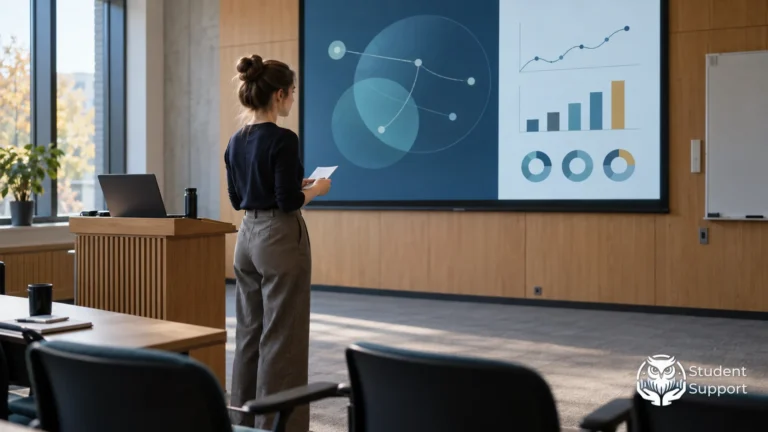
Bachelor’s and master’s thesis defence presentation - what should go on the slides?
A bachelor’s or master’s thesis defence presentation should show what you did, why you chose that approach and what you found. You do not need to put every chapter on the slides. First, check your programme’s time limit and presentation rules, then choose material that makes your contribution clear. A bachelor’s or master’s thesis defence presentation should show what you did, why you chose that approach and what you found. You do not need to put every chapter on the slides. First, check your programme’s time limit and presentation rules, then choose material that makes your contribution clear. Gather the final thesis text, presentation requirements and any university template. Check the time limit, permitted file format and required title-slide details. A presentation may form part of the examination, but whether and how it is used depends on your programme’s rules. A general guide cannot replace them. On a separate sheet, write one sentence: ‘In my thesis, I examined, compared or developed...’. Complete it in your own words. If this is difficult, return to the aim and conclusion. The sentence will help distinguish essential information from details you can leave out of a short talk. Piotr Wasylczyk’s guide treats presentation preparation as choosing a purpose, organising material, design and delivery. This division is a reminder that finishing the file does not complete the preparation: you still need to rehearse how you will present it. Below is an original six-slide outline for a talk with an illustrative seven-minute limit. This is not a required structure or compulsory slide count. If your faculty expects a different arrangement, follow the rules provided. Include the title, author and details required by your university. In your talk, identify the thesis problem. Do not read the entire title page aloud or start with a long story about choosing your degree programme. Show the main question and the limits of the work. Explain what you analysed and what lay outside the scope. For an empirical thesis, you can identify the most important research question; you do not need to reproduce the complete list of specific objectives. Present the...
2026-10-15
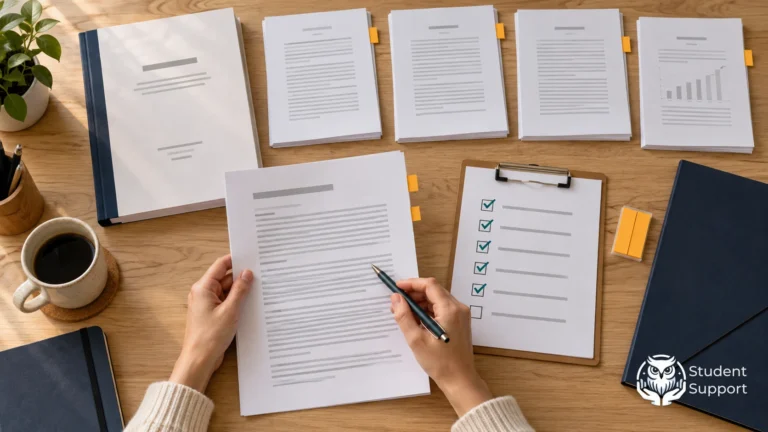
How to check a bachelor’s or master’s thesis before submission: audit and checklist
When checking a bachelor’s or master’s thesis before submission, start with its substance and completeness. First, check that you address the aim and provide material supporting your conclusions. Then review sources, language and file layout. This order avoids polishing paragraphs that still need restructuring. When checking a bachelor’s or master’s thesis before submission, start with its substance and completeness. First, check that you address the aim and provide material supporting your conclusions. Then review sources, language and file layout. This order avoids polishing paragraphs that still need restructuring. A thesis audit is a structured diagnosis: what needs improvement, why and where to start. Receiving a list of comments does not mean the document has been revised. When commissioning a check, agree whether it covers assessment of specified areas, comments on the text or subsequent revisions as well. Keep a copy of the document. Gather the current university guidelines, approved outline, supervisor feedback and material underlying the analysis. Record the name of the file to be checked. If some chapters are in other documents, combine them or state their order unambiguously. Note unresolved issues separately: a missing source, an unclear comment or calculations awaiting verification. These are easy to miss once draft markers have disappeared from the finished file. Also mark the sections already accepted so the revision plan respects earlier agreements. Open the introduction, contents page and conclusion side by side. Write one sentence stating what the thesis was meant to establish. Then identify the passage giving the answer. If you must search across several disconnected places, the argument may need reorganising. A theoretical, review-based or design-based thesis also needs a clear outcome. Do not add a survey merely to make it resemble empirical research. Check whether your approach to comparing sources, analysing a case or evaluating a solution can answer the questions posed. For chapters that repeat content or head in different directions, use the guide to organising your thesis structure. The final check is primarily about identifying these problems and prioritising them. Not every problem needs the same response. The original example below illustrates how to organise comments....
Page 1 of 5