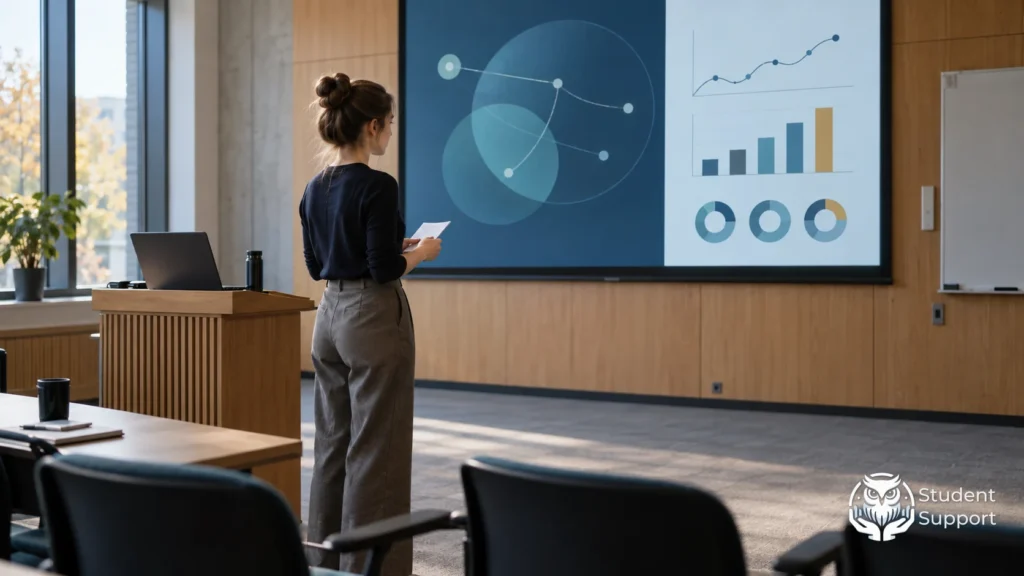
A bachelor’s or master’s thesis defence presentation should show what you did, why you chose that approach and what you found. You do not need to put every chapter on the slides. First, check your programme’s time limit and presentation rules, then choose material that makes your contribution clear.
Where should you start when preparing your defence presentation?
Gather the final thesis text, presentation requirements and any university template. Check the time limit, permitted file format and required title-slide details. A presentation may form part of the examination, but whether and how it is used depends on your programme’s rules. A general guide cannot replace them.
On a separate sheet, write one sentence: ‘In my thesis, I examined, compared or developed…’. Complete it in your own words. If this is difficult, return to the aim and conclusion. The sentence will help distinguish essential information from details you can leave out of a short talk.
Piotr Wasylczyk’s guide treats presentation preparation as choosing a purpose, organising material, design and delivery. This division is a reminder that finishing the file does not complete the preparation: you still need to rehearse how you will present it.
What should go on the slides? An example presentation outline
Below is an original six-slide outline for a talk with an illustrative seven-minute limit. This is not a required structure or compulsory slide count. If your faculty expects a different arrangement, follow the rules provided.
Title and starting point – about 20 seconds
Include the title, author and details required by your university. In your talk, identify the thesis problem. Do not read the entire title page aloud or start with a long story about choosing your degree programme.
Aim and scope – about 50 seconds
Show the main question and the limits of the work. Explain what you analysed and what lay outside the scope. For an empirical thesis, you can identify the most important research question; you do not need to reproduce the complete list of specific objectives.
Material and approach – about 60 seconds
Present the sources, study group, case analysed or design assumptions. Select information needed to assess the results. Naming the calculation software does not replace explaining which data and methods you used.
Main result – about 90 seconds
Choose a finding or solution that addresses the aim. It might be a clear chart, a comparison using shared criteria or a design diagram. Add a sentence explaining its significance rather than displaying several pages of results.
Interpretation and limitation – about 90 seconds
Explain what conclusion the material supports. Identify a limitation that actually affects interpretation. A study of one group does not automatically describe the whole population, and comparing two solutions does not prove one superior in every setting.
Addressing the thesis aim – about 60 seconds
Finish with the main finding and any application supported by the work. Do not add new data. The final slide should help listeners remember the thesis’s central point, including if a discussion follows the talk.
This allocation gives about six minutes and ten seconds of speaking time, with fifty seconds to spare. Test it in rehearsal; it is not a recommended pace for everyone.
How do you adapt slides to the type of thesis?
For an empirical thesis, show how the aim, research approach, selected findings and conclusions connect. Do not include every survey question. If you use percentages, state the response count they are based on. For clear presentation of results, see the guide on analysing and presenting survey results.
For a review-based or analytical thesis, present the source material and comparison criteria instead of describing respondents. Choose an example showing what the comparison of positions establishes. A list of publications read does not by itself present the analytical outcome.
For a design-based thesis, explain the need, assumptions, solution developed and how it was evaluated. Separate what you completed from planned extensions. Bachelor’s and master’s theses do not automatically need two different slide sets: the structure follows from the content and presentation rules.
How do you present content without overloading a slide?
Instead of pasting in a paragraph, ask what listeners should see and what you can explain aloud. A heading can identify a specific issue, such as ‘Comparing two ways of organising consultations’, rather than the generic ‘Analysis’. A diagram of the criteria and a finding supported by the thesis material may be enough underneath.
Keep any required university template. If the format is flexible, choose a consistent background, clear contrast and readable labels. View your chart from a distance: the legend and values should be legible without zooming in. Credit images and cited findings in the required style.
Do not create the appearance of a result by changing a chart’s scale or omitting some responses. A presentation simplifies the form of communication, but the figures, meaning and limitations must remain consistent with the thesis.
How do you shorten the presentation and prepare your spoken text?
Add a short explanation in each slide’s notes: what you show, why it matters and how it leads to the next section. You can prepare a full script for practice, but check whether you can say the same thing without reading every sentence.
An original example of a slide note
On the slide: ‘Criteria for comparing consultation arrangements: availability, response time, contact method’.
What to say: ‘I compared both approaches using the same criteria. This distinguished consultation availability from the contact method itself. On the next slide, I will show what the material analysed revealed.’
This illustrates how to structure a talk; it is not an actual research finding. Use it only after adapting it to what you really analysed.
If you exceed the limit, remove secondary examples and repeated explanations. Do not speed up the whole talk to fit in too much material. A difficult issue may need more time than a simple title slide.
How do you rehearse before the defence?
Zabielski and Godlewski emphasise rehearsing aloud and checking that slides work on the intended equipment. Silently reviewing the file does not reveal how long your explanation will take.
- Run through the entire presentation with a timer and note where you lose your thread.
- Compare the figures, names and conclusions with the final thesis version.
- Open the file in the intended environment; check fonts, charts and supplementary material.
- Prepare a backup copy and a PDF if that format is permitted.
- Practise explaining your choice of material, method and the main limitation of your work.
Have a finished thesis but struggle to choose slide content? I can help develop the structure, design and agreed speaker notes. The scope of work on the whole document is also set out in the description of the service “Bachelor’s and master’s thesis writing”.
Questions about preparing a presentation
What should a presentation for a bachelor's or master's thesis defence include?
Check your degree programme's requirements, then select the information that explains your research problem, objective, material and approach, main findings, conclusions and limitations. Adapt the structure to your type of thesis: a theoretical thesis does not need a slide about respondents if the study did not involve them. Do not copy every chapter onto the slides. Your slides and spoken presentation should explain what you actually did and what you found.
How many slides do I need for my thesis defence, and how do I fit them into the time available?
First, determine the time and presentation requirements for your field of study. There is no single number of slides suitable for every defence. Prepare the key points, conduct a timed rehearsal, and remove secondary examples and repetitions if you exceed the limit. Leave time for transitions and calm explanation of difficult elements; simply reading faster does not solve an overloaded presentation.
Can you help create a university presentation from scratch?
Yes. We can develop the content, slide order, and consistent graphic design for a presentation for classes, a seminar, or a defence. We will use the instructor's instructions, provided sources, and your materials. Before starting, we will agree on the number of slides or presentation time, file format, and the scope of additional elements. You can also provide a draft presentation for expansion or improvement.
Can I order a presentation together with speaker notes?
Yes. We can agree on a presentation with speaker notes or a script. We tailor the amount of content to your time limit and topic. If you also need a seminar paper, report or project description, both materials can form part of the same agreed order. Speaker notes and any additional document are included in the quote before work begins.
Bibliography
- Wasylczyk, P. (2017). Prezentacje naukowe. Praktyczny poradnik dla studentów, doktorantów i nie tylko. Warszawa: Wydawnictwo Naukowe PWN.
- Zabielski, R., Godlewski, M. M. (2011). Przewodnik prezentowania informacji naukowej. Warszawa: Szkoła Główna Gospodarstwa Wiejskiego, Katedra Nauk Fizjologicznych, Wydział Medycyny Weterynaryjnej.