Your report is due in six weeks, but your calendar contains just one task, “do the research”. Alongside the interviews, you need time to prepare the recordings for analysis, analyse the material and write. A research project timeline should cover that whole process. Build it backwards, from the completed report to the preparation for your study.
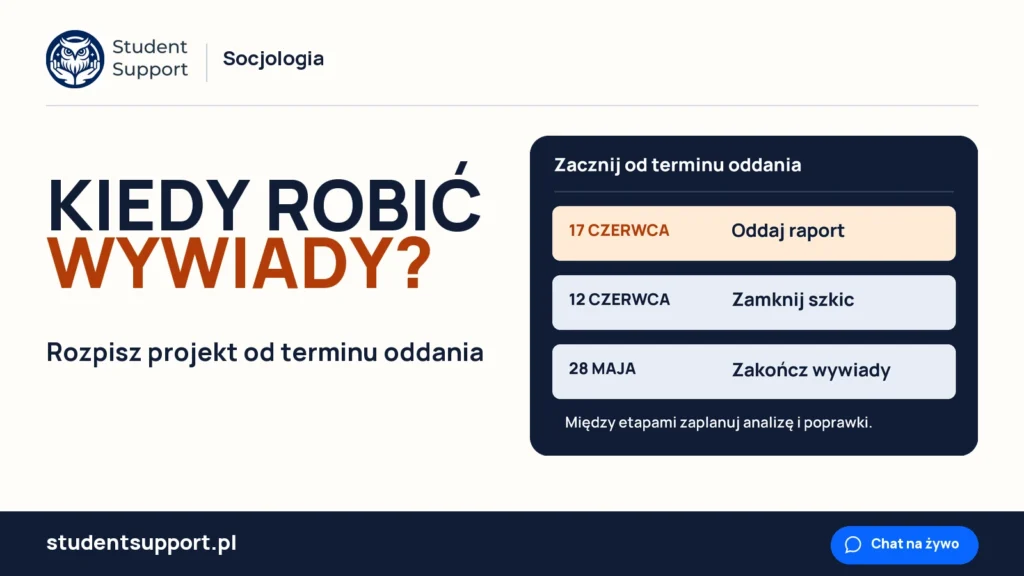
Start by writing down three dates. The first is the submission deadline, the second is the date for a complete draft of the report, and the third is the latest safe date to finish collecting material. Specific tasks need to fit between them, along with time for corrections. The date of your last interview alone does not tell you when your material will be ready for analysis.
We will work through a fictional project by a sociology student in Poland. It concerns barriers to attending classes and includes six interviews and a report for course assessment. The numbers, dates and illustrative findings explain how to plan. They are not the results of a real study or the requirements of a particular university.
First, check what you actually have to submit
Before dividing the work into weeks, open your lecturer’s instructions, the course syllabus and any feedback you have received. Check whether assessment requires a research proposal alone, a completed study and report, or a presentation as well. These are three different scopes of work. A document describing future interviews does not need the same timetable as a report based on interviews already conducted.
Describe the required outcome in one simple sentence. In our example, it is “On 17 June 2027, I will submit a report on a small qualitative study, presenting the research question, participant selection, how the material was processed, the findings and the limitations”. The requirement to produce a report is part of the fictional assignment. You need to establish the length, appendices and any presentation requirements for your own course.
A useful reference is the description of “Preparing and conducting a research project” in the University of Warsaw course catalogue. It distinguishes planning, implementation, analysis and drawing conclusions, and a final stage covering research outputs. This shows why the timetable should extend all the way to the report. However, the organisation and assessment rules of that course apply to those particular classes, not to all degree programmes.
For your assignment, also note who approves the topic and research instrument, whether a consultation is planned, and how the work should be submitted. If your lecturer’s answer could change the scope, that consultation needs to take place before recruitment. Waiting until after the interviews may leave you with material that does not meet the assignment.
Separate agreed decisions from ideas. The number of interviews and the inclusion of complete transcripts are not automatic requirements. Mark any unconfirmed decisions as needing agreement.
Narrow the question before estimating the time
The topic “students’ problems” is too broad to plan a small study for course assessment. It does not tell you whom to interview, which experiences to ask about or what the report should contain. Even a very detailed timetable cannot resolve that gap. First, you need a question that the material you can collect will allow you to answer.
In the fictional example, the question is “How do students in one year group on a full-time programme describe situations in which paid work, commuting and their daily schedules make attending classes difficult?”. We are interested in their experiences and how they deal with difficulties. We are not trying to calculate the proportion of absent students across the university or evaluate individual lecturers’ work.
The project includes six interviews with adults from two class groups in the same year. We plan to include four people in paid work and two who are not currently working. This distinction is intended to capture different situations, but it does not make the sample representative. Nor does it justify claiming that we have covered every possible experience. The number of interviews must fit the purpose, course requirements and realistic capacity.
Each interview is intended to last around 35-45 minutes. The interview guide focuses on specific situations from recent weeks, their circumstances and the actions taken. We do not add a separate investigation of mental health, family finances or opinions about the entire education system. Those topics may matter, but researching them properly would require different preparation and a wider scope.
Write down the project’s boundaries too. In this case, we decide against a supplementary questionnaire, comparisons between several universities and a second round of interviews. This does not mean those ideas have no value. Within the time available, one coherent study needs to reach the report stage. If the course requires more, we change the plan in agreement with the lecturer rather than quietly removing parts of the assignment.
Count the hours you actually have
Six weeks does not mean six weeks free from other commitments. Put tests, work, commuting and obligations you cannot move into your calendar. Only then mark out time for the project. Two hours after a tiring shift may be enough to organise files, but not necessarily to compare several interviews carefully.
In our example, the student can find 70 hours between early May and mid-June. They are not evenly spread. Longer blocks are needed during interviewing and preparation of the recordings, so some other activities are moved in advance. This is a condition of this particular plan being feasible, not a suggestion that every student should have that much free time.
The initial time budget is as follows.
- Agreeing the scope and requirements takes 2 hours.
- Preparing the interview guide and participant information takes 3 hours.
- The pilot, discussion and revisions take 2 hours.
- Recruitment and arranging interviews take 3 hours.
- Six interviews of up to 45 minutes each total 4.5 hours.
- Preparing for meetings and writing post-interview notes take another 3 hours.
- Preparing working transcripts of six recordings is expected to take 12 hours.
- Checking the transcripts and removing identifying details are allocated 3 hours.
- Comparing the material and developing the findings take 8 hours.
- Writing the complete report takes 10 hours.
- The final check and preparation of the file take 3 hours.
This totals 53.5 hours. Of the 70 hours available, 16.5 hours remain as contingency time. Some of that time belongs to earlier stages, so do not save it all for the day before submission. Check the estimate for preparing recordings after the first interview. Sound quality, the pace of speech and the level of detail required can increase it considerably. If the pilot shows that the planned blocks are insufficient, revise the budget straight away.
Do not confuse working time with waiting time. Sending an invitation may take a few minutes, but replies can arrive several days later. Recruitment therefore needs space in the calendar even when it accounts for a small share of the total working hours. Similarly, a half-hour consultation may need to be arranged a week in advance.
Build the timeline backwards from the submission date
The final deadline in the example is 17 June 2027. That day is for submitting a checked file and confirming that it reached the right place. We do not assume that the final interview will still be awaiting analysis on the evening before submission. A complete text that can be read as a whole is needed earlier.
The full draft should be ready on 12 June. We set aside 13 and 14 June to check the argument, the accuracy of quotations against the material, and compliance with the assignment. The day of 15 June remains available for an identified gap or an unexpected delay. The final file is prepared on 16 June. This is a specific allocation of work in our calendar, not a universal number of days for revision.
Since the main report-writing period is 7-11 June, the main findings need to be organised by 6 June. By 31 May, the material should be prepared and checked sufficiently for analysis. The last planned interviews therefore take place on 28 May. That date follows from the time required for the subsequent tasks, rather than a wish to end contact with participants as quickly as possible.
Recruitment runs from 12 to 19 May. Before that, on 11 May, we test the interview guide in a pilot. The period of 6-10 May is for agreeing the scope, preparing materials and obtaining the necessary agreements. If your course requires additional approval or a particular ethics procedure, start it earlier as appropriate. This example does not assume it can always be completed in a few days.
- 17 June
- Submit the checked file and confirm it was received.
- 12 June
- Complete the full draft so there is time to review and revise it.
- 28 May
- Finish the interviews. Allow time to prepare, check and analyse the material.
Leave time between milestones to work with the material and handle delays.
The fictional project calendar from 6 May to 17 June
- 6-10 May. An agreed research question, report scope, interview guide and approach to handling data.
- 11 May. A pilot, an assessment of interview and recording preparation time, and revisions to the research instrument.
- 12-19 May. Recruitment, sharing information and confirming appointments.
- 20-28 May. Six interviews, with material prepared after each successive conversation.
- 29-31 May. Completing transcript checks, organising the material and removing identifying details.
- 1-6 June. Comparing accounts, examining differences and developing the findings.
- 7-11 June. Writing the findings section and combining it with the method and limitations.
- 12 June. A completed full draft of the report.
- 13-14 June. Checking content, quotations, sources and compliance with the assignment.
- 15 June. Contingency time for corrections that could not be anticipated.
- 16 June. The final version and a check of the file.
- 17 June. Submitting the report and checking that it was received.
Some dates can overlap. An analytical note is written after the first interview, and the method section can be started before interviewing ends. However, not every task can be reordered. A sound account of the complete set requires familiarity with the remaining material.
Give every stage a condition for completion
The task “analysis from 1 to 6 June” is still fairly vague. It could mean careful reading, colour coding or completed conclusions. Add an answer to the question of how you will know that the stage is finished. You do not need a complicated management system. One sentence beside each major task is enough.
For preparation, completion means that the question, participant selection and interview guide are consistent and the required agreements have been clarified. For recruitment, you have confirmed interviews with people who meet the criteria, rather than just invitations sent. For an interview, you have the material, a post-interview note and a record of the arrangements for its use.
Preparation of a recording is only finished when the file can be analysed safely and meaningfully. An automatically generated text that nobody has checked against the audio is insufficient. In the example, important passages need checking, errors that alter the meaning need correcting, and interview identifiers need to be consistent. The detailed approach to the transcript depends on the method adopted.
Analysis is ready for writing when you can identify the supporting material, differences between cases and limits of interpretation for every main finding. A collection of striking quotations alone does not meet that condition. A full draft means a text with all its sections complete, even if it still needs editing. Passages marked “add findings here later” are still unfinished work.
At a consultation, you can then say that you have four prepared interviews, two confirmed appointments and an initial comparison of accounts of commuting. This description makes it easier to establish what is urgent and whether the scope needs to change.
Allow time for recruitment refusals and rescheduling
Start recruitment only when you know whom you are inviting and what you can explain clearly to them. In the example, the criteria include being an adult, being in the specified year group and having experiences related to class attendance. Paid employment status helps diversify the interviewees. We do not ask for employment documents or attendance records, because they do not serve the purpose of this small study.
The invitation should state the topic, approximate duration, voluntary nature of participation and contact arrangements. An interested person needs to understand the request before reserving a time. Being in the same student group does not mean agreeing to a research interview. Do not treat silence as confirmation either.
We include a recruitment review on 16 May. This is an early decision point, not the date for closing the list. If only people in employment have come forward by then, we check whether our way of reaching people is overlooking others. A general invitation can be repeated through an agreed channel. Do not publicly disclose who has already been invited or who declined.
By 19 May, we want six confirmed appointments and the option of offering an interview to two additional interested people if a place becomes available. We do not promise them a meeting we do not intend to conduct. We explain that we may contact them if availability changes. If more people volunteer, we apply the selection criteria agreed earlier rather than choosing only our closest friends.
The first interviews are planned for 20 and 21 May, the next for 24 and 25 May, and the last for 27 and 28 May. The day of 26 May remains a possible alternative date for one meeting. Combining this gap with a manageable pace of interviews makes it easier to prepare material as we go. A cancellation then does not immediately have to delay the entire report.
Consent and secure handling of material belong in the calendar
Ethical matters need to be addressed before collecting data. The Polish Sociological Association’s “Code of Ethics for Sociologists” calls for voluntary, informed consent and separate, explicit consent to recording. It also emphasises privacy and secure storage of material. These are ethical guidelines, not a substitute for your university’s requirements or an individual legal assessment.
In the example, participants receive understandable information about the study before the scheduled meeting. At the start of the interview, there is time for questions and confirmation of the agreed arrangements. We explain audio recording separately. We do not start recording on the assumption that consent can be obtained later. If someone does not want to be recorded, the next steps must be agreed rather than imposed.
The timeline includes setting up storage, controlling access and establishing how contact details will be kept separate from research material. Removing a name is not always enough, because an account of an unusual situation can reveal someone’s identity. In a small student group, combinations of details also need care. Setting aside time to check them reduces the risk of inadvertently including them in the report.
Before starting, agree with the lecturer how to explain withdrawal arrangements to participants and what will be possible at each stage. Do not promise the technically impossible removal of a passage after irreversible anonymisation. Nor should you impose a deadline that removes participants’ entitlements. The arrangements must match how the project is actually conducted and the applicable requirements.
In this study, we do not collect other people’s absence lists or details about particular lecturers. If an interviewee starts giving names, we can remind them that our interest is in situations and experiences. This reduces the later work involved in protecting the material. It does not remove the need to check it carefully before using quotations.
Let the pilot change the plan if it reveals a problem
A pilot is a trial run to check whether the research instrument and the study arrangements work. In our calendar, it takes place on 11 May. Beforehand, the participant needs an explanation of what the trial involves and how their material will be used. We do not automatically assume that the pilot interview will count as one of the six main interviews. Including it depends on the conditions being consistent and on the rules adopted.
After the trial, the student checks whether the questions lead to accounts of specific events. “Does the university make studying difficult for you?” may turn the conversation into a general evaluation. “Tell me about the last time you found it difficult to get to class” produces a different kind of material. This is a decision that affects both the quality of the interview and later analysis.
We also check the time. If the interview lasted 70 minutes, we need to establish why. Perhaps the guide covers two separate topics, questions are repetitive, or the interviewee needed longer to describe events. We do not mechanically cut every answer short just to make the calendar work. First, we improve the scope and the way the interview is conducted.
A second test is preparing a section of the recording. Twenty minutes of work on five minutes of audio means that, in this trial, preparation takes four times the recording’s duration. It does not prove that all material will always require exactly that much time, but it helps expose an unrealistic estimate. At a similar pace, six interviews of 45 minutes each would require around 18 hours of work on the transcripts alone.
That exceeds the planned 12 hours. Check how much contingency time you can use before analysis begins and how much will remain after the change. If necessary, agree a narrower interview scope, reserve an extra working block or choose another preparation approach allowed by the assignment. Keep time for checking the material.
If the planning stage already shows that your question, number of interviews and deadline do not fit together, it is worth organising the project before recruitment. For the Research projects service, you can provide course instructions, a working timeline and an interview guide. The context of your degree subject, Sociology, helps focus the discussion of scope on the nature of your study. Do not send other people’s contact details or recordings unless you have established grounds for sharing them.
Do not leave all the interview material until the end
After every interview, reserve a short block for a note. Record the interview conditions, technical issues and initial observations that may help make sense of the material. Separate what the participant said from your own assumption. “The interviewee described a change to their work rota” has a different status from “they are probably most worried about their manager’s reaction”.
In the example, the interview on 20 May is assigned the identifier R01. The recording, transcript and note all use the same label. Details allowing you to contact the person remain separate, in line with the agreed protection arrangements. A consistent system reduces the chance of quoting the wrong interview in the report or losing track of which file version was checked.
The first block for preparing R01 falls on 21 May. Subsequent material is prepared on the days following each interview, allowing for the hours available. For the interview on 28 May, the main preparation block may fall on 29 May. The days of 30 and 31 May remain for completing checks and organising the whole set. This schedule needs to be checked against actual commitments, not just entered into an empty calendar.
How material is prepared depends on the purpose of the analysis. A study focusing on the content of experiences does not always require every feature of speech to be transcribed. An analysis of how the conversation unfolds may be different. Set the standard before starting so that you do not prepare the first three recordings according to different rules from the rest.
Technical decisions about transcription itself are discussed in more detail in the guide on preparing an interview for a dissertation. Here, the key issue is their effect on the timeline. Each chosen level of detail requires time, and the material must be ready before the stage of analysis that needs it.
You can begin preliminary comparisons once the first interviews have been prepared. This does not mean settling on an interpretation before reading the rest. A note after R01 may suggest that clashes with work are important. A later interview with someone who is not working may reveal an equally important commuting problem. The plan should allow that first impression to be tested.
Plan analysis as a series of decisions
In the example, we allocate eight hours to analysis between 1 and 6 June. This is not eight uninterrupted hours of “thinking about the findings”. First, the whole set needs reviewing, then passages related to the question need marking, followed by comparison between cases. Finally, we check whether the proposed findings are actually supported by the material.
On the first day, we read the notes and prepared interviews, marking passages about specific barriers and responses to them. Working labels might include “work rota change”, “long commute”, “gap between classes” and “finding cover”. These are codes, short labels that help locate similar passages. We do not immediately treat them as complete explanations.
In later blocks, we compare the circumstances in which each difficulty arises. A long commute alone may be manageable with a fixed timetable, but become a problem when a class time changes. Similarly, paid work does not necessarily lead to absence in every situation described. In the fictional material, we therefore also look for cases that complicate our initial assumptions.
One illustrative finding might be “In the interviews described, difficulties increased when participants faced overlapping commitments scheduled at times they could not change themselves”. To write this in a real report, you would need to check it against all the relevant accounts. In our example, it only demonstrates the move from labels to interpretation.
For every working finding, write down three things. Identify the interviews and passages that support it. Then add differences or exceptions. Finally, state what the material does not allow you to say. You cannot establish the scale of a phenomenon across a university from six purposively selected interviews. Nor can you treat a cause described by an interviewee as an independently verified fact.
At this point, a separate block for returning to the recording or the full context of an account is useful. A quotation taken from a longer answer can suggest something different from the conversation as a whole. A timeline allowing only for choosing and pasting quotations leaves no time for this check. We therefore use part of the eight-hour analysis budget to check interpretations.
Start writing before the analysis feels completely polished
You do not need to wait until June to open the report file. The question, justification of the scope and a working method description can be written earlier. After the study, they need to be updated to reflect what actually happened. If six interviews were planned but five were conducted, the text must say five. Do not leave a future-tense proposal in the report as though it described completed research.
From 7 to 11 June, the main task in the calendar is writing the findings section and bringing everything together. First, set out a brief order for the findings. For each one, note which question it answers and what material illustrates it. Only then develop the paragraphs. This makes it easier to spot two planned sections covering the same point or one without enough support.
A passage from the fictional report might begin like this. “The interviews pointed to the importance of several time constraints coinciding. Participants described difficulties particularly when a change in class time overlapped with a fixed work rota or a commute dependent on infrequent transport connections. The material also included situations in which advance notice made it possible to avoid a clash.” This illustrates paragraph construction, not content to attribute to real participants.
In a real report, that introduction should be followed by discussion of specific accounts and the differences between them. A quotation does not do the analysis for the author. You need to explain what it shows in relation to the question, without assigning it wider significance than the context allows. If a passage is merely decorative, it is better to remove it than to lengthen the report with more similar accounts.
Allow separate time for limitations. In our project, these concern the small purposive sample, one year group, the recruitment method and reliance on participants’ accounts. If the invitation circulated mainly among friends, that also affects the material. Describing limitations is not a formality added at the end. It helps readers understand how the findings can be used.
The link between planning and practical implementation is also visible in the description of “Methods of Social Research” at Jagiellonian University. The course refers to applying methods and techniques when planning and conducting a project. Simply naming techniques in a report does not show how they were actually used. However, always check the detailed requirements for your own course.
Decide in advance when to change the scope
The budget contains 16.5 hours of contingency time, distributed between recruitment, recording preparation and checking the report. After using some of those hours, recalculate the work that remains. If four hours went on a difficult recording, 12.5 hours remain available for other events.
The first decision point is 16 May. If there is insufficient interest, we change how we reach people while keeping to the agreed criteria. The second is 25 May. If only two interviews have taken place by then and the remaining appointments are uncertain, the feasibility of the whole plan needs reviewing. Putting four interviews on the last day does not resolve the problem of preparing the material.
The changes available depend on the lecturer’s requirements. You may agree a narrower question, a smaller report scope or a different deadline. You must not present invented interviews as conducted or fabricate missing accounts. Do not replace interviews with a questionnaire without agreement simply because it is quicker to distribute. Changing the technique affects the question and the kinds of answers you can obtain.
The third checkpoint is 31 May. If two recordings are still unsuitable for analysis, the delay is now measurable. Check whether the problem concerns time, sound quality, access to files or an undefined preparation standard. Each situation requires a different response. A general promise to “work faster next week” does not explain how you will recover the missing hours.
Record each change with its date and reason. A short note is enough to say that, on 25 May, an interview was moved to 26 May because the participant cancelled, while the analysis plan remained unchanged. If you change the scope, also record who agreed it and what it means for the report. This record later makes it easier to describe how the study actually proceeded.
Check the completed report in two separate passes
The days of 13 and 14 June are for two different checks. First, we read the report for substance, from the question to the conclusions. We check whether the method description matches what was done, whether every main finding is supported by material, and whether limitations have been omitted. This is the time to improve the meaning, not just the punctuation.
In the second pass, we check quotations, references, the bibliography, appendix labels and the required format. If the text says that interview R04 illustrates a commuting problem, we return to the right material. If the report refers to an appendix, we check that it is present and contains only the permitted data. These elements need a calm review, which is difficult while still adding findings.
Before submission, work through a short checklist.
- The research question in the report matches what was actually studied.
- The number of interviews, dates and description of selection agree with the documentation.
- Findings are separated from assumptions and do not make unsupported claims about the whole university.
- Quotations preserve the meaning of the accounts and do not reveal unnecessary details.
- Sources cited in the text appear in the bibliography.
- Required sections and permitted appendices are complete.
- The file opens correctly, and its name and submission method follow the instructions.
On 17 June, we check that the report has actually been sent or saved in the required place. Preparing the file is not the same as submitting the work. If the system provides confirmation, keep it in the way accepted on your course. Do not leave the first submission attempt to the last few minutes. Time for technical problems should not depend on whether anything is left after intensive writing.
A good plan makes the next step clear
Once a week, compare the material completed, the tasks remaining and the hours available. Adjust the plan to your actual working pace. Stalled recruitment needs attention before the date of the last interview.
One concrete step is enough for today. Write down the submission deadline, the full-draft date and the latest date for finishing data collection. Then fit analysis, preparation of the interview material and report checks between them. If those tasks do not fit, revisit the scope before starting recruitment. This is the easiest point to avoid a project in which material exists but there is no time to use it properly.
If you need help turning course requirements into a workable plan, prepare your lecturer’s instructions, the submission deadline and a short description of what you already have. You can include your own interview guide or an anonymised extract from a working report, if sharing it is permitted. When contacting us about the Research projects service, explain whether the problem is the research scope, the order of work, preparing the material or editing the full text. This makes it possible to discuss a specific assignment and its conditions without promising a grade or assessment outcome.
Questions about planning and preparing a research project
How does a research project differ from the research section of a thesis?
A research project is a standalone assignment, for example for a course or seminar, with its own scope set out in the instructions. The research section of a thesis must also fit the thesis topic, theoretical framework, outline and other chapters. This work is covered by the service Thesis research section: methodology, results and discussion. If the task is an essay, seminar paper or semester paper, explore the service Coursework and essays. The choice depends on what needs to be produced, not just the name of the task.
Does the service cover interviews and open-ended questions?
Yes, the scope can include organising participant accounts, coding, identifying categories or themes, and describing them with examples from the material. I adapt my approach to the chosen qualitative method and the thesis research questions.
What does preparing a university research project involve?
I prepare the agreed work for a standalone class or seminar project. Before data collection, this may be a research proposal covering the objective, research questions, methods, a research instrument and an analysis plan. If data have already been collected, the work may include a report on how the research was actually carried out, its results and conclusions. I agree on the required sections, calculations and file formats after reading the assignment. Not every project needs all these elements.
Can I order a research project before collecting data?
Yes. I can prepare a proposal for a planned study: the objective, research questions and justified hypotheses, material selection, methods, a research instrument and a plan for subsequent analysis. The document sets out the study design and how the research will be conducted. Results can only be described once real data have been obtained. I agree on access to data and the research arrangements before accepting the project.
What should I send for the analysis of interviews in a sociology thesis?
Send anonymised transcripts, the interview guide, the aim and research questions, and a description of participant selection. Include the adopted analysis method and the supervisor's comments, if you have them. Based on this, I will determine the scope of organising themes, summarising statements, and editing the chapter.
What should I send for a quote?
Provide your topic, subject area, type of thesis, stage of preparation and required deadline. Describe what needs to be prepared, checked or revised. Attach the current document, university guidelines and any comments from your supervisor.
For research support, include your research outline, survey or interview guide and the data you have collected. For editing that addresses text similarity, attach your JSA report if you have one. You don't need every document before asking about the scope of support.
Sources and literature
- University of Warsaw, ECTS course catalogue, “Przygotowanie i realizacja projektu badawczego” [Preparing and conducting a research project], course code 3402-10PRPB. Used to distinguish stages of the research process without extending local assessment rules to other courses.
- Jagiellonian University, USOSweb, “Metody badań społecznych” [Methods of Social Research], course code WFz.KPSC-8293. A source showing the link between methods and the practical planning and implementation of a project.
- Polish Sociological Association, “Kodeks etyki socjologa” [Code of Ethics for Sociologists], adopted on 25 March 2012. A source for principles concerning informed, voluntary participation, recording, and the protection of participants and material.
The calendar example, time budget and illustrative findings are original teaching material. They do not describe a real study and do not replace the lecturer’s instructions.
Need to refine the scope of your research project?
Describe the topic, the required report and the material you already have. Include the deadline and say whether you need help with planning, the interview guide, analysis or editing.
Contact StudentSupport