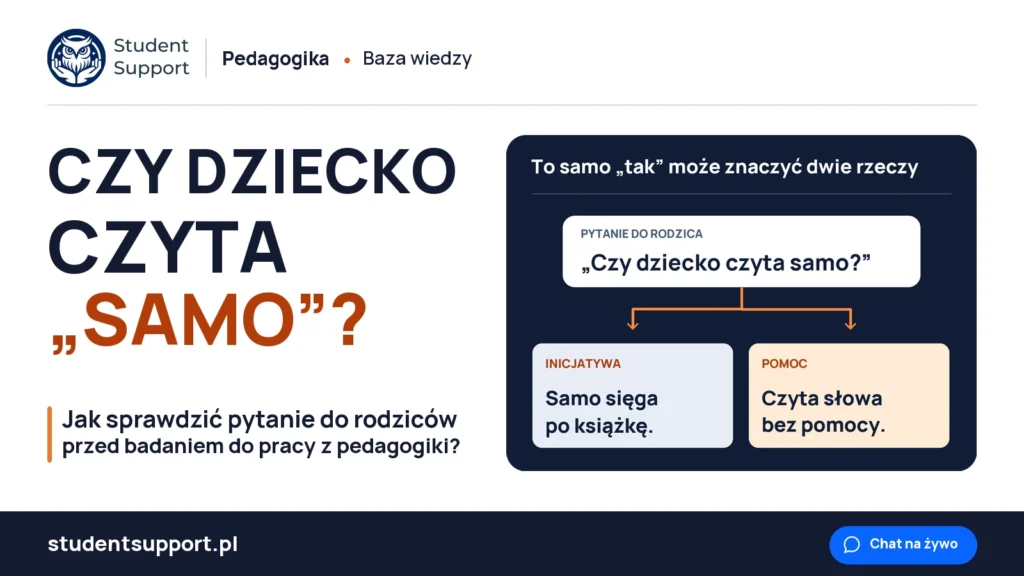
A parent selects “yes” for the question “Does your child regularly read books independently?”. For the questionnaire's author, this means reading without reminders. The parent may instead mean that the child decodes the words without help, even though an adult encourages the child to pick up a book. The form accepts the answer, but the two people give it different meanings. Before the main study, it is worth examining this path from reading a question to selecting an answer.
An in-depth check of one question can include discussing its meaning, recording a difficulty, explaining a revision and checking the new version. Simply asking whether the questionnaire is clear is insufficient. You need to know which situations the parent recalled when answering and what determined the choice. This material can help you improve the instrument without attributing thoughts to participants that they did not express.
We will work through one example for a dissertation in the field of “Pedagogy”. The questions and possible interpretations are a demonstration, not findings from completed interviews or a validated scale. We will show how to prepare a record, distinguish starting to read from receiving help with reading, and describe the work completed in the methods section. Fields that require actual data will remain to be completed after the study.
What are you checking when you examine one answer?
In an ordinary questionnaire preview, you see the wording and available options. In a cognitive test, you also examine what the participant did with that wording: how they understood it, what information they searched for in memory, how they assessed the situation and how they matched it to an answer. A question can be grammatically correct yet require knowledge the parent does not have. It may also combine two characteristics that cannot honestly be assessed with one “yes”.
A cognitive interview is a way of collecting information about these difficulties. A discussion with your supervisor or sending a form to friends does not automatically constitute one. The participant should have experiences similar to those addressed by the planned question. If the questionnaire is intended for parents of children of a particular age, a fellow student's comments may help with wording, but they cannot replace checking how the intended respondent answers.
In Polish research developing educational instruments, these activities have been distinguished from subsequent psychometric studies. Wiejak, Krasowicz-Kupis and Błaszczak described checks of parents' understanding of items, recall difficulties and access to information during work on the Educational Prediction Scale. The implication for our task is limited: examining the response process can reveal a need to revise a question. It does not establish the properties of an entire questionnaire developed by its author.
First decide what “independently” is meant to mean
Before inviting a parent, write down the purpose of the item. In our example, the author wants to describe parent-reported situations in which a child starts reading a book outside school assignments without an adult's reminder. This is a narrow range of observed events. It is not the child's overall reading motivation, intention or ability to decode text correctly. Changing this scope requires a decision about the aim, rather than simply polishing one word.
The word “independently” may direct attention towards several different issues. A child may choose a book but ask for help with a difficult word. They may read fluently after a parent's reminder. They may also say that they want to read without actually starting. Each piece of information describes a different aspect. A shared label will not later reveal which aspect the parent assessed unless you distinguish them in the question itself.
Record three boundaries before testing:
- Initiating reading means, in this example, starting to read without an adult's reminder; how respondents identify such a situation still needs to be checked.
- Help with decoding concerns another person's involvement in reading the text and does not establish who suggested reading.
- A child's intention or desire is not directly visible; a parent may know what the child said or offer an interpretation, but that is different from observing the start of reading.
If your dissertation genuinely concerns children's intentions, a parent questionnaire may be insufficient. You need to explain why this informant and this type of data can address the research problem. Adding an instruction asking parents to answer carefully cannot repair an unsuitable information source. At this stage, you may already conclude that the research question needs narrowing or that another method should be considered before finalising the instrument.
Prepare an item record before the conversation
Create a separate record for the question you intend to check. Preserve its exact wording and options, even if you already suspect a problem. Label the initial draft version 1.0. A date and version number help distinguish what the participant actually saw from wording revised after the conversation. Do not overwrite the old wording in your only file, as this removes the basis for explaining what the comment concerned.
Write the item's purpose in your own words in the record, without giving that explanation to the participant before they answer. If you first explain that independence means no reminders, you may obtain an answer consistent with your explanation rather than information about how the original question works. During testing, distinguish the wording the parent will see from the researcher's notes used to evaluate it.
A minimal working record can include:
- The item identifier, version, date and position in the questionnaire.
- The complete question, instructions and every response option.
- The information the author seeks and the limits of its interpretation.
- Planned neutral follow-up questions after the initial answer.
- Space for an actual record of statements and the response process.
- The decision following analysis, its rationale and the scope of the next check.
An item does not operate in isolation. Record its immediate context, such as a preceding instruction about reading outside school assignments. If the main study places the question after a block about homework, this context may affect its interpretation. Testing a sentence removed from the form does not fully explain answers within the whole questionnaire. The material you retain should allow someone to reconstruct the testing conditions.
How do you begin without turning it into an exam?
Explain that you are checking the question and how it works. You are not assessing the parent or the child's abilities. Make clear that doubts, difficulty recalling a situation and the absence of a suitable option are useful information too. Someone invited to help may want to please the author. A calm explanation of the purpose and avoiding praise for a “correct” interpretation therefore matter for the quality of the information collected.
Present the question in a format close to the one planned. First let the parent read and answer without your explanation. Record the selected option, any uncertainty raised or any request for clarification. If the parent asks what “independently” means, you need not immediately remove the difficulty. You can first ask how they understand that word in this sentence. This uncertainty is itself part of the issue under examination.
You can ask participants to comment on their thinking or ask questions after they answer. In our example, the record is easier to organise if a first choice is followed by brief probes about understanding, the situation recalled and how the option was selected. Do not combine the approaches without considering the consequences. If you supply a definition during the answer and later describe the result as a spontaneous interpretation of the original sentence, your intervention becomes obscured.
Agree participation conditions, how the conversation will be recorded and how material will be handled before starting, in line with the project's rules. Limit information identifying the family. Distinguish verbatim statements from your summaries; without an exact record, do not reconstruct quotations from memory.
Two possible interpretations of the first version
Version 1.0 reads: “Does your child regularly read books independently?”. To make the demonstration clear, suppose the author has provided only “yes” and “no”. This already combines regularity and independence, leaves the period unspecified and offers no way to express uncertainty about the parent's knowledge. Before calculating anything, establish what the person answering could actually have answered.
Consider hypothetical interpretation A: “independently” means that an adult does not read the text for the child. A parent might select “yes” while recalling evenings when they reminded the child to read but did not help with decoding. This answer does not address the item's stated purpose. It provides information about assistance in performing the activity, whereas the author wanted to identify starting it without a reminder.
In hypothetical interpretation B, the focus is on picking up a book on the child's own initiative. A parent might also choose “yes”, although they subsequently helped with several words. The spreadsheet would contain the same code as in A, but it would concern a different behaviour. Analysing the column alone cannot recover a distinction that was never recorded. This is why explaining a choice matters when testing a question, rather than merely obtaining matching final answers.
These are invented analytical paths, with no information about how frequent these interpretations are. An actual record must contain participants' statements and observations from the conversations. The demonstration must not be presented as a pilot study that was carried out.
What can a parent know from direct observation?
A parent does not see every situation in which a child reads. They may be in another room, return from work after the reading has finished or know about an event only from someone else's account. Even precise wording cannot remove this limitation. During the conversation, check the source of the answer: observation, a conversation with the child, information from another carer or a general belief about the child's habits.
Do not assume that all indirect information is useless. What matters is whether it fits the project's purpose and whether you can identify its source. If the aim is to describe parents' accounts of reading, you can study such accounts with appropriate limitations. If you intend to report an exact number of occasions when reading started independently, an observer's absence may undermine the feasibility of obtaining that information through a single retrospective question.
Be particularly careful about inferring intention. Starting to read without a reminder may indicate a specified behaviour, but it does not by itself reveal a motive. The child may have picked up the book for enjoyment, out of obligation or because a plan had previously been agreed with a parent. If the parent says “they wanted to read”, ask what information supports that assessment. Do not turn the parent's interpretation into a confirmed psychological state of the child.
Similarly, not observing the start does not mean that the child never started reading. The options and later account must accommodate the limits of the informant's knowledge. Sometimes it is more sensible to ask about situations the parent knows about or narrow the period to time spent together. Such a change must still fit the research question and be recorded, because it changes the scope of the data collected.
Identify the kind of difficulty before revising the sentence
One participant comment may concern different stages of answering. “I don't know what to select” does not yet tell you whether the problem concerns a term, memory, assessment of an event or the options. Instead of immediately proposing simpler wording, establish where the difficulty occurs. This helps avoid a revision that sounds better but leaves the actual obstacle in place or introduces another change in meaning.
You can provisionally distinguish these problems in the record:
- Understanding: the parent reads “independently” as no help with decoding rather than no reminder.
- Scope: they include compulsory school reading, although the project concerns reading outside assignments.
- Recall: they cannot retrieve situations from an unspecified period or determine their frequency.
- Knowledge: they did not observe the reading and lack the information needed to answer.
- Matching: they remember different situations, but “yes” and “no” cannot express that variation.
These labels help organise notes, but they are not ready-made study findings. For each, identify the evidence: a statement, a participant's question or an observed response process. If you cannot determine whether the parent cannot remember something or never knew about it, retain that uncertainty. Do not make a statement more categorical merely so that every entry in the record fits into a single box.
Also distinguish a problem with a question from a difference in experience. One parent may never give reading reminders and another may do so often, while both understand the sentence identically. That may be a substantive difference in answers. A cognitive problem arises when they answer different meanings, cannot access the required information or cannot find a way of conveying it. Improving a questionnaire is not meant to make the answers identical.
Version 1.1: ask about starting to read if that is your aim
After analysing possible difficulties, the author can prepare version 1.1: “On how many days in the last seven days did your child start reading a book outside school assignments without a prior reminder from an adult?”. This remains a draft requiring testing. It replaces unspecified regularity with a defined period and selects one behavioural aspect.
The response unit becomes a day, rather than an individual start. Two episodes on Monday count as one day containing the event. Decide whether this is the information you need. If the research problem concerns the number of all episodes, version 1.1 does not serve that purpose. Counting days may make answering easier, but convenience does not justify changing the measured characteristic without recording that decision in the study design.
Version 1.1 narrows the behavioural question but does not give access to intention. A suitable later account would refer to reported days when reading started without a reminder. It must not be replaced with a statement about the number of children motivated to read. Even if the chapter concerns motivation, one item does not become a complete measure of it merely because it fits the dissertation's topic.
If the focus is help with reading, you need a different item
Now suppose a discussion with your supervisor leads to a different decision: you are interested in an adult's involvement in decoding the text. You would then stop developing version 1.1 as an initiation measure. Prepare a separate item about help and record that it addresses a different question. A child can start reading without a reminder and receive assistance. There is no reason why one fact should exclude the other.
A draft question could read: “During the last occasion when your child read a book while you were present, did another person help them decode words?”. Adapt the options and instructions to what you count as help. The question concerns the last observed situation, rather than the whole week. Do not compare its answers with the number of days in version 1.1 as though they were two versions of the same variable.
During testing, examine the boundaries of help. A parent may think of supplying a word's pronunciation, taking turns reading, explaining meanings or arranging a quiet place. Some of these actions extend beyond decoding words. The decision about what to include should follow from your aim and theoretical basis. Do not determine the meaning after collecting data by selecting whichever produces a more interesting distribution of answers.
The example illustrates two legitimate design routes but does not recommend automatically adding both questions. If help is unrelated to the research problem, collecting this information may be unnecessary. If both aspects matter, retain them as separate pieces of information, each with its own response basis. Clarifying scope is part of questionnaire preparation, not an obligation to expand the form to cover every phenomenon connected with reading.
Match the options to what can actually be established
For the number of days in version 1.1, a range from zero to seven seems natural. Adding eight numbers is insufficient, however. The parent may know about some events without being able to establish a total for the entire period. Decide whether the form should allow an answer indicating insufficient information. In this example, “0” would mean no reported days with the specified event, rather than the parent's absence or inability to remember the week.
Also check whether the participant understands the counting rule. After their answer, you can ask how they handled a day with two reading situations. Do not explain this rule only to selected individuals during the main data collection. If the instruction is necessary for answering, it should be part of the instrument and tested with the question. Otherwise, different participants will receive different support in interpreting it.
Neutral probes versus prompting the desired answer
A probe should help you understand an answer, rather than persuade a parent to adopt your interpretation. “You meant reading without encouragement, didn't you?” supplies the expected direction. Similarly, praise such as “that's exactly what I meant” can lead later comments to align with the author. The participant need not know which answer is convenient for the researcher; they should be able to describe their own process without being judged.
Prepare brief, open follow-up questions:
- “What did the expression used in this question mean to you?”.
- “What situation did you think of when answering?”.
- “How did you work out the number of days?”.
- “Was there any information you needed to answer but did not have?”.
You do not have to ask every probe mechanically of every person. If a parent has already explained the counting process in detail, repeatedly asking about it may add nothing. Retain the same main areas of examination, however, so that you can compare the material later. Record additional probes and occasions when you supplied an explanation. Do not present an answer following such an explanation as independent confirmation that the question is clear.
An explanation is not always prohibited. It may be needed to finish the conversation or examine a new proposal. Mark the transition: first understanding without assistance, then discussion of alternative wording. If the parent agrees after a suggestion, this tells you about their response to that explanation. You still do not know whether someone seeing the revised form for the first time would independently give it the intended meaning. That is what retesting addresses.
From a statement to a decision: how do you complete the record?
Separate the material from its interpretation in the record. In the first field, enter an actual account of what the participant said or did. In the next, explain the problem you identify. Only then propose a revision. This allows someone reading the documentation to check whether the decision follows from the material or merely from the author's preference for a shorter sentence. Do not merge these layers into a note saying “question unclear”.
For hypothetical path A, a demonstration entry would work as follows: the material to collect concerns the parent's explanation of “independently”; a possible problem is interpreting it as no decoding assistance; the consequence would be a mismatch with the aim concerning starting to read; the proposed decision is to specify starting without a reminder within a defined period. This is a reasoning framework, not a completed record from an interview that took place.
Every decision should identify what was retained, what changed and what remains unknown. You may remove “regularly” but still not know whether seven days is a suitable period for participants. You may distinguish initiation from help yet still need to assess whether the questions fit the child's age. “Revised” does not settle these issues. Good documentation also shows what remains to be checked.
- Initiative
- The child picked up the book. They may have needed help afterwards.
- Assistance
- The child read the text unaided. An adult may have suggested the book.
- Decision
- Choose the event that fits your aim and ask someone else to explain the revised item in their own words.
Record what prompted the change and what happened when you tested it again.
Retesting: check the new version without explaining it first
In this task, retesting means checking how the revised question works. It does not mean calculating a scale's stability over time. You want to know whether the revision removes the identified difficulty without creating another. Before starting, record what the new wording should achieve: distinguishing starting from help, using one period and counting days rather than individual episodes. Do not record the response option you expect the parent to choose.
If you return to the same person, remember that they know the earlier conversation and the author's intention. They may correctly explain version 1.1 because of your previous explanation. Returning can help assess their response to a revision, but it has different limitations from a first encounter with the item. Testing with someone who has not heard those explanations may reveal difficulties an earlier participant no longer encounters. Describe recruitment and the procedure accurately.
During the new check, retain the way the question is presented and the main probing areas. Ask about the situation, counting rule and source of knowledge. Check whether the parent still shifts attention towards reading technique or the child's intention. Also watch for a new recall burden: a defined period may organise an answer, yet accounting for each of seven days may be too detailed for someone who did not observe the reading.
Record the retest material against its particular version and conditions. Possible decisions include retaining the item for further development, revising it again, abandoning it or reconsidering measurement. You are not obliged to secure approval for every item. If the informant cannot access the information required, further wording changes may merely conceal the problem. In that case, an honest decision changes the design rather than declaring success.
What if comments differ and the decision is unclear?
Comments need not form a single consistent message. Some parents may readily recall events, while others rely on a general impression. Examine whether the difference concerns observation conditions, the child's age or the question's context. Do not automatically treat the majority view as proof of clarity. Even one case may reveal a logical gap, but it cannot estimate how frequently that gap occurs in the population.
Compare what comments mean for the aim. Adding an explanation may improve understanding while also suggesting socially desirable behaviour. Shortening the period may reduce recall demands but describe an unusual week. For each alternative, identify the benefit and cost for the information collected. The decision is not simply about finding the most elegant sentence or adding every suggestion participants make.
When a decision remains open, record the reason and the next step. This might be a further check of an ambiguous term, discussing scope with your supervisor or moving from a single retrospective question to another information source. Do not write “no issues” when the problem was actually unresolved. That would remove important information about the instrument's limits and make an accurate later methods account harder to produce.
How do you describe the completed work in the methods chapter?
The description should allow someone to reconstruct what actually happened. Specify the checking aim, participant selection, the actual number of conversations, the versions tested, probing areas and how comments were recorded and analysed. There is no single compulsory sample size for every project. Numbers in articles about particular instruments are not automatically requirements for your dissertation. Justify the scope in relation to your task and limitations.
The following is a template to complete after the activities: “Before the main study, [actual number] conversations were conducted with [participant selection criteria] to examine understanding of selected items in the author's questionnaire. After participants answered, questions addressed the meaning of expressions, situations recalled, information sources and selection of an option. The material was recorded using [actual recording method] and organised according to [areas of analysis actually applied]”.
The next part could read: “In item [identifier], [specific revision] was introduced because of [documented difficulty]. Version [identifier] was then checked using [actual retesting procedure]. This informed [actual decision], with a remaining limitation concerning [unresolved uncertainty]. The main study used version [number and date]”. Every field requires your own material; do not fill it with the story from this guide.
If no retest took place, remove the claim that it did and identify the limitation. If the draft was only discussed with your supervisor, describe that consultation. If conversations were unsystematic and no notes were retained, do not reconstruct an apparently complete procedure afterwards. You can state what happened without giving it a greater evidential scope. A careful account documents the work, rather than creating the impression that every possible stage was completed.
What does piloting one question not establish?
Checking understanding does not establish a scale's reliability, the validity of every conclusion or the sample's representativeness. It cannot tell you what proportion of all parents would understand the question identically. Nor do several consistent comments establish that an item measures reading motivation. Assessing an instrument's properties requires procedures and analyses appropriate to its construction and intended use. There is no single shortcut from a clear sentence to a validated scale.
In the Polish ARHQ adaptation described by Bogdanowicz and her co-authors, cognitive interviews were one stage alongside other development work. For our example, the important point is that these tasks are separate. We do not transfer ARHQ findings or reproduce its procedure as a ready-made recipe. An original item about a child's reading does not acquire that questionnaire's properties by using a similar checking technique.
Keep versions and separate trial material from the main study
Store the original question, the revised proposal and the version adopted for the study separately. Assign every set of comments to the appropriate version. A conversation date alone is insufficient if the form changed within a day. This organisation makes it possible to identify which wording an answer concerns and whether information based on different meanings has been combined. This matters especially when moving from “yes/no” to a number of days.
Cognitive test material diagnoses how a question works. Do not automatically add it to the main survey dataset. Participants may have received probes, explanations and successive versions that others never saw. This changes the response conditions. Any planned use of trial data requires justification and transparent reporting. Saving a few forms is not enough to establish their comparability with responses from the main study.
Before launching the main form, revisit the whole design. Check that instructions, question version, options and analysis plan remain consistent after the final revision. The guide on preparing a questionnaire for your own research explains the general route from the aim to the instrument. In this task, the key is retaining a trace of one decision: what you want to know, what the parent understood and what was actually checked after the revision.
Reviewing the item before submitting the questionnaire
Read the final question as a parent seeing it for the first time would. Do not mentally add definitions that exist only in your notes. Then compare it with the aim written before testing. If the aim concerns initiating reading but an answer can still concern decoding assistance, work on meaning is unfinished. If you ask about behaviour, a later conclusion should not introduce an unmeasured intention.
Before adopting the version, check:
- Does the item concern one specified aspect with a justified connection to the research problem?
- Does the parent know which situations and period to include without an extra explanation from the interviewer?
- Have starting to read, decoding help and an intention attributed to the child been distinguished?
- Do options allow a lack of the necessary knowledge to be expressed rather than forcing a substantive answer?
- Does the record separate actual statements, interpretation and the revision decision?
- Does retesting describe the new version and disclose any influence of an earlier explanation?
- Have remaining uncertainties been retained without calling the test full validation?
- Does the methods chapter describe only completed activities and the correct questionnaire version?
The practical result is a coherent set: a question with a clear purpose, a record tracing the revision and an accurate methods account. You do not need to show that every initial proposal was good. You need to explain why one was revised, another retained for further checking and another abandoned. These decisions help you write an honest methodological section and preserve the limits of later conclusions.
Questions about piloting and reviewing a questionnaire
Does piloting a questionnaire mean the instrument has been validated?
No. Trial completion can help check question comprehension, response options and form operation. It does not automatically establish all measurement properties. Report what the pilot actually covered and the resulting changes; do not call it full validation without appropriate studies.
What should a research instrument description in a thesis include?
State the instrument’s name and origin, purpose, language version, structure, response options and scoring rules. Explain its conditions of use, checks performed and limitations. Describe the questionnaire actually used rather than a revised version created afterwards.
How do you adapt the questionnaire to the respondent group?
Please send a description of the group your survey is intended for and the research aim. I adapt the wording of the questions, response options, demographic questions and instructions to the participants and the way the survey will be conducted. I take the planned respondent group and method of collecting responses into account when preparing the instrument within the agreed scope.
Can the objective be changed after the survey is prepared?
Yes, but you must check the consistency of the new objective with the questions and planned analysis. Before starting the research, this may mean improving the tool. After collecting data, possibilities are limited by what was actually measured. Do not add findings that the data does not allow you to obtain.
Can I request a review of just the questionnaire?
Yes. Please provide the questionnaire, the topic, the objective, the research questions, and information about the target group. I will check whether the questions allow you to collect the necessary information and whether the instrument is consistent with the research assumptions.
What will I receive when I commission a research questionnaire?
The agreed scope may include questions, response options, instructions, participant background questions and routing, as well as notes on how the questions relate to the research design. I provide the material in the agreed format for further checking and discussion with your supervisor. Collecting responses and analysing the results are not automatically included in questionnaire preparation.
Sources
- Augustyńska, U. (2011). Pytania ankietowe – rzemiosło czy sztuka? Prace Naukowe Akademii im. Jana Długosza w Częstochowie. Pedagogika, XX, 233-240. Scope used: unambiguous questions, their assumptions and shared understanding between author and respondent. Full text: https://bazhum.muzhp.pl/media/files/Prace_Naukowe_Akademii_im_Jana_Dlugosza_w_Czestochowie_Pedagogika/Prace_Naukowe_Akademii_im_Jana_Dlugosza_w_Czestochowie_Pedagogika-r2011-t20/Prace_Naukowe_Akademii_im_Jana_Dlugosza_w_Czestochowie_Pedagogika-r2011-t20-s233-240/Prace_Naukowe_Akademii_im_Jana_Dlugosza_w_Czestochowie_Pedagogika-r2011-t20-s233-240.pdf
- Wiejak, K., Krasowicz-Kupis, G., Błaszczak, W. (2016). Trafność Skali prognoz edukacyjnych jako narzędzia do przesiewowej diagnozy specyficznego zaburzenia uczenia się czytania i pisania. Edukacja, 4(139), 5-25. Scope used: pp. 11-13, examining item understanding, information availability and parents' response difficulties; distinction between qualitative development and psychometric piloting. Full text: https://jbc.bj.uj.edu.pl/Content/409144/PDF/4-1-wiejak-i-in-skala-prognoz-edukacyjnych.pdf
- Bogdanowicz, K. M., Wiejak, K., Krasowicz-Kupis, G., Gawron, N. (2015). Ocena przydatności kwestionariusza Adult Reading History Questionnaire do diagnozy rodzinnego ryzyka dysleksji w Polsce. Edukacja, 1(132), 117-138. Scope used: pp. 126-127, cognitive interviews as a separate stage in developing the Polish adaptation. Full text: https://jbc.bj.uj.edu.pl/Content/409095/1-8-bogdanowicz-i-in-ocena-przydatnosci-kwestionariusza-arhq.pdf
Prepare a questionnaire aligned with your research aim
If parents may understand your question differently, send your dissertation topic, research questions, draft questionnaire and retained testing comments. At StudentSupport, we can help define the scope of preparing or revising questions, instructions and options suited to your planned study. Include your supervisor's requirements and identify the activities already completed.
Tell us what the problematic item is intended to describe and whether its revised version has already been checked.