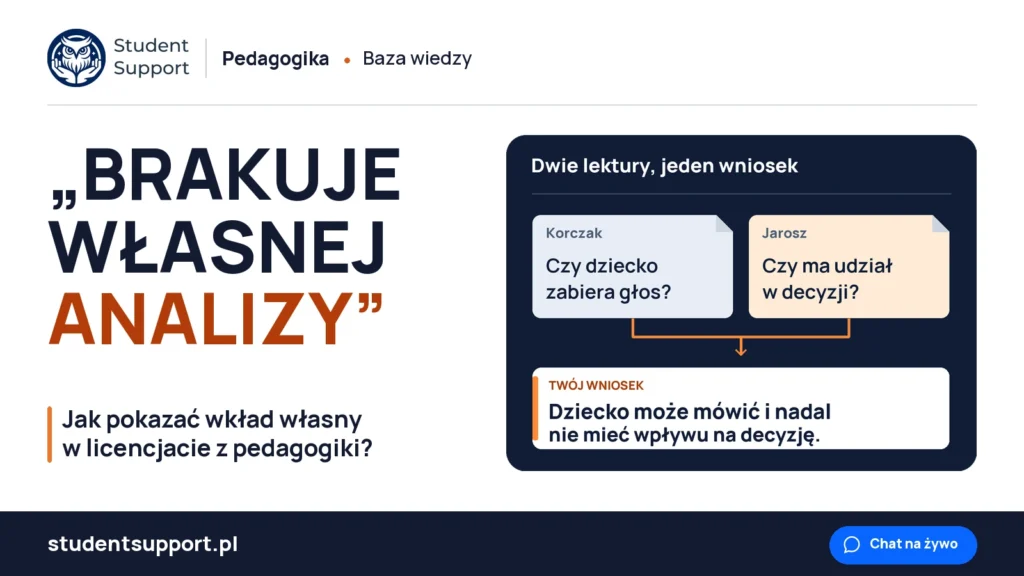
You have an approved topic for a literature-based thesis, publications you have read and several pages of writing. Yet a comment beside the chapter says: “Your own analysis is missing.” This does not automatically mean you must add a questionnaire or invent a new theory of education. Start with one passage. Write down the question you are answering, the basis on which you compare the sources and the conclusion that follows. These three points make it easiest to check whether the text reveals the work you have done.
Your own contribution to a bachelor's thesis in pedagogy can become visible through a justified selection of material, its organisation, comparison of positions and careful reasoning. Rewriting somebody else's idea in different words does not by itself achieve this. You need to explain why you bring these particular passages together and what the comparison helps readers understand. The scope of independent analysis must match the agreed type of thesis and the requirements of your programme and supervisor in Poland.
We will work through a thesis example in the field of “Pedagogy” concerning children's participation in decisions. We will use a text by Janusz Korczak and a 2020 article by Ewa Jarosz. The thesis-writing situation is an exercise, while the publications are real. You will follow successive decisions: refining a question, selecting criteria, drafting a passage of analysis and drawing conclusions. These readings will not be used to establish how particular schools actually operate.
What might your supervisor mean by a missing contribution?
A comment about missing independent analysis often concerns what the text does. One subsection describes one author's views, another describes a second author's views, and the ending repeats that the subject matters. Readers learn what the publications contain but cannot see why you have placed them together. Before adding more pages, check whether you can identify the problem connecting the summaries. If the only connection is the broad term in your thesis title, you need a clearer analytical task.
However, do not assume that every such comment means the same thing. The issue might be a missing comparison, conclusions that are too broad, an unexplained choice of literature or a plan that does not address the topic. At your next meeting, show a specific passage and ask which operation is missing. Establishing whether you need to compare assumptions, analyse concepts or better justify your material gives you a basis for revision. A general promise to “add more personal reflections” does not identify what needs changing.
Your contribution does not have to appear in a separate chapter with that title. It can emerge through the way the whole thesis proceeds, from its question and selection of texts to the final answer. Check the structural requirements in your programme's guidance. If a separate account of the method is required, explain the analytical approach there. In the analytical chapter itself, demonstrate how you used it. A statement about independent work in the introduction cannot replace the comparison you promised to carry out.
Also distinguish independence of the work from novelty across the entire discipline. You can independently construct a sound comparison without claiming that nobody has compared these authors before. If you have not checked the full literature, do not describe your analysis as the first of its kind. What matters when evaluating a passage is whether readers can follow the reasoning, whether the sources support the claims and whether the conclusions fit the material. A claim of a breakthrough is unnecessary.
First establish which type of thesis has been approved
A literature-based thesis and a theoretical chapter preceding a questionnaire serve different purposes. In the former, publications may provide the main material for analysis. In the latter, they prepare the ground for questions and a study whose results will appear later. Removing the questionnaire from an existing plan does not automatically produce a complete theoretical thesis. You still need to establish which problem the literature analysis addresses, how you will conduct it and what result should justify the conclusion.
The 2025 guidelines of the Faculty of Pedagogy at Kazimierz Wielki University describe a critical literature review as a separate form of project within a bachelor's seminar. They indicate the need to justify the source selection and the limits of the analysis. This is an example of an arrangement adopted by a particular institution. It does not mean that every programme must accept an identical project. Your own degree requirements and agreed scope apply, rather than an arbitrary plan found online.
The Institute of Pedagogy at the University of Wrocław presents its own forms of bachelor's and master's theses on its graduation guidance page. Its detailed description of a theoretical master's thesis appears separately from the bachelor's forms. This distinction matters when collecting guidance: read the heading above a requirement, the level of study and the programme name. Do not transfer a master's description to a bachelor's thesis simply because both documents mention literature, analysis and conclusions.
Before revising, therefore, write a brief working agreement. What type of thesis has been accepted? What constitutes its material? What result is it intended to produce? Where will you describe your procedure? If any point is unclear, prepare a proposal and discuss it with your supervisor. Do not retrospectively add a procedure you did not follow. Agreement between the plan, the actual work with sources and its description allows independence to be assessed much better than elaborate names for methods.
One example: from authors' biographies to a question about decisions
Imagine a working topic about children's participation in matters affecting them. The initial plan has a chapter on Janusz Korczak, a chapter on contemporary participation and a concluding section on the importance of respect. This arrangement may help you start gathering material, but it does not yet show what you seek in both readings. You could fill it with accurate summaries and still fail to answer a shared question. Authors' names would then organise your notes rather than your argument.
Narrow the task to this question: “How do the selected texts present the role of children's voices in decisions affecting their lives?” This is a working question for the exercise, not a ready-made topic approved for every university. It requires identifying who speaks about children's needs, what role adults are given and which type of participation is described. It does not require establishing how many teachers put these proposals into practice. Answering that would require different material.
The first text is Korczak's “Prawo dziecka do szacunku”, in the open Wolne Lektury edition based on a 1948 publication. The second is Jarosz's 2020 article “Ewolucja dyskursu o partycypacji społecznej dzieci”. These are not two reports on the same population. They differ in when they were written, how they argue and what they set out to do. That is precisely why you must identify what you are comparing. We are interested in how children's participation is presented, rather than ranking the authors' effectiveness.
Also record what the exercise excludes: Korczak's entire body of work, all contemporary discourse on participation, the current procedures of every school and the results of implementing a particular solution. Two readings suffice here to demonstrate a writing operation, but they are not a complete bachelor's bibliography. In a real project, the corpus size and scope of searching should follow from the question and the thesis requirements. The number of sources alone does not guarantee comprehensive coverage.
How can you select material without deciding the conclusion in advance?
Your justification for choosing a text should explain what it contributes to your question. In our example, Korczak allows us to examine criticism of decisions made over children's heads and the significance of their experience. Jarosz's article supplies contemporary distinctions for describing social participation. It is not enough to say that the first author is well known and the second text is newer. Those features help identify the publications but do not explain their task within the analysis.
First read the complete text and note passages that may not fit your initial idea. Selecting only sentences containing the word “respect” might cause you to overlook discussion of self-organisation, cooperation or adults' responsibilities. The question guides the search, but it must not become a reason to reject everything that complicates a convenient conclusion. Check the context before and after each passage. Similar wording alone does not prove that the authors describe the same relationship.
Explain the restriction to selected texts. You may analyse a particular work and one problem-focused article if that suits the exercise's purpose. Do not present that selection as an exhaustive review of pedagogy. In your thesis, record where you looked for material, which types of publication you considered and why some were left outside the scope. The description must concern actions you actually took. Do not add database names merely to make the search sound more substantial.
After an initial reading, you may discover that the chosen material cannot address an important part of the question. You then need to decide whether to narrow the question, add literature or change the basis of comparison. Keep a note explaining the change. This records work on the project rather than a defect in it. A problem arises when you replace missing support with a confident-sounding sentence or select only another text that confirms a conclusion already written.
Develop criteria that genuinely allow the texts to be compared
A criterion is a specific question you ask of each reading. The first in our exercise is: “Who is credited with knowledge of children's needs and experience?” The second is: “What role does a child's statement play in adults' actions?” The third is: “Does the discussion concern an individual, or children as a group as well?” These three questions form our working analytical framework. We do not call it a ready-made Korczak model or a measurement instrument developed by Jarosz.
Check whether both texts support an answer to each criterion. If one reading offers no basis for an answer, record that the analysed passage leaves the matter unresolved. Do not turn this into a claim that the author rejects that possibility. Silence in one text does not automatically express the author's position as a whole. The question may concern something that this publication does not address. Sometimes that difference between the texts' functions is itself an important limit of the comparison.
The criteria should reveal distinctions rather than give three names to the same evaluation. “Respect”, “a positive approach” and “good treatment” can easily produce similar accounts. Questions about who can speak, who responds and how this relates to a decision are more useful. The purpose is not to replace the language of pedagogy with a technical form. It is to identify a passage supporting your answer and explain the scope of that answer.
Test the framework on a short selection before organising the whole chapter around it. If your notes for every criterion are identical, the criteria probably need refining. If each question applies to only one author, you may be comparing two separate subjects. You can justify changing the criteria through reading, but should not conceal the change. The final methodological description must reflect how the comparison actually developed, including any substantial narrowing of the initial idea.
- Question
- What does listening to a child mean in each text?
- Comparison
- Check who speaks and whether their voice can affect the decision.
- Conclusion
- Name one difference you can trace to the two texts.
Claims about what a school actually does require evidence of its practice.
How can your notes make your own decision visible?
For every important passage, record four things: its location, the meaning of the statement, the criterion assigned to it and the limit of your interpretation. The location may be a page in a specific edition or a numbered paragraph in an electronic edition. Do not invent a page for an online text. In our example, Wolne Lektury provides paragraph numbers, while Jarosz's article has numbered journal pages. This lets you return to the exact passage supporting your comparison after editing.
A note on Korczak can identify paragraph 18 as criticism of decisions about children made without asking their views. For the role of experience, paragraph 163 is relevant to knowledge of one's own life and cooperation. Your commentary should explain why these passages address our question. However, do not attribute a description of a contemporary school consultation procedure to Korczak. Selecting these paragraphs does not establish such a claim.
In Jarosz's article, note page 25 alongside the distinction between manifestations of participation: information, expressing opinions, evaluating actions and taking part in organising matters. In a separate field, explain how you will use that distinction. It can help check whether your analysis has equated simply allowing someone to speak with influence over a decision. That is the function assigned to it in our comparison. It does not mean the author studied the particular school situation you use as an example.
Visually separate the source note from your proposal. Labelled fields such as “what the text establishes” and “my interpretation” are enough; you do not need complex software. If you copy a sentence verbatim, mark it as a quotation in your notes immediately. Later polishing of unmarked extracts makes it easy to confuse your wording with somebody else's. Well-prepared notes support independent work while allowing you to check whether a paraphrase preserves meaning and which source an idea belongs to.
Three distinctions when analysing children's voices
Being heard does not explain what happened to the statement
First distinguish the opportunity to speak from what happens to that contribution afterwards. In an invented classroom situation, children might be asked how they want a shared space arranged, yet the decision is then made without reference to their answers. Alternatively, adults might explain which proposals were included and why others were not accepted. These describe different actions. The example helps organise concepts but is neither a school observation nor a finding on the effectiveness of consultation.
When comparing the texts, therefore, ask about the function assigned to a statement as well as its presence. Korczak's criticism of deciding over children's heads justifies attention to their perspective. Contemporary analysis of participation forms helps break this issue down into more detailed questions. Your own step is to explain why “the child was asked” does not fully describe the relationship between expression and decision in the example under discussion.
An adult's response and shared decision-making are separate issues
Next identify the scope of influence. An adult may respond carefully to an argument while retaining the final decision. They may also give some decisions to the group or jointly establish possible solutions. Do not give each arrangement an identical name when the distinction matters to your question. This does not imply that children should make every decision independently. Responsibility and the conditions of the particular situation need separate justification.
Do not put this distinction into the authors' mouths as their shared classification. Our task is to use the passages we have read to organise the problem. Provide the appropriate reference when describing a source's statement. When presenting your own comparative conclusion, show the transition between the readings. Readers should understand that “response”, “taking into account” and “shared decision-making” serve to analyse a specific relationship here, rather than reporting results from a validated scale used with pupils.
One person's voice does not replace the perspective of a whole group
The third distinction concerns the level of analysis. Listening to one child and the participation of a group of children in organising shared matters are not the same thing. In the invented example, one person's statement may reveal an important difficulty but does not establish that the whole class shares the opinion. Equally, a majority decision does not automatically describe every individual's needs. A theoretical thesis can introduce this as a distinction in meaning without supplying imaginary voting results.
Jarosz discusses individual and collective dimensions of participation and changing emphases in the discourse. Do not present this as simply replacing an “old, bad approach” with a new one. On page 27, the author notes the continuing presence of earlier perspectives. Your own analysis can show that the two levels raise different questions about children's participation. It should retain that caution rather than create an artificial dispute merely to give the chapter a stronger ending.
What might a passage showing the author's contribution look like?
The following passage is our example of analysing the two specified readings. It does not come from somebody else's thesis. Its purpose is to demonstrate reasoning, rather than replace your comparison or the referencing style you must use. Paragraph references concern the Wolne Lektury edition, while page references concern Jarosz's article. If you use another edition of Korczak, find the locations in that edition rather than mechanically transferring the numbers.
“In the analysed passages, Korczak challenges the omission of children's views from decisions affecting them and draws attention to their knowledge of their own experience (Korczak, edition used by Wolne Lektury, paragraphs 18 and 163). Jarosz presents a broader range of participation forms, including access to information, expressing opinions and involvement in organising shared matters (Jarosz, 2020, p. 25). Bringing these perspectives together allows recognition of the right to speak to be separated from the question of how that voice is taken into account. Within this analysis, these are connected but distinct aspects of participation.”
“For the problem considered here, this means examining what happens between a child's statement and adults' decision. Saying that opinions were collected does not yet describe participation in the decision. This conclusion organises the problem: it follows from the chosen comparison of texts. It does not establish what happened at a particular school or whether a consultation format affected pupils' functioning. Those questions would require appropriately selected material on practice.”
Notice where the independent operation occurs. The first sentences reconstruct relevant points from the readings and supply references. A criterion separating two issues then appears, together with an explanation of its importance for the problem. Finally, we restrict the answer's scope. Without the middle part, we would have two summaries. Without the last part, an interpretation of literature could easily be mistaken for a school study finding. The contribution is visible in how the elements are connected, rather than in the declaration “in my opinion”.
Do not copy this construction word for word into every paragraph. One passage may develop a disagreement, another a shared assumption or a limit of the material. However, retain the ability to identify what comes from sources, what constitutes your comparison and why that step leads towards an answer. For more detailed guidance on constructing such a paragraph, see How to write a literature review for a thesis. Here, our focus is the function of analysis in the whole bachelor's thesis.
How can one comparison inform the plan for the whole thesis?
After completing the exercise, do not automatically expand one paragraph into three chapters. Return to the main question and check which parts of the answer are needed. Our example requires explaining the conceptual scope, presenting the material and rules of comparison, analysing the role of children's voices and drawing conclusions with limitations. These are functions of the text. The final number and names of chapters should follow the thesis requirements rather than a universal guidebook template.
Assign one task to each planned subsection. A part on children's perspectives may explain the basis of the first criterion. A part on participation forms may organise different ways of relating expression to a decision. A separate passage can compare individual and collective levels. If two headings lead to the same comparison and conclusion, check whether you are repeating material. A longer outline does not necessarily mean a more developed analysis.
Prepare an alignment map: the main question, supporting questions, corresponding thesis sections and intended type of conclusion. This is a working tool, not a compulsory element to publish in the thesis. It helps reveal a chapter that answers no question and a question left without material. If a new problem appears in the conclusion, return to the map and check whether you actually analysed it. Do not add an answer merely because it sounds useful.
How can you describe your procedure without inventing a method?
The procedure should make the route from readings to conclusions understandable. Present the object of analysis, scope of material, justification for selecting it and criteria for comparison. Also explain how information was recorded and interpretations checked. Not every literature-based thesis is a systematic review, and close reading does not automatically mean using every recognised form of content analysis. Agree the terminology with your supervisor and appropriate methodological literature.
In the exercise, you can describe the operations plainly: two specified texts were selected, passages concerning children's voices were read, they were compared using three explicit questions and checked again against the context of complete statements. If you did not use coding software or an independent second person's assessment, do not add those activities. If the passage selection changed during reading, explain any important change. A method should describe the work performed rather than decorate the document.
Do not present your own question framework as a validated research instrument. It organises this comparison and should be justified by its purpose. It does not automatically acquire established validity because it uses concepts from scholarly publications. A real project may require a more developed analytical approach. What matters is maintaining consistency between the approach's name, the operations described and what readers will see in the analytical chapter.
Your own conclusion, an opinion and a recommendation for a school
A conclusion answers a question on the basis of the analysis. An opinion may express a preference, but does not itself explain the basis of that choice. “I find Korczak most convincing” does not yet show a comparative result. Explain what you find convincing, in relation to which problem and why. You may not need to judge an author at all, but instead identify a shared assumption and the difference between the scope of his text and a contemporary account of participation.
In our example, a justified ending distinguishes the opportunity to speak, the way that speech is addressed and the extent of influence over a shared matter. It does not establish that a particular school meets or breaches these conditions. Nor does it establish that implementing a chosen solution will improve pupils' attainment. Such statements require sources concerning practice and effects. Replacing “proves” with “suggests” does not repair a complete lack of supporting material.
You can formulate a cautious implication for further questions. For example, when describing consultation, it is useful to distinguish collecting opinions from explaining to children how they were used. This proposes a way of analysing or documenting a situation, rather than a confirmed recipe for effective education. If your programme requires practical recommendations, explain their basis and the conditions limiting application. Separate a source-based conclusion from an idea that needs to be examined.
The thesis conclusion should not become a store for every association that emerged while writing. Return to the questions in turn, identify the points resolved and indicate what the material could not settle. An analysis may end with an important uncertainty if its origin is clear. Do not replace it with a general statement that further research is needed. Specify what type of material or comparison would be required to answer the remaining question.
What should you change in a completed chapter made up of summaries?
Choose two neighbouring paragraphs about different authors. In the margin, identify the function of each: definition, argument, context, comparison or conclusion. If both merely report content, add a question that can connect them. Then check the sources again from that perspective. Only afterwards change the order of sentences. Replacing an author's name in the heading with a problem will not, by itself, turn two independent summaries into analysis of a shared issue.
For each important claim, note which source passage you can return to. If your reference identifies only a whole book, look for a more precise basis. If your own conclusion depends on two texts, check both rather than attributing everything to the last author cited in the paragraph. Do not add an original publication to the bibliography as if you read it when you know it only through another account. Repairing attribution and developing analysis are connected but separate tasks.
Remove repetition according to function rather than word count alone. Several similar statements may be needed if they reveal different conceptual scopes. Conversely, a long quotation may contribute nothing beyond a sentence already discussed. Retain what the reasoning needs and explain the connection between passages. After revising, read only the starts and ends of paragraphs. They should let you reconstruct the route towards an answer, rather than merely the order in which books were read.
Also review the introduction, conclusion and section titles. If the revised analysis concerns selected texts while the introduction still promises an assessment of all contemporary education, the scopes are inconsistent. If the ending discusses school practice while the chapter examines arguments in literature, change the ending or agree an expanded project. Good editing covers these relationships. It does not end with polishing one passage that sounds convincing in isolation.
How can you show your supervisor a concrete improvement?
For your meeting, prepare a short set: the initial question, the refined question, a passage before and after revision and the relevant source locations. Alongside it, record what changed: a criterion was added, summaries were connected, a conclusion was narrowed or the material selection was explained. This lets the discussion focus on the analysis's correctness. Sending a longer file with the message “the independent contribution has been added” does not show where a substantive difference arose.
If your supervisor still considers the work insufficiently independent, ask about a particular decision. Are the criteria too general? Is the selected corpus too narrow? Does the comparison fail to address the thesis topic? Each comment leads to a different action. Keep the version preceding revision and a brief note of what was agreed. You do not need to turn every working decision into an extra thesis page, however. Documentation supports writing, while the final text shows the justified result.
When using editorial assistance, distinguish language organisation from substantive decisions that require your reading and agreement with your supervisor. It is possible to improve transitions, identify unclear references and help reveal the argument. It is not possible to confirm from one submitted paragraph that a whole book supports a conclusion. Checking the comparison requires the sources used, the thesis question and the conditions of the task. A precise scope of assistance reduces the risk of polishing a mistaken interpretation.
A final check: can you point to your own contribution?
Read one selected passage as though the assessor does not know your plan. Identify the question, the basis of comparison and the resulting conclusion. Then check whether readers can distinguish source statements from your interpretation. If they need a lengthy spoken explanation, part of the reasoning probably remains in your notes. Bring the necessary transition into the text instead of adding another declaration of independence.
Before submitting the thesis, check the following points:
- The thesis type and analytical approach match your programme's and supervisor's agreements.
- The question concerns material that was actually analysed.
- The source selection and limits of the corpus are justified by the purpose.
- Comparison criteria are explicit and can be applied to the specified passages.
- Your distinctions are not presented as the authors' literal models.
- References locate the basis of important claims in the edition used.
- Conclusions answer the questions without turning proposals into findings about schools.
- The introduction, outline, analysis and conclusion describe the same scope of work.
In our example, the contribution is not discovering that children deserve respect. It is the comparative work performed and justified: choosing a question about voices in decisions, distinguishing aspects of participation, reading specific passages and defining the answer's limits. Start with one passage developed in this way. When you can show what you did with the sources and why the result is justified, it becomes easier to plan the rest of the thesis revision without adding arbitrary pages.
Questions about your analysis and help with a chapter
What should I change when my supervisor says there is too much description and not enough analysis?
Check if you are only summarising successive publications. Choose a common issue and compare how authors define it, what material they work with, and what conclusions they reach. Explain similarities, differences, and the limitations of the comparison, then show their significance for your topic. Do not add evaluations without justification in the sources. For a general comment, ask the supervisor to point to one section where you can practise the change.
How does literature synthesis differ from summarising papers?
A summary presents one publication. Synthesis connects several sources around a question, showing agreements, differences and limits to comparison. It needs your own line of reasoning and identifiable citations; placing summaries one after another is not enough.
Does a theoretical thesis without a survey also have limitations?
Yes. They may concern source selection and availability, languages, dates, document comparability or the chosen perspective. Explain how these features affect interpretation. Not conducting a survey is not itself an error if the design suits the aim and programme requirements.
Are correct footnotes enough to make the text your own work?
No. Citations show where information comes from. Producing your own work also requires engaging properly with the content: understanding sources, comparing them, and clearly separating quotations from your own discussion. Simply adding a bibliography to a chapter assembled from borrowed material does not solve this problem.
Do you help with a pedagogy thesis without original research?
Yes. The scope can include the plan and chapter structure, organising the argumentation, editing the text, and improving citations and the bibliography. I will tailor the help to the nature of the work and the guidelines of the supervisor or university.
What should I send if I already have feedback from my supervisor?
Send the current version of the thesis, the supervisor's comments, guidelines, and the deadline. If the comments concern a specific chapter or results, highlight those sections. Based on this, I will define the scope of changes, the price, and the possible completion date.
Sources
- Korczak, J. Prawo dziecka do szacunku. Wolne Lektury electronic edition based on: Król Maciuś Pierwszy, Prawo dziecka do szacunku, Spółdzielnia Wydawnicza “Książka”, Warsaw – Kraków, 1948. Scope used: paragraphs 18, 144 and 163, children's views, experience and cooperation. Text address: https://wolnelektury.pl/katalog/lektura/prawo-dziecka-szacunku.html
- Jarosz, E. (2020). Ewolucja dyskursu o partycypacji społecznej dzieci. Przegląd Krytyczny, 2(1), 21-32. DOI: 10.14746/pk.2020.2.1.02. Scope used: pp. 22, 25 and 27, partnership, different participation forms and limits to contrasting perspectives. Full-text address: https://pressto.amu.edu.pl/index.php/pk/article/download/23065/21773
- Faculty of Pedagogy, Kazimierz Wielki University. (2025). Wytyczne dla Rad Kierunków do procedury dyplomowania na Wydziale Pedagogiki. Scope used: pp. 7 and 9-10, thesis forms, the critical literature review in a bachelor's seminar and justification of material selection. An institutional example, not a common set of regulations for every university. Document address: https://www.ukw.edu.pl/download/55146/Wytyczne_dyplomowania_na_Wydziale_Pedagogiki_2025.pdf
- Institute of Pedagogy, University of Wrocław. Dyplomowanie. No publication date indicated, accessed 24 November 2026. Scope used: separately presented forms of bachelor's and master's theses. Page address: https://pedagogika.uwr.edu.pl/zasady-dyplomowania/
Organise your own argument in a pedagogy thesis
If you have literature and a completed passage but struggle to identify independent analysis within it, prepare your topic, thesis question, outline, your supervisor's comment and the publications used. StudentSupport can help define the scope of support with comparing positions, structuring the argument and editing the text in line with your thesis requirements.
Tell us which type of thesis was approved and which passage received a comment about a missing independent contribution.