Your outline says “observation of pupil engagement”, yet a blank sheet leaves you wondering what to record. Start by choosing one situation and listing a few behaviours you can recognise during a lesson. Then add space for the time, context and a short note. The sheet should help you collect material for a specific question in your thesis.
If you are interested in group work, you might observe suggestions, requests for clarification and actions contributing to the shared task. Each behaviour needs a clear recording rule. Calling a pupil “active” leaves considerable room for interpretation, especially when several things happen in the classroom at once.
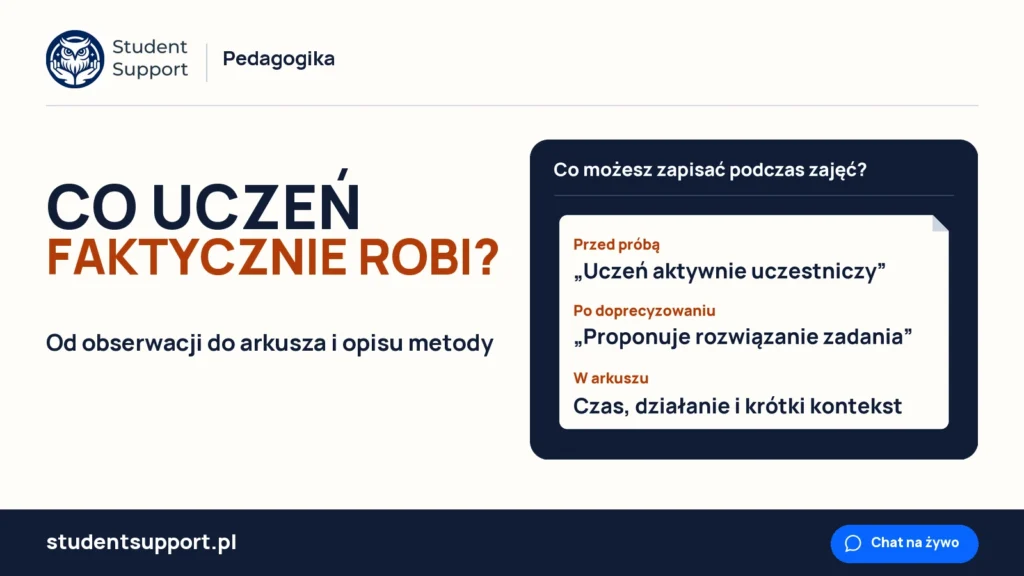
We will work through our own entirely fictional project in “Pedagogy”. The researcher wants to describe pupils' participation in small groups during a problem-solving task. You will see a draft sheet, changes following a trial, a completed record and a methodology passage. The example illustrates tool design and recording procedures. Its numbers and situations were created for this guide.
Begin with a question that observation can answer
In our example, the researcher initially asks whether pupils enjoy working in groups. Observing a lesson will show their actions in a particular situation, but it cannot by itself establish their preferences. A pupil may enjoy the activity and speak rarely. Another may speak frequently while trying to understand unclear instructions. The question therefore needs to fit the available material.
The researcher adopts a narrower question. What forms of participation appear in the observed group during successive stages of the task? She wants to examine suggestions, requests for clarification and actions contributing to a shared solution. This question directs attention to behaviours that can be described from a lesson record.
The theoretical chapter will explain engagement more broadly. The study will cover selected manifestations visible during a shared task. This restriction needs to be stated honestly. You can retain an important concept even when one observation covers only some dimensions. Identify the part you will actually study and the information your material will leave unavailable.
Write your question above the draft sheet. Read each proposed field and ask how its contents will contribute to the answer. A rating of the room's appearance will probably distract you if it has no connection with task conditions. If you compare work at a shared table with work at separate stations, the layout may provide relevant contextual information.
Decide whether you are observing a person, a group or an event
The observation unit is the entity to which a particular record refers. In the example, the researcher selects one group of four pupils, identified as A, B, C and D. The sheet records individual pupils' events, while the findings concern the work of this group. Four people at one table contribute to the same situation.
This decision affects the conclusions. When three pupils respond to a single suggestion, there are three observed responses within one conversational episode. They do not constitute three independent teaching situations. If you later compare groups, retain information about the group and lesson to which each record belongs. A list of pupil behaviours alone will be insufficient.
You could choose one pupil and follow them over specified periods. The sheet should then indicate when the person was visible and when their speech could be heard. Following a whole class requires a simpler procedure or several observers. Detailed recording of thirty pupils' conversations will usually exceed one novice researcher's practical capacity.
Our project deliberately limits observation to one group during a given task. Subsequent observations may cover other groups according to a documented plan. The researcher does not simply select whichever group appears most interesting each time. A recorded selection procedure will later explain why these particular situations were included.
Turn “engages with the task” into recognisable behaviours
The initial sheet contained three judgements. “Active”, “cooperative” and “interested” appear clear until you need to classify an actual scene. A pupil listening carefully might be judged passive. Passing equipment helps the group even though it contributes no proposed solution. The researcher therefore breaks broad judgements into smaller actions.
The first category is a suggestion concerning the task. An entry is made when a pupil proposes a solution, a material or a division of subsequent actions. “Let's start with a drawing” meets this rule. So does “I'll hold the ruler while you mark the points.” Merely saying “okay” after someone else's statement remains a response rather than a new suggestion.
The second category is a request for clarification. A pupil asks about the task, how to carry it out or the meaning of another person's suggestion. An unambiguous nonverbal request can be included only when its meaning is established in context, for example pointing to a passage while asking a question. Looking at another person's sheet is too ambiguous on its own.
The third category is starting an action involving the shared material. This might mean drawing part of the solution, reading out relevant information or checking a result at the group's request. The researcher records the start and a short description. Continuing to draw the same part does not generate a new event every few seconds. The instruction will need to make this boundary clear.
The broader process of moving from a concept to indicators is explained in the guide to operationalising variables and indicators. Here we use it to prepare a practical sheet that can be completed during a lesson.
Include borderline examples in the instructions
A category name and one model example may be insufficient. Borderline situations create the greatest uncertainty. A pupil says “that looks wrong”. Does this count as a suggestion? Under our instruction, it is an assessment of the solution. Adding “let's calculate it again” introduces a suggestion. The observer records what they actually heard.
At another point, a pupil asks “can I?”. Without context, this could concern clarification, taking a tool or leaving the room. The researcher notes the short statement and its circumstances. She assigns a category only when there is enough evidence. Otherwise, she marks it as ambiguous. Such entries may reveal what needs to be improved in the tool.
Plan how to handle overlapping behaviours. “I don't understand this drawing, could we make our own?” contains both a request for clarification and a suggestion. Our example permits two labels on one episode, with a single time entry. This preserves the fact that categories can occur together. Their sum cannot later be treated as the number of separate events without checking.
The instructions should also cover repetition. When one pupil repeatedly says “let's make a drawing” while seeking a response, the researcher treats this as one suggestion episode. A new record begins when the content changes or the previous exchange has ended. This is a working rule for our project and needs checking during the trial.
Decide when to record an event and when to record a state
The example concerns the initiation of actions, so the researcher chooses event recording. For each new episode, she notes the time, person, category and a short description. This makes it possible to reconstruct the order of suggestions and responses. It also requires hearing the group and keeping pace with its work.
A different procedure would involve checking what a pupil is doing at predetermined moments. You might record every minute whether the pupil works on task material, discusses it, does something else or is outside the observation field. This samples the state of the situation at selected points. Brief events between them may go unrecorded.
These procedures address somewhat different questions. Event recording helps describe initiatives and conversational sequences. Recording at selected moments characterises participation at those moments. Avoid adding both elaborate systems simply to collect more information. A trial may show that neither can then be completed attentively enough.
Our sheet records events during a fifteen-minute group-work period. Its header also identifies three task stages. This helps readers see when pupils were becoming familiar with the problem, preparing a solution and checking the result. The researcher records stage boundaries from the actual lesson rather than assuming they occurred at fixed times.
- Define the behaviour
- Identify the action that would show a pupil taking part in group work.
- Try the sheet out
- Check that you can record the event and its context while the lesson is in progress.
- Describe the procedure
- Explain when you observed the group and the rules you used to take notes.
The findings describe behaviour available to observe in the defined setting and time.
Make the sheet usable in a classroom
The first part contains an observation code, date, start time, group code, number of pupils present and a short task description. It also provides space for the observer's position and audibility conditions. These details may later explain why fewer statements were recorded during one period. The observation number links the sheet to project documentation.
In the main part, each entry occupies a separate row in the working document or a separate card in a digital tool. The fields are straightforward. Time since the task began, pupil identifier, category, behaviour description and context. The printed sheet leaves generous space for notes. A brief category instruction stays alongside it for quick reference.
Check the identifiers before entering the classroom. Category letters should be easy to distinguish from pupil codes. Pupils are identified as A-D, while the categories use short words, “suggestion”, “question” and “action”. With three categories, saving a fraction of a second is less valuable than avoiding confusion between similar abbreviations. A real trial will show whether a different system is needed.
The end of the sheet has space for contextual notes and questions to check. We do not immediately give the pupil an overall rating there. We might record that the teacher stood between the observer and the group for two minutes, or that the final stage lacked a shared worksheet. These details help interpret the material and plan another observation.
Specify observation time and selection of situations
The fifteen-minute period in our example is a decision for this particular task. It is not a recommended length for every educational observation. The researcher selects the period of jointly preparing a solution. The teacher's earlier explanation and the later presentation serve different purposes and are described as context.
If you compare several observations, define their comparability. Establish whether tasks had similar aims, groups had the same number of members and working time was similar. Different tasks can encourage different forms of participation. Discussing a story's meaning creates different opportunities for speech and handling material from building a model together.
Consider whether this is the first time pupils have been observed. An adult with a notebook can affect behaviour. Describe how the observer was introduced, where they sat and whether the group had previously encountered them. Complete naturalness cannot be guaranteed. The study can instead explain the conditions under which the records were produced.
Plan what to do if the lesson changes. If the teacher ends the task after five minutes, record the actual duration. The researcher does not fill in the remaining ten minutes using a different exercise. Another observation may be conducted according to the plan, while the earlier one remains a record of altered conditions.
Check the arrangements for observing the situation
Before starting, agree access, participant information and material protection with your supervisor and the school. With pupils, consider age, institutional arrangements and the requirements of the specific project. A headteacher may enable access to a lesson, while organisational access alone does not settle every issue concerning children's participation in research.
Describe the information you will collect and its purpose in project documentation. Our sheet uses A-D, a group code and a task description. It requires no surnames, addresses or medical diagnoses. If a contextual detail could easily identify a pupil, discuss with your supervisor whether it is needed to answer the question.
Audio or video recording requires separate arrangements. Do not add it to the procedure as an automatic convenience. This example uses an observer's notes without recording. If you later plan recordings, agree how participants will be informed and how files will be stored, accessed and analysed. A form found online cannot replace a procedure fitted to the study.
Consider the classroom situation as well. Observation should not require pupils to disclose information to the group or alter the lesson in an unagreed way. If an incident requires adult intervention, the applicable care arrangements remain relevant. The methodology can describe an interruption or intervention and its effect on the material.
Run a short trial before collecting the main material
The researcher tests the sheet during one similar task. She checks whether she can see, hear and recognise the intended behaviours, then record them in time. The trial alone does not establish the validity of the tool. The trial identifies specific problems that can be addressed before the main study.
After five minutes, she notices the first difficulty. “Action involving material” contains several nearly identical entries about the same pupil continuously drawing. The instruction did not make the start of a new episode clear enough. She adds that continuous work on one element forms one record, with changes of action described in the note.
The second problem concerns audibility. Conversations at a table further away blend with the rest of the class. In two places she records only that a pupil spoke. This cannot establish a category. With the teacher's agreement, she changes position and adds a label for “content inaudible”, preserving information about the missing passage.
The third difficulty appears when she rereads the notes. “D does not want to work” fails to describe the behaviour supporting that judgement. The revised sheet will say “for about a minute, D does not handle the shared material and looks towards another group”. A motive will require additional evidence. This change immediately improves the usefulness of the material.
Retain both versions of the tool and explain the change
The draft sheet is labelled “trial version” and the revised sheet “main-study version”. The researcher keeps both and a short explanation of the changes. When writing the methodology, she can state what was tested and what followed from it. Months later, she will not need to reconstruct the trial from memory.
Her note identifies three changes. The boundary of an action episode was clarified, an inaudible-content label was added and the general motivation rating was removed. Each change responds to a problem encountered when completing the sheet. Merely stating that “the tool was improved after piloting” would leave readers unable to see how the changes affected the material.
The trial material also needs a decision. In our project, it stays separate and supports preparation of the procedure. Main findings use observations conducted with the revised tool. Another study could adopt a different approach, but would need to justify comparability and consistency with its plan. Trial data should not automatically enter the main findings.
If a substantial flaw appears only after several main observations, first describe its extent. Is one contextual field missing, or has the meaning of a whole category changed? Records produced under different rules may be unsuitable for one combined summary. Discuss further collection and use with your supervisor while retaining both instruction versions.
Read a completed section of our example sheet
Observation G1 covers four pupils at a shared table. Their task is to propose two ways of reducing paper waste in the classroom and present one chosen solution. They have an instruction sheet, a large piece of paper and markers. Recording begins when the teacher hands over the task for independent group work.
In the first minute, pupil A says “we could list where we throw the most away”. The record gives 00.40, A, “suggestion” and a short account. Shortly afterwards, B asks whether they should choose one idea or present both. This becomes a “question” entry at 01.10. The researcher also sees C pointing at the instruction sheet, but cannot hear the statement and marks the content as unavailable.
Two minutes and twenty seconds into the task, D starts writing the places named by the group on the large sheet. This is the beginning of an “action”. The others add more places while D continues writing. The same episode lasts until approximately three minutes and thirty seconds into the task. The researcher describes its extent rather than making a new entry for every word. The record identifies work on material without measuring each pupil's precise total working time.
Four minutes into the task, A suggests a box for paper used on one side. B asks “but where would it go?”. In context, this requests clarification of the proposal. C replies “by the printer” and develops the idea. The researcher retains the sequence of these three events because it shows joint elaboration. Category totals alone would lose that relationship.
Six minutes and ten seconds into the task, the group becomes difficult to observe for approximately two minutes while the teacher consults the neighbouring table. The researcher marks reduced visibility and audibility. When it ends, she resumes from the actual situation. She does not enter zero suggestions for a period during which she could not reliably identify them.
Distinguish an absent event from an unavailable observation
A blank field can have several meanings. A behaviour might not have occurred, might have gone unnoticed or might have been omitted from the notes. The instructions therefore require marking periods in which the planned observation was impossible. This matters particularly when findings include counts of recorded behaviours.
Our example contains fifteen minutes of task time, including approximately two minutes of clear observation difficulty. The researcher can describe events recorded during the remainder. She should state that the whole period was not covered equally closely. Reporting a rate per minute first requires establishing actual observation time and deciding whether the calculation serves the question.
Do not reconstruct events from the result visible after a gap. If two new suggestions appear on the sheet during those two minutes, the material has changed. This does not establish who suggested them or how they emerged. Record the change in contextual notes. Attributing it to a particular person would require another source.
Apply the same care to absence. D may leave for several minutes, making a smaller speech count incomparable with A's complete record. Include actual presence time or restrict comparison to the shared observation period. The choice depends on the analysis plan and needs to be explained in the thesis.
Leave room for context beyond the categories
Three categories organise the record without covering the whole group process. The teacher may change the instructions, markers may be unavailable or one pupil may take control of the instruction sheet. The researcher records such circumstances separately with their times. Every occurrence does not immediately require a new permanent category.
Afterwards, she can examine whether similar circumstances recur and help explain the work. Recurrence may justify further analysis or a subsequent study. Explain which elements were planned and which emerged from the material. Readers should be able to follow the path from note to interpretation.
Context does not justify freely assigning motives. “The pupil avoided the task because they feared assessment” would require knowledge that the behaviour sheet alone cannot provide. Observation can record that the pupil asked whether the solution would be graded and began work after the teacher's reply. That description can later be compared with other evidence.
Distinguish short quotations from your own summaries. Put precisely heard words in quotation marks. When retaining only their general meaning, label the passage as an observer's note. A hurried entry should not turn into a purported verbatim statement weeks later. The quotations in this guide were invented to illustrate use of the sheet.
Check how a second observer understands the instructions
Before the study, ask another prepared person to read the categories and apply them to several described scenes. Avoid guiding their answers during the trial. Differences reveal definitions needing clarification. This exercise is useful even when one person will conduct the eventual observations. It helps uncover assumptions hidden in short category names.
If the project uses two observers, plan shared material and independent recording with the same instruction version. During live observation, both should have reasonably similar access to the situation. Otherwise, some disagreement reflects hearing or seeing different passages rather than interpreting categories differently.
Agreement can later be described and, with suitable data, calculated. A separate guide explains how to check observer agreement and calculate Cohen's kappa. Here the priority is preparing rules and a common recording unit. These make any agreement result interpretable.
High agreement alone cannot establish that categories answer the thesis question. Two people may consistently identify speech counts while the topic concerns joint decision-making. The study then needs sequence, content and responses. Evaluating the tool involves both consistency of recording and usefulness for the intended analysis.
Plan how to organise the sheets after the lesson
Reread the sheet soon after observation and expand abbreviations while you still remember them. Mark what was recorded at the time and what was added afterwards. Avoid making an unclear entry appear as though it was precise from the start. Traceable information matters more than a superficially perfect sheet.
Keep the original record and an organised version for analysis. Each event in the working file can have an identifier combining observation code and sequence number. Add the time, pupil, category, content and context. This organisation makes returning to the original sheet easier when checking an example during writing.
Do not discard ambiguous entries merely because they complicate a summary. You may exclude them from a particular category count and retain them as context under a stated rule. Numerous ambiguous entries reveal limitations in the tool or conditions. Their proportion may affect how closely the whole record can be interpreted.
Consider filenames and access as well. An observation code should link documents without disclosing participant identities. Any list linking codes to people should follow the agreed procedure and remain separate from material used for analysis. A consultation generally requires the instruction, an anonymised sheet and the research question.
Build the findings from what the sheet actually records
Suppose the observed task period produced six suggestion episodes, four clarification requests and five starts of actions involving shared material. Two episodes were labelled both suggestion and question. Category totals add to fifteen, while there are thirteen separate entries. Preserve this distinction whenever reporting the numbers.
The description can begin with the sequence. During the first minutes, pupils clarified instructions, then proposed solutions and jointly developed one. Next, report category counts and an exchange in which a question prompted elaboration. Readers can then see both the process and how it was summarised.
Do not turn thirteen entries into thirteen “engaged pupils”. There are four pupils, each potentially appearing repeatedly. Nor should the person speaking most often automatically be deemed most engaged without establishing what the category was intended to capture. Participation may include handling material, listening and responding in ways incompletely recorded by the sheet.
For a single group, a useful conclusion may concern observed participation and the conditions in which it occurred. A statement about all pupils of a given age would require a much broader basis. Explain why this situation was selected and what it reveals. The analysis gains value from the answer it supports rather than the size of the population to which it is extended.
Read a completed methodology passage
The following passage is our own description of the fictional project. Use it to check the structure of your account. Replace the numbers, task and rules with your real arrangements. Select methodological references consistent with the approach adopted in your thesis.
“The study used observation of a four-pupil group during a problem-solving task. The record concerned selected forms of participation in preparing a shared solution. It covered task-related suggestions, requests for clarification and actions involving shared material. Categories were defined in an instruction that included borderline examples.”
“A researcher-designed sheet contained lesson conditions and a chronological event record. Each episode included time since the task began, pupil identifier, category, a short behaviour description and context. Two categories could be assigned to the same episode. Repeated statements of one suggestion within a single exchange were treated as one episode.”
“Before main collection, the tool was trialled during a similar task. This led to clarification of action-episode boundaries, an inaudible-content label and removal of a general motivation rating. Trial notes were stored separately and used to prepare the final instruction. Main observations followed the revised version.”
“The analysis covered a fifteen-minute period of independent group work. Interruptions and restrictions on visibility and audibility were marked on the sheet. Findings referred to observed behaviours under the stated conditions. They were not used to establish stable pupil characteristics or declared preferences concerning group work.”
How can the sheet fit another education topic?
If the topic concerns help-seeking, distinguish a question addressed to a peer from one addressed to a teacher and define what counts as a request. Raising a hand may signal several intentions. The instruction can combine the signal with the statement or retain an ambiguous category when the content is unavailable.
For feedback, the sheet might follow a comment and the pupil's subsequent response. Relevant information includes the comment's content, the opportunity to use it and a visible change of action. Counting only praise and criticism would address a different question. Choose fields according to what the findings chapter needs to explain.
In preschool education, the procedure must fit the situation and observer's capacity. Short play episodes, movement between areas and several children's speech need a different arrangement from fifteen minutes at one table. Avoid mechanically transferring our codes. Begin with your own question and a trial under real conditions.
If the topic concerns pupils' experiences or meanings, discuss a suitable conversation or another complementary technique with your supervisor. A sheet can describe a situation's course, while its meaning for a participant needs additional evidence. Every source should contribute to the answer, and the overall project must remain feasible.
Check the sheet before meeting your supervisor
Prepare a blank sheet, category instructions and one completed trial passage. Add the research question, group-selection procedure and intended duration. This set helps assess whether the sheet will provide useful material and whether it can be completed in practice. A visually appealing form alone cannot demonstrate these connections.
Read several trial entries and check whether another person could recognise the situation. Is an “action” described? Does a blank period indicate poor visibility? Can readers see that two categories concern one event? Improvements here make later analysis and methodology writing easier.
Finally, write one sentence defining the scope of the conclusions. In our project, the sheet describes selected forms of participation in a particular group task. It does not provide a complete account of each pupil's engagement across school situations. A consciously defined scope helps keep title, procedure, findings and conclusion aligned.
When question, categories and observation plan fit together, collection can begin under the agreed arrangements. If you still cannot see what answer the material will support, return to one example episode and explain its relevance to the question. This often reveals a missing field more quickly than adding further boxes.
Questions about observation and planning a project
Does every thesis or survey require hypotheses?
No. Whether hypotheses are appropriate depends on the objective and nature of the research. Testing relationships requires a different approach from research focused on description or exploring experiences. I adapt the approach to the project and the requirements of the relevant degree programme.
If you formulate hypotheses, plan the data and analysis that will allow you to actually test them. Do not add them solely to fill out the chapter scheme.
How can I connect a limitation to its effect on the conclusions?
Identify a specific feature of the procedure, the finding or claim it affects, and the consequence. Then explain what you actually did to address it and what remains uncertain. A generic list mentioning sample size and time pressure is not enough.
Can you check an already written methodological chapter?
Yes. I can analyse its structure, the link between the objectives and research questions, and the consistency of the descriptions of the methods and research instrument. Include your supervisor's comments and the questionnaire or interview guide itself so that I can assess the whole, rather than the description alone.
Are the thesis objective and the research objective always the same?
They can be very similar, but do not have to be. The objective of the entire thesis may include literature analysis, empirical research, and the development of recommendations. The objective of original research then refers to the empirical part. Agree on the terminology and division with your supervisor.
Can I order a research project before collecting data?
Yes. I can prepare a proposal for a planned study: the objective, research questions and justified hypotheses, material selection, methods, a research instrument and a plan for subsequent analysis. The document sets out the study design and how the research will be conducted. Results can only be described once real data have been obtained. I agree on access to data and the research arrangements before accepting the project.
How does a research project differ from the research section of a thesis?
A research project is a standalone assignment, for example for a course or seminar, with its own scope set out in the instructions. The research section of a thesis must also fit the thesis topic, theoretical framework, outline and other chapters. This work is covered by the service Thesis research section: methodology, results and discussion. If the task is an essay, seminar paper or semester paper, explore the service Coursework and essays. The choice depends on what needs to be produced, not just the name of the task.
Sources
- Juszczyk, S. (2013). Badania jakościowe w naukach społecznych. Szkice metodologiczne. Wydawnictwo Uniwersytetu Śląskiego. Section 4.12, “Obserwacja”, and discussions of research objects and material analysis. Full Polish publication in the Silesian Digital Library. A source for the methodological foundations of observation. The sheet and example in this guide are original.
- Pintal, D., and Tomaszewicz, D. (2017). Wspomaganie szkół w rozwoju umiejętności uczenia się przez eksperymentowanie, doświadczanie i inne metody aktywizujące uczniów. Ośrodek Rozwoju Edukacji. Sections on information sources, observation and planning school diagnosis. ORE publication in Polish. School-development material used to distinguish observation purposes and context.
- Pedagogiczna Biblioteka Wojewódzka w Opolu. (n.d.). Obserwacja zajęć. Bibliographical guide and introduction to school-observation purposes. Library resource in Polish. Supports literature searches and the distinction between school lesson observation and a tool designed for a particular research question.
Plan the observation before collecting data
Send the assignment or guidelines, your observation plan and a draft of the sheet. We can agree what is needed for the tool and procedure.
Contact StudentSupport