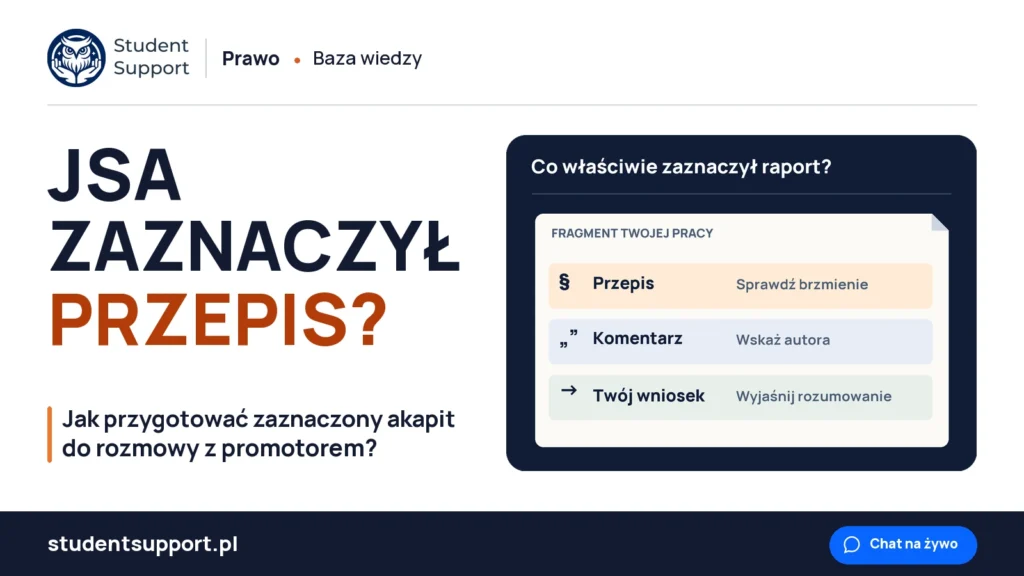
You see a highlighted paragraph in a similarity report. It begins with statutory wording, moves to an explanation from a publication and ends with your conclusion. Do not immediately revise every sentence. First open the exact dissertation version covered by the report and establish the boundaries of the match. Check separately what comes from legislation, what comes from another author's discussion and what you are responsible for as the author of the analysis.
Textual similarity alone does not determine how such a passage should be assessed. Nor does the presence of a legal provision establish that the whole paragraph is correct. You need to compare it with the appropriate sources, identify the quotation and clearly attribute the explanation to its author. The result should be an organised passage and a specific question for your supervisor, rather than a promise of a particular result in the next check.
Consider a model paragraph from a law dissertation. It refers to Article 4 point 1 of Poland's Copyright and Related Rights Act and OPI's explanation of how to read a report. When studying “Law”, it is useful to identify where a provision ends and an explanation or your conclusion begins. The example is fictional; we will check its foundations in actual sources and prepare material for discussion.
First connect the report with the correct dissertation version
Save the dissertation file that was checked and its corresponding report. If the text has since been revised, do not compare a match only with today's version. Page numbers, sentence order and footnotes may have changed. “There are many similarities in chapter two” is insufficient to reconstruct a particular issue. You need the paragraph's location, its full wording in the checked file and the context available to the reader at that time.
Do not replace this material with a photograph of a percentage or indicator colour. That image does not show which words were compared or with what source. If you lack enough information to read the passage, ask your supervisor to identify the location and scope requiring examination under your university's procedure. Do not assume every student has direct access to all JSA views or can independently make decisions within the system.
OPI's documentation distinguishes general and detailed reports. Its description of the latter includes similarity sources and marked text passages. What matters for your preparation is obtaining material that allows the match to be compared with the dissertation, rather than a filename remembered from an earlier consultation. Also record which checking attempt the report concerns. Printouts for two successive versions are not interchangeable evidence of the same text state.
Create a working copy and retain the original material. A brief identification note is sufficient: filename, date or version identifier, report attempt and chapter location. You do not need an elaborate system. What matters is being able to explain afterwards what was assessed and what changed. Otherwise, you might revise a different paragraph or present your supervisor with a report concerning outdated wording.
One paragraph may contain three different layers
The first layer is the provision's wording. The second is another author's explanation, interpretation or argument. The third is your analytical step: applying a distinction to the dissertation's problem, comparing sources or identifying a conclusion's limits. Placing these layers next to one another does not give them shared authorship. Nor does a single footnote at the end necessarily clarify which sentence it concerns when the source type changes beforehand.
Imagine a match spanning three sentences. The first repeats legislation verbatim, the second summarises institutional guidance and the third declares that the passage needs no assessment. Each needs a different check. For the first, identify the correct statutory unit and verify the quotation. For the second, establish the actual source and scope of its statement. For the third, ask whether it follows from the earlier sentences and attributes any unsupported effect to the system or provision.
In practice, do not assess the layers by highlight colour. A technical match does not identify a sentence's function for you. Read the text before and after the paragraph too. A statement such as “the author's position is presented below” may help establish a reference's scope, but it cannot repair a missing source if the author's identity is unclear. Similarly, a copyright heading does not make every sentence an explanation of statutory wording.
Provisionally label the layers A, B and C in your working copy. These letters are analytical aids, not a required dissertation format. For each sentence, complete two prompts: “This information comes from…” and “It is needed in this paragraph because…”. If you cannot complete them, establish the source and function first. Rewording without that knowledge may simply conceal an unclear origin.
Before revision: three sentences, three problems
The following passage is deliberately unfinished and illustrative. It comes from no actual dissertation or report; the legislative wording remains in Polish: “Nie stanowią przedmiotu prawa autorskiego: 1) akty normatywne lub ich urzędowe projekty. Flagged passages may be properly used quotations, so the report's colour does not determine whether there is a problem. Consequently, this entire paragraph requires no further assessment”. The quotation and sources are not clearly identified, and the final conclusion is too broad.
Sentence A contains the substance of Article 4 point 1, but readers should receive the statute's identity and know that its wording is being quoted. Sentence B uses the meaning of OPI's guidance without identifying its origin. Sentence C is not a simple repetition of A or B. It is the illustrative author's own claim, whose scope exceeds those foundations. Neither the provision nor the documentation assesses this entire fictional paragraph on the supervisor's behalf.
For this exercise alone, suppose the report identifies similarity with a publication that also quotes Article 4. This does not establish that every sentence comes from that publication. Nor does it make an explanation beside a provision part of the legislation. The source must be opened and the boundaries compared. We provide no percentage and make no prediction about how the system will mark the revised text.
The task is to improve documentation and reasoning. Afterwards, you should be able to show the basis of A, the source of B's meaning and your own limited analytical step in C. These are three different outcomes. Removing one highlight cannot replace any of them; a remaining highlight does not itself prove the revision was unnecessary. Substantive checking concerns the content, rather than the desired appearance of the next report.
Layer A: verify the exact wording and statutory unit
Our example relies on the Act of 4 February 1994 on Copyright and Related Rights, Article 4 point 1. In the consolidated text published in Dz.U. 2025, item 24, the provision lists normative acts and their official drafts as outside the subject matter of copyright. This is an actual basis for the distinction. It does not mean that every statement about law, scholarly commentary or another author's analysis becomes statutory text.
Open the official source and compare the words, statutory unit and scope of the quotation. Note that Article 4 point 1 is not the same reference as Article 4 paragraph 1. The unit designation matters when locating the provision. Also check that your dissertation does not confuse the statute with the notice publishing its consolidated text. You are referring to a rule in the Act, even if the document in which you read it is an annex to a notice.
When quoting verbatim, preserve the wording and mark the quotation's boundaries. Do not replace statutory terms with arbitrary synonyms merely because they were flagged. You may decide the full quotation is unnecessary and a reference to the rule is enough, but you are then preparing your own account. It still requires a source and fidelity to meaning. Choose quotation or discussion according to the provision's role in the argument.
Do not expand a quotation to the whole article when analysing just one category. Equally, do not remove a part needed to understand the claim. In your working note, record where the quotation starts and ends and where you read it. If you shorten it, mark the omission according to your adopted convention and check that the meaning is unchanged. Adding an act number alone will not explain where its literal wording ends.
The legislative version and the date of your analysis
Legal dissertations need an identified date for the legislation being analysed. A file's download date is not automatically the legal-status date adopted in the chapter. Consolidated and subsequently updated texts can facilitate reading, but today's wording must not be applied to a past situation without verification. Record the problem's time frame, then check the relevant unit's wording and any amending provisions.
This demonstration uses the actual text published in 2025; the exclusion in Article 4 point 1 also appears in the verified Sejm Chancellery updated text dated 16 October 2026. This check concerns that particular unit. It is not a review of every amendment or advice on applying the entire Act to a specific dispute. Your topic may require additional examination of other provisions and their commencement dates.
The record for A needs information that allows a return to the basis: the Act's title and date, unit, publication reference and version used. Add why that version was adopted. Do not copy the newest search-result address into a footnote without establishing which document it opens. A page describing the Act and the actual text file may serve different functions in your check.
The result of this stage is specific: you can demonstrate agreement between the quotation and the provision appropriate to the adopted scope. You have not yet established whether B and C are correct. Even an accurately quoted act may sit beside an unattributed argument or your own excessive generalisation. Version checking completes one layer rather than extending a positive assessment to the whole paragraph.
Layer B: attribute the explanation to the correct source
In this exercise, the third-party explanation comes from OPI's documentation “Analiza Raportu – wskazówki”. The institution notes the possibility of justified quotations within marked passages and the need to examine the content. That meaning can be discussed briefly with attribution to OPI. The documentation explains report analysis and provides a separate source alongside the Act in our paragraph.
If sentence B in your dissertation comes from scholarly commentary, open the publication actually used at the relevant page. Check who authored the passage, especially in an edited collection or commentary with a different editor. A name on the cover does not always identify the author of a specific position. Also establish that you are citing the author's view, rather than an opinion they quote and subsequently challenge.
Read more than the highlighted sentence. A qualification in the next paragraph may limit the claim, while the preceding passage may show that it concerns a different rule or version. If you lack the material, do not fill the gap from memory of what scholarship “usually says”. Record the gap and obtain the source, or remove a claim you cannot document while honestly describing the material you actually read.
Changing words does not change an argument's origin. If you adopt someone else's distinction, it still requires a reference after being accurately explained in your own language. Conversely, do not attach a source to a sentence it does not support just because the topic is similar. In the checking record, identify as precisely as possible which part of the meaning the page supports and where your own application begins.
Check exactly what the report's source shows
The report may direct you to a text that also quotes the statute. Open the indicated passage and identify whether the overlap covers statutory words alone or also their explanation, argument structure or neighbouring sentences. Do not attribute the Act's wording to that publication's author. Nor should you assume that a shared quotation explains every subsequent similarity. Examine the comparison boundaries rather than inferring them from the source title.
The report may show a different source from the one you used. Your note should distinguish the source identified as similar from the material actually used in writing. Different addresses alone neither resolve nor establish an authorship problem. Compare both texts. If you cannot reconstruct your route to an argument, identify that gap rather than inventing a source-use history afterwards.
Do not add a publication to the bibliography solely because it appears as a comparison result if you do not actually use it. Reading it may be necessary to explain the match, but that does not make it the original paragraph's foundation. A note for your supervisor can honestly separate the stages: material X was used earlier, then material Y identified in the report was compared afterwards. This prevents an apparently reconstructed sourcing history from replacing what happened.
If the indicated passage is unavailable, do not claim agreement after reading a title or short preview. Record what could not be checked and what material is needed to decide. Your question for the supervisor may concern access to sufficient context for analysis. An incomplete comparison describes your preparation's status; it does not establish that the entire match should be accepted or dismissed.
Layer C: define the limits of your conclusion
Sentence C should perform analytical work with foundations visible in A and B. In this exercise, one can conclude that assessing the paragraph requires distinguishing the quotation of legislation from neighbouring explanations. Those foundations do not support automatic approval of the whole passage. Your contribution lies in applying the distinction to the material and identifying what remains to be assessed, rather than claiming authority to make the final decision.
Examine connectors between sentences. “Therefore”, “consequently” and “this proves” promise a reasoning relationship. Read the conclusion after them and identify the premise that actually supports it. If A concerns copyright subject matter and B the report's role, C should not suddenly decide whether the entire dissertation is independently produced. Moving between different questions requires further justification that a forceful connector cannot provide.
Your own conclusion need not be an elaborate new theory. It can specify the situation's scope: the paragraph requires checking the statutory quotation, attribution of the guidance and the suitability of its application to the reported match. That is more modest than declaring there is no problem, but better reflects the analysis performed. It also shows the supervisor which issues the author recognised and which remain unresolved.
If C turns out to be a conclusion copied from a publication, beginning with “in my opinion” does not make it your own analytical step. Return to the source, attribute its origin and decide what you add. You can compare the scope of two statements, identify a limitation or justify an interpretative choice. You need not invent a disagreement, but you should honestly distinguish repeating a view from applying it yourself.
- Statute
- Check the cited provision and the version that applies to your analysis.
- Commentary
- Find the interpreter and establish where their argument ends.
- Your inference
- Explain how applying the rule answers the question your thesis asks.
Note the source or reasoning behind each sentence and bring the particular uncertainty to your supervisor.
The revised paragraph and its two references
A revised example could read, retaining the statutory quotation in Polish: “Article 4 point 1 of the Copyright and Related Rights Act provides: ‘Nie stanowią przedmiotu prawa autorskiego: 1) akty normatywne lub ich urzędowe projekty’ [footnote A]. OPI's report-analysis guidance indicates that marked passages may include quotations used for a justified purpose [footnote B]. When examining this paragraph, I therefore separate the statutory quotation from the explanation in the guidance and assess the justification for each element separately”.
This remains an editorial example, not an assessment of an actual dissertation or a promise that a report will be approved. The final sentence defines the author's task. It does not claim that OPI assessed this paragraph or that the provision removes the need to check it. The two footnote markers show two foundations rather than suggesting that the statutory wording and report guidance come from one discussion.
Footnote A should identify the actual statute, unit and publication reference required by the adopted style. For this demonstration, they are the Act of 4 February 1994 on Copyright and Related Rights, Article 4 point 1, consolidated text Dz.U. 2025, item 24. Footnote B should identify OPI's documentation “Analiza Raportu – wskazówki” and the location corresponding to the information used, following your dissertation's convention for online material.
“Footnote A” and “footnote B” are demonstration placeholders, not a style to copy into a master's dissertation. After inserting real footnotes, check their scope within the sentences. If you quote legislation in one place but position the reference only after your own conclusion, a reader may attribute the entire paragraph's meaning to the statute. The revision should make information origins clear without access to your notes.
When should you retain a quotation or replace it with discussion?
Ask why literal wording is needed in the paragraph. If you analyse a term or compare the provision's construction with an interpretation, a quotation can have a clear function. If you merely signal that a rule exists, an extensive quotation may be unnecessary. The editorial decision follows from the chapter's task. Do not make it solely because the report highlighted the passage.
Discussion in your own words requires fidelity to meaning and a reference to the basis. In this example, you can briefly explain the exclusion of normative acts and their official drafts from copyright subject matter, referring to Article 4 point 1. You cannot turn that into “all legal material is free of restrictions”. That expansion loses the statutory category's boundaries and confuses it with other issues concerning use of material.
Do not present discussion as a quotation. If you change sentence construction, omit elements or combine meanings from several places, readers should know they are reading your account. Conversely, do not silently improve details of verbatim wording that seem stylistically awkward. You can limit the scope, but cannot sacrifice accuracy to make normative wording flow within your paragraph. Show your supervisor a specific passage if you are unsure how to present it.
After making the choice, read the paragraph as a whole. Shortening A may leave B referring to a word no longer quoted. Removing the quotation may also reveal that C merely repeats the foundation without applying it. Revising one sentence requires checking connections, rather than automatically rewriting the whole chapter. Preserve the argument's function, rather than merely a similar paragraph length.
What does the provision's exclusion mean, and what remains undecided?
Article 4 point 1 defines a particular material category in copyright law. It is not an instruction on footnotes or a decision about an academic argument's quality. Readers still need to identify which act and wording you use. The text's origin, accuracy of presentation and independence of analysis matter to dissertation assessment regardless of whether the act's wording itself is copyright subject matter.
Do not extend the exclusion to commentary because it is printed below the provision or in the same database. A discussion may contain its own selection of arguments, interpretation and expression. This guide does not decide every publication's legal status. The practical checking task is narrower: establish which words are legislative text and which are an author's statement, then identify the sources according to their actual roles.
A correct footnote alone does not settle whether using the material is justified. A paragraph can be well documented but unrelated to the dissertation's problem. It may also consist entirely of other people's quotations without explaining their purpose. In discussion with your supervisor, distinguish origin from the need to retain the passage. This clarifies whether the revision concerns a reference, quotation scope or the argument.
Do not set yourself a “safe” percentage
In its information of 20 July 2021, the ministry described JSA as supporting a university process and warned against treating a report as an automatic decision on admission to a defence. For this case, that means presenting material for assessment rather than seeking a number that settles the matter without reading. University decisions do not follow from a service provider's promise or a student's personal interpretation of an indicator's colour.
It would be dishonest to predict how much a score will change after this paragraph is clarified. We do not have its actual report, checking conditions or the entire dissertation. More importantly, revision aims at clear quotation boundaries and accurate attribution rather than a target value. A source reference does not become unnecessary because wording was not marked. A highlight, in turn, does not remove the need to compare the content.
If your supervisor identified a particular revision, record it precisely. “Limit the quotation and develop your application” differs from “identify the source of this view”. Do not turn both instructions into generic rewording. After revision, show how the actual comment was addressed. This facilitates substantive assessment rather than reducing the conversation to comparing two context-free numbers.
Create a brief paragraph-checking record
The record should assist the discussion, not create a second dissertation. You can prepare one working page with space for the passage before and after revision. For A, B and C, record the basis, comparison performed and remaining uncertainty. Refer to specific locations. “The statute was checked” is less useful than naming the unit and version and stating whether the entire quotation was verified.
Prepare these elements:
- The checked dissertation version, report and paragraph location.
- The whole passage with the context needed to understand references.
- For A: the statute, unit, version and boundaries of verbatim quotation or discussion.
- For B: the source actually read, its author or institution, location and scope of the idea used.
- For C: your analytical step, its premises and the conclusion's limits.
- The overlap with the source identified by the report and any lack of access to that passage.
- The revision made and a question that remains unresolved.
Do not enter “consistent” in every field if you only compared the start of a sentence. Separate confirmed checks from those not completed. You may have verified statutory wording but still not located the commentary page. That material can be passed on for further work if its status is clear. Apparent completeness would hinder your supervisor by concealing where help is actually needed.
Retain a readable revision trail without repeatedly copying whole chapters into notes. Appropriately identified files, a location and a brief decision description are enough. If a revision affects later conclusions, flag those locations for review. The record concerns one paragraph, but its claim may recur in a summary. Fixing a local reference does not automatically correct every later generalisation based on the old C.
How do you prepare a specific question for your supervisor?
Instead of asking “will this pass?”, show the passage and name the issue. In this example: “I have separated the Article 4 point 1 quotation from the discussion of OPI's guidance and limited the final conclusion to how those layers are checked. Is the quotation's scope needed for this chapter's problem, and are the references clearly assigned?”. This is a question about content and function that can be answered by reading the material.
If you have not established the overlap boundaries, ask a different question: “I have verified the provision's wording but cannot see the full scope of the source identified in the report. Which part of the explanation does the comment concern?”. Do not claim the revision is complete if the basic comparison is missing. Identifying the exact gap is more useful than a general message that the report looks worrying.
Bring the materials used, rather than only the revised wording. Your supervisor may need to see what was removed, whether the commentary's meaning remains faithful and whether your conclusion genuinely has a basis. You do not need a long history of every stylistic change. Show the substantive decision: quotation retained or limited, explanation attributed, conclusion narrowed and remaining questions identified.
After consultation, record the agreement as specifically as possible. A decision concerning one passage must not automatically be extended to every statutory quotation. Assessment depends on each quotation's purpose, scope and context. If further revision is requested, connect it with the appropriate file version. This distinguishes material prepared for consultation from material accepted by the supervisor within the university procedure.
Check the revised passage throughout the chapter
Return to where the Act is first introduced and to later references. Check whether the shortened name still refers to the same statute and unit references are consistent. Do not impose a universal style if your programme has particular requirements. The priority is that readers can locate the provision, recognise the wording used and distinguish an official source from commentary.
Check footnotes after adding or removing sentences. A reference number may remain technically correct while its position changes the meaning it appears to support. Read the paragraph without looking at the bibliography and decide which statement you would attribute to each source. Then open the footnote and verify that it supports that statement. A bibliography cannot repair unclear authorship boundaries within the argument.
Also review the summary, conclusion and any slides presenting the claim. If the chapter no longer says the paragraph is automatically correct, do not leave that claim elsewhere. Revision must be consistent at the argument level. It does not mean replacing every similar expression throughout the document, because identical wording can serve a different purpose and have a different basis in another context.
The guide on JSA and similarity reports explains the tool generally and the distinction between a report and assessment. Here we finish with one case: you can assign each sentence to its source or your own reasoning and identify what requires discussion. If checking reveals issues elsewhere, specify their scope separately rather than declaring the entire dissertation correct on the basis of one example.
Final check before submitting the material for consultation
Open the checked paragraph, official source, explanation actually used and revised version side by side. Examine origin, agreement and conclusion boundaries in that order. This helps detect a reference that looks correct yet still does not support the sentence. You need not resolve everything independently. You need to show the comparisons performed and prepare material for assessment clearly.
Before the discussion, make sure:
- Do the report and passage concern the same dissertation version and correct attempt?
- Have the match boundaries been identified and the similarity source opened to the extent available?
- Have the statutory wording, third-party explanation and your conclusion been distinguished?
- Do the statutory unit and version fit the analysis's adopted scope?
- Does the explanation's reference identify material actually read and its correct location?
- Does the revision avoid attributing approval of this paragraph to the Act or OPI?
- Does your conclusion follow from the premises shown without presenting someone else's view as your own?
- Is the revision consistent with the chapter summary, and are remaining gaps identified?
A well-prepared passage need not stop resembling statutory wording. It should show clearly why the provision was used, where the explanation comes from and what the author derives from those foundations. In this example, revision removes the unsupported claim that the entire paragraph is automatically correct. It leaves specific material for substantive discussion with a supervisor, without pretending that a technical highlight determined the dissertation's assessment.
Questions about a highlighted statute and your report
Do all highlighted fragments need to be rewritten?
Not always. A correctly marked quote, bibliographic entry, or citation of a legal provision requires assessment in context. I tailor changes to the actual problem, ensuring precision of terminology and consistency with the sources used.
Does a high percentage of similarity mean plagiarism?
A percentage alone is not enough for such an assessment. I must check the indicated fragments, their sources, the citation style, and the context within the thesis. My analysis helps determine the necessary editorial corrections; the evaluation of the report belongs to the supervisor.
Which statute details belong in a bibliography and footnote?
Record the act's type and full title, its date and publication reference, identifying the version used. A footnote to a specific provision should also include the relevant article, paragraph, section, point or letter. Check the details in the official ELI or ISAP record. Adapt element order and abbreviations to your thesis requirements. A website address alone does not identify the document sufficiently.
Are a Polish official consolidated text and an updated unified text the same?
No. A tekst jednolity is an officially promulgated consolidated text. A tekst ujednolicony helps readers follow the wording with amendments incorporated; ELI states that this type of text has no legal force. When citing, establish the document type, its publication reference and the period your analysis concerns. Do not assume that the most recently downloaded PDF automatically fits every historical situation.
How do I determine the scope of editing after the JSA report?
Send the similarity report, the current version of the thesis, and comments on the indicated fragments. I compare the markings with the text and available publications. I determine the parts to be re-edited, citation and footnote corrections, the deadline, and the form of file delivery. The quote refers to this agreed scope.
What should I send for correcting footnotes to court rulings and legal commentaries?
Attach the text with footnotes, the list of sources, and the supervisor's or university's guidelines. For court rulings, I need details that allow me to locate them, such as the court, date, case number, and publication source. For legal commentaries, useful details include the author of the relevant commentary passage, the editor, the edition, and the article, page, or numbered point, depending on the publication. If anything is missing, send a link or a copy of the passage used, together with the source details.
Sources
- Ośrodek Przetwarzania Informacji – Państwowy Instytut Badawczy. Analiza Raportu – wskazówki. Jednolity System Antyplagiatowy documentation. Scope used: substantive assessment of marked passages and justification for quotations. Address: https://jsa-cp.opi.org.pl/baza-wiedzy-skroty/analiza-raportu/
- Ośrodek Przetwarzania Informacji – Państwowy Instytut Badawczy. Wygląd wydruku raportu. Published 28 December 2018, updated 8 December 2020. Scope used: general versus detailed reports, checking attempts, sources and marked text. Address: https://jsa-cp.opi.org.pl/baza-wiedzy-skroty/wyglad-wydruku/
- Ministerstwo Edukacji i Nauki. Informacja o roli Jednolitego Systemu Antyplagiatowego i charakterze jego raportów. 20 July 2021. Scope used: JSA's supporting role and the distinction between its report and a university decision. Address: https://www.gov.pl/web/edukacja/informacja-o-roli-jednolitego-systemu-antyplagiatowego-i-charakterze-jego-raportow
- Ustawa z dnia 4 lutego 1994 r. o prawie autorskim i prawach pokrewnych, Article 4 point 1, consolidated text Dz.U. 2025, item 24. Scope used: normative acts and their official drafts as outside copyright subject matter. Published text: https://eli.gov.pl/api/acts/DU/2025/24/text/T/D20250024L.pdf . The unit was also checked in the Sejm Chancellery updated text dated 16 October 2026: https://eli.gov.pl/api/acts/DU/2025/24/text/U/D20250024Lj.pdf
Clarify a dissertation passage following a similarity report
If a match covers a provision and neighbouring analysis, prepare the checked dissertation version, relevant report passage, sources and supervisor's comments. At StudentSupport, we can help define the scope of revising wording, references and your conclusion's boundaries. Identify comparisons already completed and materials still missing so that the work addresses the actual issue.
Tell us where the statutory quotation ends and which sentence your supervisor has questioned.