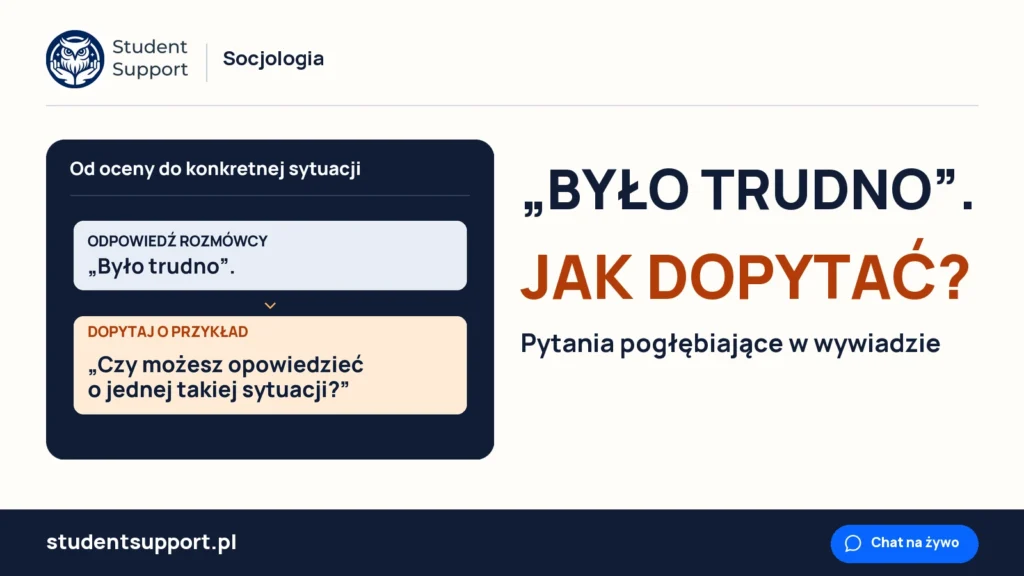
The participant says “it was difficult”, and your guide has another question waiting. Before moving on, ask for one specific situation connected with the answer. You could say “Could you tell me about a moment that best shows what was difficult?”. Then ask about the sequence and meaning of that event, using the participant’s own words. This helps you understand the experience without supplying a ready-made explanation.
You do not need dozens of prepared prompts to conduct every conversation well. A few simple ways of responding, together with a clear understanding of the information your research question needs, are more useful. In a semi-structured interview, the guide organises the areas to cover, while a particular follow-up arises from what you have just heard.
We will use an original, fictional example of a thesis in Sociology. The author is studying how adults obtain other people’s help with online administrative tasks. The entire exchange and all statements below were written for this exercise. They are neither client material nor quotations from the studies in the bibliography. You will see a question, an answer, the interviewer’s decision and the next part of the interview.
How do you decide what you actually need to ask about?
Before interviewing, write the research question in ordinary language. In our example, it is “How do participants organise other people’s help with online administrative tasks, and what meanings do they attach to that help?”. This is a question for the material as a whole. A simpler invitation to a participant could be “Tell me about the last task of this kind that someone helped you with”.
List three pieces of information needed to answer the thesis question. Here we need the course of a specific task, how help was arranged and how the participant understands their own involvement. We do not need every experience with technology, a complete family history or opinions about every public office.
When you hear a general statement such as “my daughter helped”, check which information is missing. Perhaps it is unclear who first offered help. Perhaps “helped” means reading the form together, the daughter completing it independently, or a suggestion over the phone. Each possibility supports a different description of the participant’s involvement.
A short note about these gaps beside your guide is useful. A long list of assumptions is less helpful. “Who did what?” reminds you of a detail you need. “The daughter took over” already suggests one interpretation before the interview. Consider that interpretation later if the material supports it.
How does a follow-up differ from the next question in the guide?
A follow-up develops something already said. When a participant mentions an unclear message on the screen, you can ask what they did after reading it. The next main question might concern another area, such as agreeing a time to work with the person helping them.
This distinction helps the conversation flow. If you hear “I did not know whether I had already submitted the application” and immediately ask about trust in institutions, you may lose an important account of uncertainty. A brief “How did you try to work that out?” stays with the participant’s experience.
The Academy of Special Education textbook describes a qualitative interview as a conversation organised around areas or prompts, with room to ask for clarification. Interview type matters. A semi-structured conversation allows a different degree of flexibility from a procedure requiring a precisely prescribed set of questions.
Before applying this advice, check which interview type your thesis actually uses. If the instrument requires a fixed order and exact wording, avoid changing the procedure independently halfway through data collection. Discuss permissible clarification with your supervisor and record the approach in the methodology chapter.
How do you start with an event rather than a general opinion?
A general answer can be a useful beginning but may have several meanings. “Dealing with public offices online is a nuisance” does not yet explain what happened during a particular task. Ask about a situation the participant remembers. In our example, it could be their most recent application completed with help from someone close.
“Could you describe what happened the last time you dealt with something like this?” invites an account. If you need a starting point, add “What did you do first?”. Avoid assuming that logging in caused the problem. The participant may be talking about finding the right service or understanding whether a document was required.
If the participant chooses an older event, establish the approximate period. “Was that this year or earlier?” can locate the experience without demanding a date they cannot recall. The required precision follows the research question. In many interviews, the order of actions matters more than the hour at which they happened.
If the participant cannot recall one particular task, accept that answer. You can ask about a typical situation, then indicate in the analysis that this was a generalised account. Avoid combining several uncertain memories into one supposedly precise event. The material needs to preserve how the participant actually described it.
- Use the participant’s words
- Go back to what they called difficult in their own account.
- Ask about one event
- Ask whether they can describe a particular situation.
- Check your assumptions
- If the question supplies a cause, person or judgement, simplify it.
Follow the answer while keeping the main topics from your interview guide.
What does a complete follow-up sequence look like?
Suppose the fictional participant is identified as R1. The interviewer began by asking about the latest online administrative task for which someone helped. R1 answers “It was an application I did with my daughter. It was difficult on my own”. The interviewer now has several options and chooses to ask about an event.
Interviewer. Which moment in that task best shows what the difficulty was?
R1. I had filled in part of it, and something came up about an attachment. I did not know whether I had to have it. I called my daughter to have a look. She came over shortly afterwards.
Interviewer. What did your daughter do when she looked at that message?
R1. She read it and told me to open the previous page. She was sitting next to me, but I was still doing the clicking.
Interviewer. How did you decide what to do next?
R1. I said what paperwork I had. She read what they wanted. In the end, we decided together that this document did not apply to me.
This passage gives us more information about the division of activities. We did not need “Did your daughter do everything for you?”. That wording would introduce a ready-made account of the task being taken over entirely. The answer describes reading and checking information together, with R1 continuing to operate the screen.
The interviewer can now ask what the help meant, for example “What mattered most to you about reading it together?”. R1 replies “Someone confirmed that I understood it correctly. I can manage the clicking”. The distinction emerged from the participant’s account. It is material for analysing experience, rather than an objective test of digital skills.
How does a leading question change the exchange, and how can you revise it?
“Did your daughter have to take over because the portal was badly designed?” contains several assumptions. It suggests that she took over, that doing so was necessary, and that the portal caused the difficulty. Even if the participant answers “yes”, it remains unclear which part they agreed with.
Break the question into prompts arising from the account. After hearing about the call to the daughter, first ask “What did you want to check with her?”. If the participant describes the message, follow with “How did you understand it at the time?”. If they say the daughter filled in the form, ask about the division of activities.
Neutrality does not require removing all names and verbs. Among other things, it involves leaving room for different answers and avoiding a preferred explanation. Read a draft question from the perspective of someone whose experience was easy. Could they answer truthfully without first correcting its assumptions?
If you notice a suggestion while recording, you can correct it openly. Say “I suggested a cause in that question. I would like to return to how you saw it at the time”. Mark the intervention in your post-interview note. Do not remove your original question from the transcript as if it never occurred.
How can you use the participant’s own words?
When a participant says “I needed someone beside me”, you can repeat that part and ask for an explanation. “You said you needed someone beside you. What did that mean to you at the time?” develops its meaning without immediately giving it a theoretical label.
In this example, “help” might mean a suggestion, reading together, checking the completed document or feeling calmer while working. Replacing it immediately with “dependence” introduces a concept the participant has not used. You may analyse dependence later, but need support in the material and your chosen approach.
Avoid mechanically repeating every last word. The exchange can quickly sound artificial. Select a word that matters for the research question and remains unclear. An ordinary “What do you mean?” is often sufficient when the reference is clear.
Be careful with your own paraphrase. After “my daughter looked at it, and I sent it”, summarising “so you did everything yourself” loses the role of reading together. You could ask “Have I understood correctly that you operated the form and your daughter helped interpret the requirements?”. The participant needs room to correct this.
How do you ask about the sequence and the people involved?
Chronology helps establish when help became necessary and how it was arranged. You do not need every minute. A few steps connected with the thesis question are enough. “What did you do first?”, “What happened next?” and “At what point did you contact your daughter?” organise the account.
A participant may say “we did it”. Ask them to expand on “we” if the division of work matters. “What did filling it in together look like?” leaves room for a description. “Who actually did it for you?” assumes the participant was relieved of the task and may prompt them to defend their independence.
Ask only about people and information needed for the analysis. A role such as “daughter”, “friend” or “staff member” is usually sufficient. The helper’s name, precise address or workplace may contribute nothing to the question. If volunteered, handle those details according to the established procedure for protecting the material.
After the conversation, your working note might contain “started alone – unclear attachment – phone call – reading together – independent submission”. This organises R1’s account. Retain a reference to the recording so you do not later confuse your shorthand with the participant’s exact words.
Does “why?” always deepen an answer effectively?
Asking about a reason can be helpful, but its reception depends on timing and tone. “Why did you call your daughter?” may invite an explanation. It may also sound as though the participant must justify asking for help. If you notice tension, consider whether asking about the sequence would supply the information needed.
In our example, you could say “What made you decide to call at that moment?”. If the participant cannot recall a motive, they do not have to reconstruct one on demand. “I do not know, it just happened” is also an answer. Your analysis needs to preserve the difference between an expressed reason and the thesis author’s explanation.
Questions about reasons can easily produce general statements. If the participant says “people do not trust the internet”, you can return to their perspective. “How did trust work in your situation?” or “How did you recognise that you could finish the task?” helps explore the experience relevant to the study.
You do not need one phrase for every interview. Match the prompt to the participant’s words and your purpose. The guide can record possible functions of follow-ups, such as requesting an example, meaning, sequence or reason. The wording can remain natural within each conversation.
How do you respond to silence and brief answers?
After asking a question, give the participant time to answer. Silence may indicate recalling an event, looking for words or deciding what to share. You do not need to fill it immediately with another question. There is no single number of seconds that guarantees the right approach in every interview.
If the participant says “I cannot remember”, ask whether they would prefer another situation from that area. If they say only “yes”, check your question first. It may have been closed and required precisely that answer. Before judging someone as uncommunicative, review how you invited the account.
In the fictional example, “Did someone help?” receives “yes”. Following with “Tell me what that help looked like during the last task” gives R1 a clear invitation. If another short answer follows, ask about one step, such as opening the form. A narrower request may be easier than recounting an entire history at once.
The participant may also choose not to develop a subject. Respect that boundary. Follow-ups help you understand an account rather than overcome refusal. Offer another area and record that the subject was not explored further. This limitation is more honest than guessing why the person remained silent.
What if the answers appear contradictory?
R1 first says “I manage the internet on my own”, then describes the daughter’s help. These statements may be consistent in R1’s understanding. Independence may refer to operating the device, while help concerns administrative language. Before calling it a contradiction, establish which situations the statements concern.
You could say “Earlier you mentioned using the internet independently, and now you have described reading with your daughter. How do those fit together in your experience?”. The question recalls both passages and allows an explanation. It does not force the participant to select which is to be treated as true.
If the participant revises an earlier account, retain that change in the material. They might say “Actually, not always independently, because I prefer checking documents with someone”. This clarifies the meaning. Do not retrospectively edit the beginning of the transcript to make it sound like the final account from the start.
Sometimes a contradiction will remain. You may discuss tensions between ways of presenting oneself if the material and methodological approach support it. A follow-up does not need to produce a single polished sentence. It helps establish how different accounts arose and what can responsibly be said about them.
What if the participant asks what you want to hear?
“Am I supposed to say it was difficult?” can arise when the guide or tone suggests an expected story. Return to the purpose and explain that you are interested in the participant’s experience. You could answer “I want to understand what it was like for you. You can also tell me about things that went easily”.
This response does not remove the influence of the research situation. The participant is still talking to someone writing a thesis and may try to be helpful. Record where they asked about expectations in your post-interview note. It helps you remember how the material was produced during analysis.
Avoid evaluating answers with “excellent”, “that is exactly what I meant” or “that confirms my hypothesis”. A simple acknowledgement or thanks can suffice. Praising a particular opinion may encourage later answers that the participant believes will please the interviewer.
If the participant requests advice on a form, establish whether this belongs to the agreed interaction. Research into experiences need not become the handling of a current task. You can return to the earlier event and, after the interview, indicate a general source of assistance if appropriate. Keep the interviewer’s role clear.
Can you give an example to explain a question?
An example can aid understanding while also suggesting an answer. “Did she help by clicking for you?” may restrict the account to operating the screen, although reading together was previously important. First try expressing the question itself more simply.
Instead of “What was the scope of instrumental support?”, say “What did that person do while you were dealing with the task?”. If someone asks what an “online task” means, refer to the definition used during recruitment. Keep the scope broad enough for the experiences relevant to your research purpose.
If examples are necessary, record this way of explaining the question in the procedure and monitor its use. Note whether the participant adopted the suggested possibility or introduced their own. This does not automatically invalidate the answer, but is relevant when assessing the interviewer’s involvement.
During the pilot, check which words repeatedly need explanation. If several people do not understand “digital competence”, the question needs different language rather than a lengthy lecture before every answer. This keeps the conversation natural and limits the researcher’s introduction of definitions while collecting accounts.
How do you move from one subject to another?
Once you have an event and its meaning, review the guide. If further follow-ups produce only repetition or details beyond the thesis question, close the subject. “Is there anything important about this situation that I have not asked?” lets the participant add something.
Then connect the transition with the account. “You have described reading the application together. I would now like to ask how you arrange a time to work on these tasks together” links the areas without an abrupt jump. The participant knows why another question has appeared.
You do not need to cover every point in the same order if your chosen method permits flexibility. The participant may already have explained the helper’s availability. Note that this information has been covered and return only to a missing aspect. Repeating a whole question verbatim can suggest the earlier answer was not heard.
As time runs out, choose a question important to the purpose rather than rushing through numerous minor prompts. If something needs clarification later, use the agreed approach to further contact. Do not promise another conversation or assume the participant remains continuously available without that agreement.
How do you ask about difficult or private experiences?
Even an interview about an online form can touch on dependence, finances or health. The research question defines the detail required. If you are studying how help is organised, you usually do not need a diagnosis, case number or the contents of the submitted document.
At the outset, explain the option to skip a question, pause and end participation under your agreed procedure. When someone declines to describe an event, move on. You may offer another situation in the same area, but avoid asking the same question repeatedly in different guises.
Do not ask participants to reveal passwords, accounts or complete applications in an interview about experience. If the project includes observing tasks being performed, that is a separate activity requiring appropriate preparation and agreement. Expanding an interview spontaneously into viewing data can go beyond what the participant accepted.
After a difficult passage, check whether the participant wants to continue. Avoid treating emotion automatically as support for your theory. In notes, distinguish an observed action, such as a longer pause, from an assumption such as “was ashamed of lacking skills”. This distinction matters for credible treatment of sensitive accounts.
What should you record before starting the analysis?
A short post-interview note can describe conditions, important follow-ups and your decisions. For R1, record that “it was difficult on my own” was developed through a request for a specific event. Identify the passage about reading together and the point where R1 distinguished it from clicking.
Add interruptions or audibility issues if they mattered. If an online call cut out halfway through an answer, mark the gap. Do not fill it from memory as an exact quotation. If the participant continued after recording ended, follow the agreed consent and recording procedure for such material.
Keep three layers distinct. The first is the participant’s statement. The second is your question that helped elicit it. The third is a tentative interpretation to check across the material. “Help as confirmation of understanding” then remains an analytical proposal rather than a label attributed to R1.
When processing the recording, see the guide to analysing an interview for a thesis. If your material was collected through notes from the outset, use the guide to an interview without a recording. Recording how you asked follow-ups matters in both cases.
How do you describe follow-ups in the methodology chapter?
Your description should reflect how the interviews were actually conducted. State the common areas of the guide, the role of open questions and the conditions for asking clarifications. “In-depth interview” alone is insufficient if the conversations consisted of reading closed questions without developing responses.
In the fictional project, the passage could read as follows.
Interviews followed common areas concerning the course of an online administrative task, the organisation of help and meanings attached to other people’s involvement. General answers were followed by requests for specific events. Supplementary questions concerned the sequence of actions, division of activities and meanings of words used by participants. Their wording and order were adapted to the conversation. Post-interview notes recorded important interviewer interventions and areas that could not be developed.
Adapt this passage to the actions actually taken. If questions changed after piloting, explain what changed and why. If you did not make post-interview notes, do not add them to the methodology. The procedure should let readers understand the conditions under which the analysed material was produced.
How do you check questions in a pilot interview?
Choose someone meeting the relevant conditions of the intended study and conduct an interview under the prepared procedure. Afterwards, check where a question elicited an example and where it produced only brief confirmation. Notice whether participants introduced important categories or the interviewer supplied them.
In our example, revise “Did someone have to do it for you?” to “How were other people involved in this task?”. If the revised wording elicits an account of reading together, it reveals a broader range of help. Wording changes should serve the research question, rather than obtain longer answers at any cost.
After piloting, ask which question was unclear or contained an assumption that did not fit. Treat this information as an instrument check, rather than an answer to the thesis’s main question. Record the guide version, revision date and brief reason. This makes the procedure easier to reconstruct later.
If you intend to include the pilot in the main analysis, establish that possibility within the design and your university’s requirements. An interesting conversation alone does not determine its status. Question comparability, participation conditions, consent and the effect of instrument changes on combining material all matter.
How do you recognise when to stop asking follow-ups?
A follow-up is useful when information relevant to the thesis question is missing and the participant wants to develop it. It becomes less helpful when you repeatedly request the same detail or try to obtain a different wording of an answer. Compare each question with what has already been said.
If R1 has clearly explained that the daughter read requirements while R1 operated the form, five more questions about who clicked are unlikely to add much. You can move to the meaning of reading together or another situation needed for comparison. The choice depends on your design.
When someone says “that is all I remember”, accept the limit of memory. When they decline, accept the limit of participation. If a valuable subject outside the thesis purpose emerges, note it for consideration without automatically redesigning the project during one interview.
At the end, give participants room to add something they consider important. Thank them and remind them of the agreed arrangements for use of the material. A well-conducted interview may leave questions open. The thesis author then needs to show which conclusions follow from the material and which remain beyond it.
How can you prepare material for a consultation?
Choose one main question and three short passages where you found responding difficult. Include your questions and the participant’s answers, anonymised under your procedure. An answer quoted without the question preceding it can conceal a suggestion that shaped the response.
For each passage, write what information you need and why it follows from the thesis question. You might note “unclear meaning of independently”, “missing sequence” or “difficulty returning from a general opinion to an event”. This supports discussion of a concrete revision instead of an overall judgement on the interview.
For Help with your thesis methodology chapter, prepare your research question, interview guide, programme requirements and planned pilot. If interviews have already taken place, also show the actual follow-ups and any revisions. The scope of assistance should follow the work stage and material you have.
Before the next conversation, read a few prompts aloud. Select those you can say naturally and that leave room for different experiences. Then return to the research question. It helps you choose between asking for an example, clarifying a word, establishing a sequence or moving on calmly.
Questions about interviews and methodology
Does every thesis or survey require hypotheses?
No. Whether hypotheses are appropriate depends on the objective and nature of the research. Testing relationships requires a different approach from research focused on description or exploring experiences. I adapt the approach to the project and the requirements of the relevant degree programme.
If you formulate hypotheses, plan the data and analysis that will allow you to actually test them. Do not add them solely to fill out the chapter scheme.
Can I modify questions after starting the research?
Changing the meaning of a question or the set of answers may make results before and after the change non-comparable. Record the scope and date of the change and agree on further action with your supervisor. It is best to catch such problems in the pilot phase.
Are the thesis objective and the research objective always the same?
They can be very similar, but do not have to be. The objective of the entire thesis may include literature analysis, empirical research, and the development of recommendations. The objective of original research then refers to the empirical part. Agree on the terminology and division with your supervisor.
How can I connect a limitation to its effect on the conclusions?
Identify a specific feature of the procedure, the finding or claim it affects, and the consequence. Then explain what you actually did to address it and what remains uncertain. A generic list mentioning sample size and time pressure is not enough.
Do you help with the methodology of original research?
Yes. I offer support with the methodology of original research, including defining the research objective and subject, research questions, hypotheses, variables, indicators, method, technique, and research instrument.
The most important thing is that all elements of the methodology are consistent with one another. The research instrument, such as a questionnaire or interview guide, should follow from the research questions and enable you to collect the data needed for the subsequent analysis of results.
Can you check an already written methodological chapter?
Yes. I can analyse its structure, the link between the objectives and research questions, and the consistency of the descriptions of the methods and research instrument. Include your supervisor's comments and the questionnaire or interview guide itself so that I can assess the whole, rather than the description alone.
Sources
- Miński, R. (2017). Wywiad pogłębiony jako technika badawcza. Możliwości wykorzystania IDI w badaniach ewaluacyjnych. Przegląd Socjologii Jakościowej, 13(3), 30-51. DOI 10.18778/1733-8069.13.3.02. Supports the discussion of the nature and uses of in-depth interviewing and consistency between the declared technique and actual procedure. Research article in Polish.
- Firkowska-Mankiewicz, A., Kanash, T., & Tarkowska, E. (Eds.). (2012). Krótkie wykłady z socjologii. Przegląd problemów i metod. Wydawnictwo Akademii Pedagogiki Specjalnej. Chapter 19, discussion of individual interviews, especially pp. 367-369. Supports differences in standardisation and the function of a qualitative interview guide. Academic textbook in Polish.
- Sakowicz-Boboryko, A., Szada-Borzyszkowska, J., Otapowicz, D., & Bilewicz, M. (2021). Aktywność zawodowa kobiet z niepełnosprawnością – stan, uwarunkowania, potrzeby. Wydawnictwo Uniwersytetu w Białymstoku. Chapter 2, p. 65. The discussion of guide construction and neutral questions is used, without transferring that study’s findings to the fictional example. University repository record.
Discuss your interview methodology
Gather your aim, interview guide, your supervisor’s comments and notes from the pilot. We can agree the scope of the review.
Contact StudentSupport