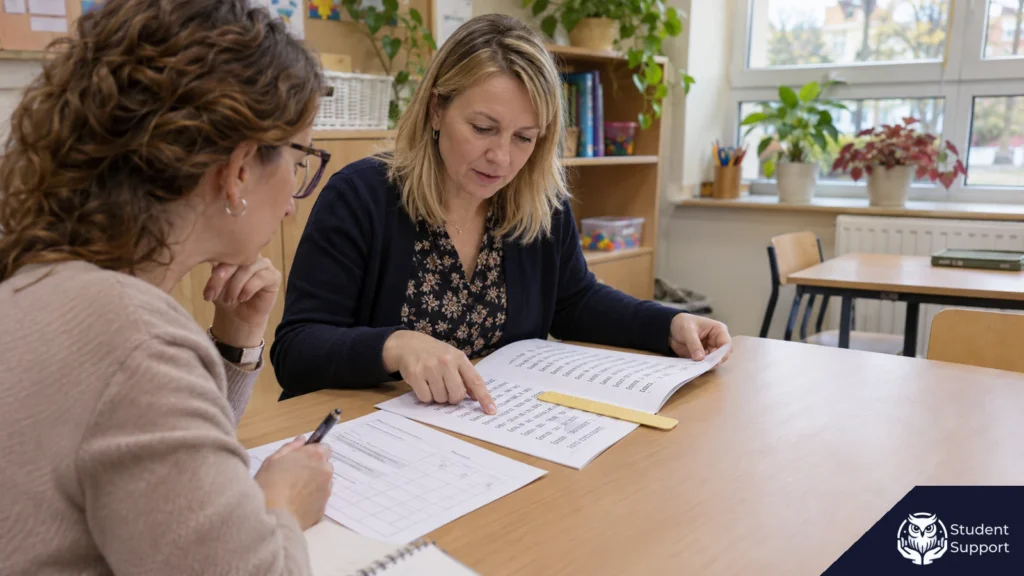
If you are writing a theoretical chapter about a pupil with dyslexia, start with two questions. What is the pupil expected to learn, and what makes a particular task difficult? Reading an instruction, explaining the water cycle and reading an unfamiliar passage fluently are three different activities. Hearing an instruction can help a pupil demonstrate their knowledge in a science lesson. In a task assessing independent reading, however, audio changes the skill the response can demonstrate. This distinction helps you decide what to include in the chapter and which literature to use.
In a thesis in “Pedagogy”, you can show how school observations, research and regulations help explain why a particular approach was chosen. We will follow a fictional Year 4 pupil called “Maja” through two ways of working with the same material on the water cycle, a separate independent reading task and an exercise in which reading itself is the goal. The example leads to a subsection outline and a sample argument. “Maja”, the lesson and the responses in the story are fictional. Each published study and regulation is used for a specific purpose.
Define the type of support and school you are writing about
A heading such as “Support for pupils with dyslexia” could cover the history of the term, diagnosis, classroom examples and specialist intervention. Give the chapter one question to answer so you can select the material you need. The question here is “How can accommodations in Years 4-6 of a Polish public primary school be justified when reading sometimes gives access to content and is itself the target in other tasks?” This scope lets you examine specific situations, such as reading a science text, giving an answer and reading independently. If your thesis looks at Years 1-3, the risk of dyslexia or specialist intervention sessions, choose sources and school material that match that age group and focus.
The theoretical chapter explains the terms, sets out the reasons for choosing certain approaches and prepares the reader for the rest of the thesis. If the empirical part draws on what teachers say, define accommodations in the theory and explain why you distinguish between their purposes. In the methodology, describe how you select participants and analyse their accounts. Report what they actually say in the findings. If you are examining school documents, explain in the methodology how you will analyse their content. A written recommendation establishes that it was recorded. Describing classroom practice also takes evidence of how staff used it.
You could end your introduction with these sentences: “This chapter examines classroom and assessment accommodations in relation to the specific goals of a task. It covers interventions intended to develop reading skills where the comparison helps explain how those interventions differ from changes to the conditions in which a pupil completes a task.” The closing lines set the boundaries of the chapter. If half a page on the history of the term later makes its way into the draft, identify the sentence that actually helps the reader understand a decision taken at school.
Choose one point to observe
The statement “the pupil experiences difficulties at school” leaves many questions open. Did the pupil run out of time while reading? Did they read the passage but struggle with unfamiliar vocabulary? Did they understand the instruction and then struggle to put their ideas in writing? Name the activity your chapter addresses. This helps you recognise when a source discusses blending speech sounds and when it discusses a pupil taking part in a lesson. Both can be relevant, and each supports a different statement.
For a wider analysis of accessibility and participation, see the guide to inclusive education in the theoretical chapter of a pedagogy thesis. In a chapter on dyslexia, specify what “access” refers to each time you use the term. It may mean access to the instruction, the subject material or the means of giving an answer. Check that you have named the right element whenever you describe a change.
Distinguish observation, risk and diagnosis
Describe what you could observe
“During silent reading, she went back to the start of the paragraph twice. After hearing the instruction, she put the stages in the correct order.” This describes specific behaviour. You can make it more precise by adding the kind of text, how much time was available and the order in which the activities occurred. “Her eyes went back because she has dyslexia” assigns a cause that a single incident cannot establish. In a pedagogy thesis, an observation can help identify when a difficulty arises. Its meaning depends on what was happening at the time and whether a similar pattern appears in other relevant tasks.
Explain in the chapter that developmental dyslexia involves persistent difficulties in learning to read. The literature discusses word-reading accuracy, reading fluency and reading comprehension, among other aspects (Łockiewicz, 2025). If you discuss reading rate, distinguish it from accuracy. One pupil may read accurately and need longer to get through the instruction. Another may read at about the same speed as classmates and skip parts of words. When considering comprehension, record separately whether the pupil read the question correctly, understood the terms and reconstructed the relationships in the text. A pedagogy chapter can explain how these measures differ without reproducing tests or setting its own diagnostic thresholds.
Explain what screening contributes
Wiejak, Krasowicz-Kupis and Błaszczak (2016) studied the validity of the Educational Prognosis Scale. They compared teacher screening assessments with specialists’ measurements using reading and writing tests. The discussion distinguished results across the educational stages studied. The authors pointed out a limit on judging how well screening predicts later performance in children who had not yet started formal reading and writing instruction. You can use this study in the theory to explain structured screening and the role of further assessment. The authors studied the validity of a specific instrument with particular groups of children. In a thesis on Years 4-6, use it to explain what screening does and keep its results tied to the age groups studied.
When reviewing the evidence, distinguish behaviour in a specific situation, a structured assessment of risk and a diagnosis based on a broader assessment. Grażyna Krasowicz-Kupis’s handbook (2025), written for specialists based in Polish psychological and pedagogical counselling centres, explains why differential diagnosis draws on multiple sources and considers other possible explanations for difficulties. You can use your chapter to describe what each source contributes. When writing about a school observation you made yourself, describe the material available. If you have grounds to record a recognised diagnosis, draw its status from the appropriate source.
Use language that matches your material
Three similar-looking sentences could open three different chapters. “Pupils reported difficulty reading instructions independently” identifies who spoke and what they described. “Teachers said they considered some pupils at risk of dyslexia” reports the teachers’ accounts. “The study included pupils diagnosed with dyslexia” calls for a description of how the inclusion criterion was established. Shortening any of these sentences to “the study looked at dyslexics” changes both its precision and the group it describes. If the study refers to “pupils with reading difficulties”, retain that description in your own account.
Terms used to describe school support may cover different things in the literature, in legislation and in school documents. Define the most important terms and give the source for each one. When discussing Polish regulations, retain the term “specific learning difficulties” where the provision uses that category. When reporting a study, state whether its authors refer to a diagnosis, a risk assessment or scores on a particular task. The term you choose should show the basis of each statement.
Match the source to the question it can answer
Reading research helps explain the nature of a difficulty
Independent reading can be assessed with several types of tasks. Reading isolated words, for example, tells you something different from answering a question about the meaning of an entire passage. Łockiewicz (2025) describes the signs of dyslexia and the instruments used to assess them, and discusses how language and measurement conditions matter. In a thesis about a Polish school, you can use the article to distinguish facets of a pupil’s performance, such as reading accuracy and rate, writing difficulties and understanding the content. A claim about the effect of a particular form of support would need evidence from a study designed to investigate it.
You could set out a general principle in the theory: “In this thesis, I distinguish reading performance from comprehension of material presented in another form.” Then give an example of the evidence needed for each question. Assessing the accuracy of a pupil’s reading takes a task in which they read. Correctly explaining the content after hearing it shows what the pupil did on the subject task under the conditions described. It does not tell you how they would read a comparable passage independently. Naming both the skill and the conditions makes the reasoning easier to follow.
An empirical study answers the question its authors investigated
In your reading notes on the paper by Wiejak, Krasowicz-Kupis and Błaszczak, start with the purpose. Then note who took part, what the teacher assessment was compared with and which conclusion you need. For a chapter on support, the useful point is that structured observation can inform screening for risk in the conditions studied, while specialist tests supply separate evidence. An informal observation cannot be assumed to have the same validity. If you are asking “When do Year 4 teachers let pupils listen to a text?”, the paper on screening gives you language for the theory. The answer about classroom practice requires evidence from the relevant lessons or school staff.
You could end your reading note by identifying its scope: “This paper helps distinguish observation and screening. It does not compare ways of presenting a text in class.” With that note in place, you are less likely to cite the paper for an effect of recorded audio when revising your chapter. The same habit helps when reading a study based on parents’ accounts. Reports about using support can describe families’ experiences. Change in reading ability requires a different measure.
Regulations set the framework and a school document describes the approach adopted
You can use two regulations to describe the context of a Polish public school. Section 2 of the regulation on assessment sets out the grounds for adjusting educational requirements. It includes a formal opinion from a psychological and pedagogical counselling centre. There is also a separate route for pupils who receive psychological and pedagogical support at school without the opinions or decisions specified in the provision. That route concerns teachers’ and specialists’ assessment of the pupil’s individual needs and abilities. The regulation on psychological and pedagogical support describes, among other things, support during regular classroom work and specialist corrective and compensatory sessions. When analysing particular material, give the version of the regulation relevant to the period, the school type and the provision you are discussing.
The regulation gives the name of the form of support and explains how it is organised. A counselling centre’s formal opinion may contain a recommendation, provided the conditions of your study allow you to use it. A public school document can describe categories of support the school has adopted. An observation can show what happened in a particular task. If you only have access to public documents, you can compare how schools describe accommodations and whether they specify what each one is intended to accomplish. Any estimate of how many pupils actually received support would require records of its use.
Identify the task goal before calling a change an accommodation
When a text gives access to subject knowledge
In Year 4, a science teacher asks pupils to put cards showing stages of the water cycle in order and explain one relationship, using a short passage. Their answers should show that they can link evaporation to the warming of water at the surface and explain what happens as water vapour cools. They receive an instruction and a short text containing this information. Reading the text aloud or providing a recording can make the content accessible. The subject task stays the same if the audio gives the same information and does not supply the correct order of the cards.
In the fictional example, “Maja” reads the opening sentences independently, goes back over the names of the stages and does not reach the last part before time is up. When she hears the same material, she sequences the cards and explains why water vapour may condense. The observation can record what she did each time, whether she could revisit a passage and whether she received an additional prompt. If the teacher explained condensation on the second attempt or emphasised words that helped to arrange the cards, the two situations would be less comparable. Hearing the text also gives “Maja” another encounter with the same material, which could itself have helped. In the theory chapter, the example illustrates what the accommodation does. Assessing its effect would require a planned comparison.
It helps to write down the criterion in advance. “The pupil uses terms from the material to explain a relationship between two stages” is a subject-knowledge criterion. “The pupil reads the text independently in four minutes without audio” describes a separate activity and conditions for assessing it. If you include both criteria in the same assessment, tell the reader how much each contributes and how a change of conditions affects the meaning of the score. In a thesis on accommodations, identifying the criterion tells the reader more than saying that a recording “helped learning”.
Specify the goal when changing the form of an answer
“Maja” may understand the relationship but struggle to put it into writing under time pressure. In a fictional variation, her teacher first lets her arrange the cards and then accepts an oral explanation. The form of the answer changes. The subject criterion still includes putting the stages in order and explaining their relationship. If the teacher supplies the word “condensation” while “Maja” speaks, the amount of prompting also changes. Distinguish this in the theoretical chapter. The way the pupil receives the content and the way they demonstrate understanding are separate features of the task.
Compare this with a lesson in which the goal is to spell words with a particular spelling difficulty. Letting pupils say their answers instead of writing them changes the evidence they can provide about spelling. Even in the same lesson, saying an idea aloud can help the pupil plan a response, while another written task can assess the spelling of particular words. Ask whether you are describing a change in access to the task, the form of the answer or the task goal itself. If a school document leaves the assessment criterion unclear, explain what information would establish the scope of the change.
When independent reading is the goal
In another fictional task, “Maja” reads a short, previously unseen passage of similar difficulty independently. The teacher wants to see which words she reads accurately and where she needs longer. Audio can give information about how well she understands material she hears. To learn whether she can read the words unaided, the teacher needs to observe her reading independently. For illustration, you can describe two tasks and state the conditions and measures for each. A teacher’s own notes here are classroom observations.
Extra time is another example where the purpose depends on the goal. In the science lesson it may give “Maja” enough time to finish reading and explain a concept. If a separate task assesses reading rate, compare scores using a consistent procedure, record actual reading time and specify how you handled pupils who did not finish. If the task assesses accuracy alone, you can record rate separately from the main outcome. The phrase “extra time was allowed” leaves open whether the teacher measured total time, changed a time limit or simply gave the pupil an opportunity to finish.
Before suggesting a change to a task in your chapter, set out one case in four sentences:
- Goal. What action or skill should the pupil demonstrate?
- Barrier. When did the difficulty arise and what material were they using?
- Change. What changed about the instruction, material, time or means of answering?
- Observation. Given the conditions, what does completing the task show?
In the science example, the goal is to explain a relationship between stages of the water cycle. The difficulty observed is reaching the end of the written description within the allotted time. The teacher changes how the description is presented by playing an equivalent recording. “Maja” sequences the cards and explains one relationship correctly after listening. If this account is all you have, keep the conclusion at that level. Fiction can clarify a concept. Empirical findings require research evidence.
Distinguish task conditions from practising a skill
Suppose “Maja”’s fictional case also includes reading exercises. She regularly works with a specialist teacher on reading unfamiliar words accurately. In one exercise, she returns to pairs of similar words and tries again after feedback. The aim is to develop reading ability. You can describe the exercise, how it works and how progress is monitored in the section on methods intended to develop a skill. A plan showing that the exercise was scheduled tells you what was intended. To describe a change in ability, you would need suitably comparable evidence of what “Maja” could do before the exercises and after a defined period of practice.
You can consider two reasons for providing support in the theory. An accommodation in science gives “Maja” access to the material she needs for a particular lesson. An intervention to develop reading has a separate aim, and its effects require a different kind of observation. A pupil may need both forms of support. If you discuss them together, retain two distinct criteria: completing a subject task under defined conditions and performance in a specified independent reading task.
One text can serve several purposes
Preparing a text before class, listening to it during class and reading it independently afterwards serve different purposes. Hearing a text may introduce new vocabulary. Reading the same passage a second time can provide practice. If you later want to assess how a pupil reads unfamiliar material, observing them reread a passage they have practised primarily tells you how they handle that passage. Say “she reread a familiar text” in your account. To investigate whether the skill transfers, plan to use a comparable text she has not read before.
This example also shows why a thesis needs to describe the circumstances. If a source refers to reading with a teacher, check whether the pupil received prompts. If it discusses independent reading, find out whether pupils read single words, sentences or a longer passage. When you write “improvement”, specify whether the change was in rate, number of errors, comprehension, readiness to attempt a task or something else. Each change requires its own evidence. A teacher may value a pupil’s increased willingness to read, and a researcher should clearly state how that change was observed.
Include the pupil’s perspective and say what it shows
“Maja”’s statement “It was easier to start because I could listen to that part again” tells you about her experience of working on the assignment. It may explain why she used the recording and at what point she found it helpful. Another pupil might prefer the written text because they can set their own pace, adding information about when the format is useful. You can study such accounts in their own right or use them to describe how a change was implemented. “Pupils said this approach helped them start the task” describes their accounts. “Pupils read more quickly” calls for information about how reading was measured.
The theoretical chapter should distinguish whether support was available and whether pupils actually used it. If a recording was posted on the school system but no one played it during the lesson, or if “Maja” chose to read the written text, the documented provision and classroom action have different evidential value. You can use this distinction to develop research questions on the conditions of access, independent decision-making and the reasons for pupils’ choices. In the theory, explain why those questions are separate.
Give each subsection a clear purpose
List the questions first. Under each, note what would answer it and the kind of source you could use. The outline below focuses on accommodations in school. If your study only examines science tests, restrict your examples to that subject or make it clear when you are drawing on wider research.
1. How are reading difficulties identified and described?
Explain the roles of accuracy, rate and comprehension. Then distinguish classroom observation, screening and diagnosis. Use Łockiewicz’s review (2025), the ORE handbook by Krasowicz-Kupis (2025) and the Polish study of screening (Wiejak et al., 2016). The subsection could conclude that an account of reading-related needs should identify the task conditions and the status of each piece of evidence. This prepares the reader for a discussion of what a particular lesson requires.
2. Which decisions concern access, the form of an answer and assessment?
Describe the framework for Polish public schools and explain the relationship between the barrier, the change and the goal. For example, explain the difference between providing a recording and permitting an oral answer. Check whether each format still allows the same target skill or knowledge to be assessed. Cite the relevant provision for the type of support and an appropriate empirical source if you discuss an observed effect. “Maja”’s fictional lesson illustrates how to make the distinction in practice. Data about a real school belong in the empirical part if you have one.
3. When does support develop independent reading and how can you describe the anticipated change?
Introduce reading practice and compare how you assess it with how you assess access to content. Where studies report the effects of exercises, note who took part, for how long, under what comparison conditions, how the authors measured change and whether they tested it on unfamiliar material. If your chapter does not evaluate the effectiveness of programmes, explain the purpose of practising a skill with an example the reader can recognise. In the conclusion, select the terms needed in your methodology: the activity’s goal, the reported barrier, the source of information and the observed response.
Write a paragraph that connects a concept, a source and an example
Imagine a draft passage: “Dyslexia causes difficulties at school. Pupils with dyslexia need to hear texts because they then achieve better results. Teachers should use suitable methods.” The first sentence leaves the scope of “difficulties at school” unclear. The second turns an observation into a general recommendation and claims an effect that would require data. The third leaves the decision unspecified. To revise it, make a defensible point: when you interpret an accommodation, check which task goal the change is intended to support.
Here is a sample passage that makes this approach explicit:
The fluency of independent reading and the ability to explain content heard aloud are measures of different skills. Research on assessment examines reading rate and accuracy and the conditions under which the measurements were taken (Łockiewicz, 2025). I use this distinction to describe two functions of a text in class. In a science task, the text gives pupils the information they need to explain a relationship. Presenting the same information in a recording can preserve the subject criterion, provided the way it is presented does not give away the answer. In a task assessing independent reading, an audio version changes what can be inferred from the pupil’s response. I therefore distinguish accommodations that change the way pupils receive material from activities that develop or assess independent reading.
The reference to Łockiewicz serves a specific purpose: it supports the statement about measuring reading. The sentences about the lesson are the sample author’s own reasoning. The final sentence introduces a distinction that will actually guide the analysis. If you have empirical evidence from a study comparing results under similar conditions, add a paragraph on that study and give the sample and measure reported by its authors. If your material consists of this scene alone, use it to illustrate the concept. The presentation format may have mattered, but the example does not establish how much it mattered or what caused the change.
What if your supervisor asks what supports the conclusion?
Read one paragraph backwards, one sentence at a time. For each claim, identify whether you are reporting a regulation, a research finding, a decision made for the thesis or your own interpretation of the evidence. If the basis changes halfway through a sentence, split it. “The school document mentions access to recorded text. In the interviews, three teachers described different arrangements for using it.” This shows which statement someone could verify in a document and which one they could find in an account. In a study with different material, this part might report that pupils actually listened to a recording during a task. Give the source, the circumstances and the number of cases covered by that statement.
Try revising the sentence “After the support was introduced, pupils read better.” If you are using responses to a teacher survey, identify the change as reported and give the wording of the question. If you have two reading accuracy scores, report both scores and the conditions in which they were measured. If pupils received an easier passage after the intervention or could return to a recording, take that into account when interpreting the comparison. If you only observed them with the same familiar text, limit the description to that passage. Your response to a supervisor’s comment can be as simple as narrowing the claim to the evidence available.
Plan the transition from theory to your own research
Once you have drafted the theory, identify the evidence you can actually collect. Documents, accounts, observations and measurements of ability support different conclusions. A narrower question makes it easier to complete the study and limit your claims to evidence you can check.
Documents and accounts
If your material consists of publicly available documents, you can establish what accommodations schools describe and whether they connect them to particular tasks. If a school says “the pupil may answer orally”, check whether it specifies a subject or skill. You can report that the documents you examined do not mention recorded texts. A question about whether a school uses recordings needs separate evidence. On closer reading, note whether the document refers to access to the instruction, access to content or the form of a response. A single statement may group these together.
Interviews with teachers can show how participants explain their choice of support. Begin with a specific example of a decision to change an instruction, text or answer format. Ask what the task aimed to achieve, what pupils were expected to do and what evidence was used to assess it. These details help you link the account to your theoretical discussion. If participants describe effectiveness on the basis of their own perception, report that perception and explain what the interviewees gave as their reasons.
Observations and results from two occasions
Observing a lesson may show when a pupil chose a recording, what they did after listening and whether they relied on prompts. Before you start, plan how you will record the conditions and the kinds of tasks. If your research involves real children, establish the requirements for data access, consent and privacy with your university and the school. This article uses a fictional pupil. A research report can give information about the subject, instruction and procedure to the extent needed to answer the question.
If pupils read two comparable passages before and after receiving support, you can describe the change observed and report the number and availability of measurements. Two scores alone do not establish what caused the change. Other lessons, familiarity with the procedure and differences between texts may have affected the results. A study of effectiveness needs a design that takes these explanations into account. Decide whether your thesis aims to estimate the effect of an intervention or to describe the conditions in which it is used. Each aim requires different evidence.
Decide what belongs in the theoretical chapter
If you only have accounts of current practice, use the theory to explain why you group the approaches by task goal. Put interview questions, the range of documents and the way you code responses in the methodology. Present findings from the material in the results. In the discussion, return to the theory to relate the observations to the scope of your sources and suggest questions for further research. A literature-based thesis can follow the same sequence: explain the concept, state how you selected publications, compare the findings and identify questions the literature leaves open.
Check your chapter before sending it to your supervisor
- The chapter question identifies the school stage, the pupil activity and the kind of support you are studying.
- “Difficulty”, “risk” and “diagnosis” each have a basis the reader can verify.
- For every example, the reader can identify the task goal, the conditions and what could be observed.
- Findings from screening research refer to the validity of an assessment under specific conditions. Any claim about effectiveness has a separate source.
- The account says whether the accommodation changed the instruction, the text format, the time available, the answer format or the skill assessed.
- The wording and references distinguish a recommendation, its documented use, the pupil’s experience and a measure of ability.
- The regulations cited apply to the schools and period studied. The example is clearly identified as fictional.
Take a working question, three headings, notes on one source and a sample paragraph to your seminar. This gives you a way to check the fit between your terminology and the material, whether the example makes the limits of the evidence clear and whether your plan matches what you have studied or can study. If you receive the comment “Please expand on support for the pupil”, ask what needs more detail: the basis for the action, how it fits the task, the pupil’s perspective or how to assess change.
Questions about sources and the theoretical chapter
How does literature synthesis differ from summarising papers?
A summary presents one publication. Synthesis connects several sources around a question, showing agreements, differences and limits to comparison. It needs your own line of reasoning and identifiable citations; placing summaries one after another is not enough.
Can a thesis be based only on Polish sources?
It depends on the topic and requirements. For an international topic, restricting sources to one language may leave out important research. Polish sources help describe the Polish context, while sources from other countries can broaden the comparison. The choice should follow the research question, not a fixed proportion.
Does every paragraph in a theoretical chapter require a footnote?
It is not the number of paragraphs that decides, but the origin of the information. Others' findings, definitions, data, arguments, and paraphrases require source attribution according to the applied style. Your own introduction to the chapter structure may not require a citation. However, the reader must know which sentences are based on a specific publication. One footnote at the end of a long paragraph may be insufficient when discussing multiple authors.
How does thesis scope differ from study limitations?
Scope defines the deliberately chosen problem, evidence, population and period. Limitations explain how design features or difficulties restrict interpretation. An omitted topic is not automatically a flaw; the important question is whether the conclusions stay within the stated scope.
Can a theoretical chapter be created based on my bibliography?
Yes, provided the publications are relevant and I can check their content. A list of titles alone cannot substantiate specific claims or quotations. Send the files you have or the publication details. If the literature does not cover the agreed scope, I will explain where additional sources are needed.
What will I receive when commissioning a theoretical chapter?
The scope may include a subsection outline, written text, a comparison of viewpoints and references to the sources used. I agree on it based on your topic, outline and guidelines. You can request a new chapter, expansion of an existing section or restructuring of the argument.
Sources
- Łockiewicz, M. (2025). Objawy dysleksji rozwojowej i narzędzia ich pomiaru – przedstawienie aktualnego stanu wiedzy. Annales Universitatis Mariae Curie-Skłodowska, sectio J – Paedagogia-Psychologia, 38(1), 131-147. DOI
10.17951/j.2025.38.1.131-147. - Wiejak, K., Krasowicz-Kupis, G., Błaszczak, W. (2016). Trafność Skali prognoz edukacyjnych jako narzędzia do przesiewowej diagnozy specyficznego zaburzenia uczenia się czytania i pisania. Edukacja, 4(139), 5-25.
https://jbc.bj.uj.edu.pl/Content/409144/PDF/4-1-wiejak-i-in-skala-prognoz-edukacyjnych.pdf - Krasowicz-Kupis, G. (2025). Diagnoza różnicowa dysleksji rozwojowej jako zaburzenia uczenia się. Materiały dla specjalistów poradni psychologiczno-pedagogicznych. Ośrodek Rozwoju Edukacji, Warsaw. Chapters 2, 4 and 7. ISBN 978-83-67366-79-3.
https://ore.edu.pl/wp-content/uploads/2025/02/diagnoza-roznicowa-dysleksji-rozwojowej-jako-zaburzenia-uczenia-sie.-materialy-dla-specjalistow-poradni-psychologiczno-pedagogicznych.pdf - Regulation of the Minister of National Education of 22 February 2019 on assessment, classification and promotion of pupils and students in public schools. Section 2. Consolidated text, Polish Journal of Laws 2023, item 2572, as amended.
https://eli.gov.pl/eli/DU/2019/373/ogl - Regulation of the Minister of National Education of 9 August 2017 on the organisation and provision of psychological and pedagogical support in public preschools, schools and educational institutions. Sections 2, 6, 8 and 20. Consolidated text, Polish Journal of Laws 2023, item 1798.
https://eli.gov.pl/eli/DU/2023/1798/ogl
Writing a chapter on school support for a pupil with dyslexia?
Send your topic, supervisor’s comments, outline and selected sources. If the type of task defines your focus, give a short description without information that could identify anyone. Tell us whether you want to organise the theory, link sources to an argument or prepare the transition to your own research.
Contact StudentSupport